


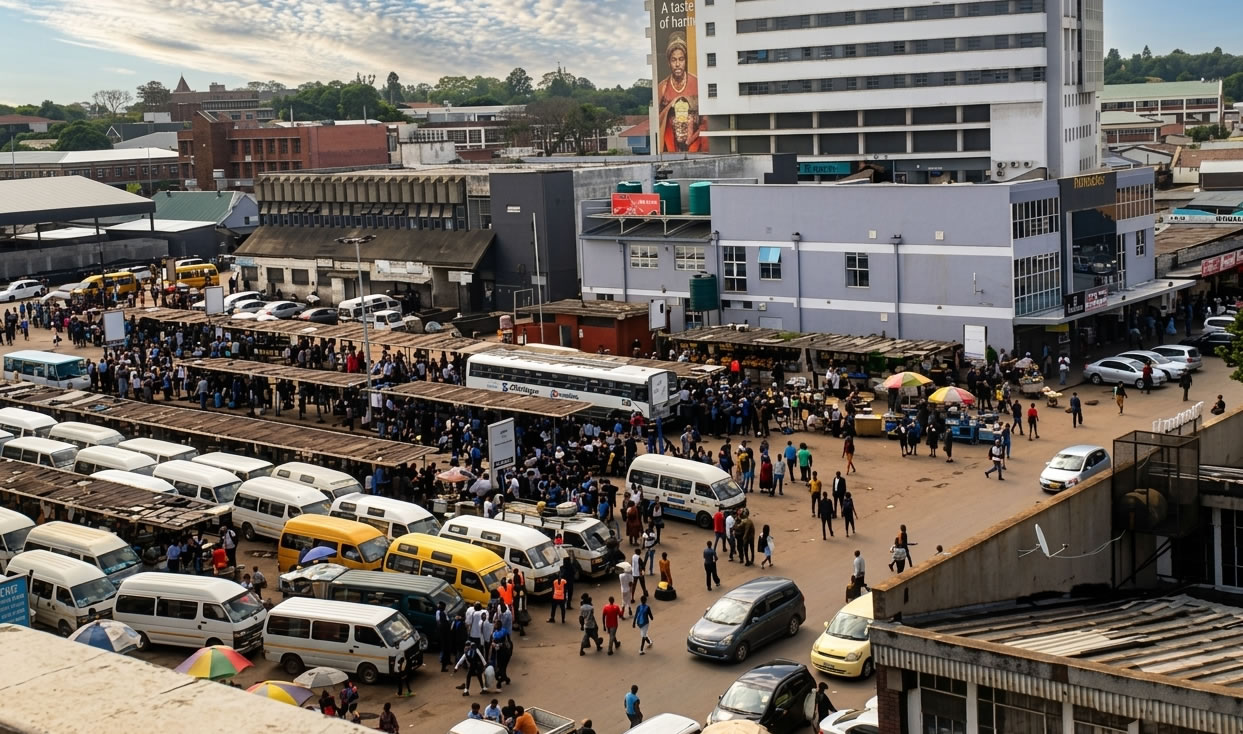
HARARE – The sun sets over Harare’s central business district, casting long, jagged shadows across the pavement of the Copacabana bus terminus. To the thousands of commuters scrambling for the last “kombi” home, it is a place of noise, exhaust fumes, and the frantic energy of survival. But as the legitimate bustle of the day fades, a different kind of commerce takes over. In the narrow alleys behind the Gulf Complex and amidst the sea of people at Copacabana, a silent, deadly trade is flourishing. These locations, once merely hubs for cross-border traders and electronics, have now been officially flagged by the government as the primary “hotspots” for a drug epidemic that is devouring a generation of Zimbabweans.
For months, we have walked these urban trenches, observing the “shadow economy” that operates in plain sight of the authorities. To the casual observer, the Gulf Complex is just a maze of small cubicles selling mobile phones and imported clothing. However, if you linger long enough, you see the patterns. You see the “runners”—mostly young men with hollow eyes and restless hands—leaning against shopfronts, waiting for the signal. They are the visible tip of a massive, submerged iceberg. This investigation reveals that while these small-time dealers face the brunt of police raids, the real masters of the trade remain shielded by wealth, political connections, and a sophisticated network of money laundering that reaches into the very heart of the capital’s legitimate business sector.
The scale of the problem is no longer a secret. During a recent high-level stakeholders’ meeting, Dr Shingirayi Mushamba, the Permanent Secretary for Harare Metropolitan Province, Provincial Affairs and Devolution, laid bare the government’s concerns. “When we talk about drugs, I have a very strong feeling that there are people who think what they are doing is not drug abuse and that the problem only happens next door,” he told the assembly. “I want us to be in the midst of the challenge ourselves and ask which drugs are being sold, where, by whom and at what time. Let us identify them.” His call for action highlights a terrifying reality: the drug trade has become so decentralised and so deeply embedded in the city’s fabric that even the authorities are struggling to map its full extent.
The Urban Trenches: Understanding the Street Hierarchy
The drug trade in Harare does not operate in a vacuum; it follows a rigid, almost corporate hierarchy that protects those at the top while sacrificing those at the bottom. At the base of this pyramid are the “peddlers” and “runners.” These are the foot soldiers you see at Copacabana, often young men who have been pushed into the trade by Zimbabwe’s biting unemployment. They take the highest risks for the lowest returns, selling small sachets of “Guka” (crystal meth) or “Mutoriro” for as little as three dollars. Many of these runners are addicts themselves, caught in a vicious cycle where they sell to fund their next hit.
Above the runners are the “Territory Managers.” These individuals do not carry drugs themselves. Instead, they oversee specific blocks around the Gulf Complex or sections of the bus terminus. They are the ones who handle the money and ensure that the “runners” stay in line. They often operate from “safe houses”—clandestine rooms in the back of legitimate-looking shops or nearby residential flats where the bulk of the product is stored and weighed.
The ingenuity of their distribution methods is staggering. Dr Mushamba revealed a particularly disturbing trend: drugs are now being moved inside fruit boxes. “Some drugs are being sold openly in the city, including pills concealed in fruit boxes and marketed to both young people and adults,” he noted. By hiding the “poison” amongst oranges and apples, the cartels have found a way to move their product through the city’s busiest markets without raising suspicion. This method is specifically designed to bypass the casual gaze of the police and, more tragically, to make the drugs accessible to schoolchildren who frequent these vendors.
The ‘Untouchables’ and the International Supply Chain
While the runners and managers handle the street-level chaos, the true “masters” of the Copacabana cartels are the importers. These are the “untouchables”—wealthy individuals who never set foot in the dusty alleys of the CBD. They are the ones with the capital to import wholesale quantities of heroin from Tanzania and Mozambique, or the precursors needed to manufacture crystal meth locally.
According to the ENACT Organised Crime Index, Zimbabwe has become a critical transit hub for heroin destined for South Africa and Europe. However, a significant portion of this transit cargo is “taxed” by local syndicates, who siphon off a percentage to sell on the streets of Harare. This “spillover” is what fuels the local hotspots. The index also notes that “state-embedded actors” are often the ones facilitating this movement, using their influence to ensure that “transit cargoes” pass through border posts like Forbes or Chirundu without inspection.
The supply chain is sophisticated. Precursors for “Mutoriro” are often imported under the guise of industrial chemicals for legitimate manufacturing. Once inside the country, they are diverted to “kitchen labs” in high-density suburbs like Mbare, Highfield, and Kambuzuma. Here, the “cooks” produce the highly addictive synthetic stimulant that is currently destroying the city’s youth. The finished product is then moved in small batches using “mushikashika” (illegal taxis) to the “safe houses” around the Gulf Complex. This decentralised system makes it nearly impossible for a single police raid to dismantle the entire operation.
The real power lies with these “importers” who facilitate the movement of drugs across Zimbabwe’s porous borders. Zimbabwe has transitioned from a mere transit point to a significant destination for heroin, cocaine, and synthetic drugs. The “Guka” epidemic, in particular, relies on precursors that are often imported legally for industrial use but diverted into clandestine labs. The masters behind these operations are rarely seen at Copacabana. They are the ones laundering their profits through the very boutiques and electronic shops that line the streets of the Gulf Complex. This “shadow economy” allows millions of dollars to flow through the financial system, disguised as the proceeds of legitimate trade.
The Complicity of the Shield: A System of ‘Protection’
One of the most harrowing realisations from our time in the urban trenches is that the Copacabana and Gulf Complex hotspots do not exist despite the police; in many cases, they exist because of them. During our investigation, we witnessed several instances where uniformed officers engaged in what can only be described as “collection rounds.”
“You see them coming in their uniforms,” whispered a vendor who has operated near the Gulf Complex for five years. She spoke on the condition of anonymity, fearing for her life. “They don’t come to arrest the big fish. They come to collect their ‘weeklies.’ Once the money is handed over, the dealers go back to work as if nothing happened. If you see an arrest, it’s usually a small boy who didn’t have the money that day, or someone the bosses have sacrificed to make the police look busy.”
This system of complicity is what allows the “untouchables” to operate with such impunity. The ENACT Organised Crime Index confirms that “state-embedded actors” are heavily involved in Zimbabwe’s criminal markets. These are individuals within the security services and government who use their positions to provide “protection” to drug syndicates. In exchange for a cut of the millions of dollars flowing through the hotspots, they ensure that raids are tipped off in advance and that key “safe houses” remain off-limits.
This corruption has created a wall of silence. When Dr Mushamba asks, “which drugs are being sold, where, by whom and at what time,” the community remains quiet. They know the answer, but they also know that telling the truth to the wrong officer could be a death sentence. The “shadow economy” is protected by a shield of blue and olive green, making the task of genuine reformers almost impossible.
The Laundering Machine: How the ‘Shadow Economy’ Survives
How do you hide millions of dollars in drug profits in a city where most people struggle to buy a loaf of bread? The answer lies in the very businesses that line the streets of the CBD. The Gulf Complex, with its hundreds of small, cash-based electronics and clothing stalls, is the perfect environment for money laundering.
The “masters” of the drug trade often own or “sponsor” these legitimate businesses. Drug money is mixed with the daily takings of a mobile phone shop or a boutique. Because the informal sector in Zimbabwe is largely unmonitored and relies heavily on US dollar cash transactions, it is easy to “clean” the money. A shop that appears to sell only three or four phones a day might officially record thousands of dollars in “sales,” allowing the drug lords to bank their profits or invest them in property in the leafy suburbs of Borrowdale and Glen Lorne.
This “shadow economy” is not just about drugs; it is about the total subversion of the national economy. While the country cries out for foreign currency, the cartels are sitting on mountains of US dollars, which they use to further corrupt the system. They buy properties, they buy influence, and they buy the silence of those who should be speaking out. The “legitimate” businesses in the heart of the capital are often just the colourful wrappers for a very dark core.
The Human Cost: Profiling the Victims of the ‘Guka’ Epidemic
Away from the balance sheets of the “untouchables,” the human cost of the drug trade is visible in the vacant stares of the youths huddled in the dark corners of the CBD. This is the “Guka” and “Mutoriro” epidemic in its rawest form. During our investigation, we met “Tinashe” (not his real name), a 19-year-old who spends his days at the Copacabana “bases.”
“I started with Broncleer (cough syrup) when I was 15,” Tinashe told us, his hands shaking as he spoke. “Then the guys at the Gulf told me about Guka. They said it would give me energy to work, to find deals. Now, I can’t think of anything else. I haven’t gone home in three weeks because I stole my mother’s phone to pay for a hit. I am a dead man walking, and the people who sold it to me just laugh when they see me.”
Tinashe is not alone. Families across Harare are being torn apart. We spoke to “Mai Tanya,” a mother from Mbare whose home has been hollowed out by her son’s addiction. “He was a brilliant student, wanted to be an engineer,” she said, her voice cracking with emotion. “Now, he steals the very pots I use to cook just to buy a hit of Guka. He is a ghost. He doesn’t eat, he doesn’t sleep. The people selling this poison know what they are doing. They are killing our children and the police are watching.”
The medical reality is just as grim. Ray Moyo, the Harare City Council Mental Health Coordinator, representing Provincial Mental Health Officer Zephania Chikudu, has seen the influx of addicts firsthand. He warns that the problem often starts with “legal” substances. “Look at how bottle stores are sprouting everywhere in town. Every corner has a bar. They may have liquor licences, but that is where it starts,” Moyo said. He argued that the proliferation of these outlets, some opening as early as 7 am and closing at 2 am, serves as a gateway to the harder substances sold at Copacabana.
The mental health facilities in the capital are overwhelmed. Hospital admissions for drug-induced psychosis have skyrocketed, with the majority of patients being young men under the age of 25. The “Mutoriro” epidemic is creating a “lost generation”—youths who are physically and mentally incapable of contributing to the country’s future, all to line the pockets of the “hidden masters.”
The ‘Safe Houses’ and Sophisticated Methods
The cartels have moved beyond simple street deals. They now employ sophisticated methods to move their “poison” under the nose of the authorities. Beyond the fruit boxes, drugs are often transported in “mushikashika” (illegal taxis) that weave through the city’s traffic, making them difficult to track.
“Safe houses” are no longer just dilapidated buildings in Mbare. They are now middle-class apartments and backrooms of legitimate businesses in the CBD. These locations serve as mini-warehouses where drugs are repackaged into smaller units. The use of digital platforms like WhatsApp and Telegram has also revolutionised the trade, allowing dealers to arrange drop-offs without ever meeting the buyer in a public space.
Beyond the Hotspots: A Call for a Coordinated Assault
The flagging of Copacabana and the Gulf Complex as hotspots is a necessary first step, but it is far from a solution. As this investigation has shown, the roots of the drug trade go far deeper than a few bus termini and electronics shops. To truly dismantle the cartels, the government must move beyond “understanding the phenomenon” and begin a coordinated assault on the entire supply chain.
This means targeting the “untouchables” in their mansions, not just the runners in the alleys. It means purging the police force of those who take “protection fees.” And it means providing real alternatives for the youths who are currently being lured into the trade by the promise of a few dollars.
“Authorities say a coordinated approach involving law enforcement agencies, health professionals, local authorities, community leaders and residents will be critical in tackling the problem,” the official reports state. But on the ground at Copacabana, that coordination feels like a distant dream. For now, the “shadow economy” continues to thrive, the “safe houses” remain full, and the “masters” of Harare’s drug trade continue to count their profits while the city’s children fade away.
The revelation of Copacabana and the Gulf Complex as drug hotspots is a start, but as this investigation shows, identifying the location is the easy part. The real challenge lies in dismantling the networks of power that sustain them.
“Once we understand the phenomenon fully, we can begin to propose solutions that truly work,” Dr Mushamba said. But for the families torn apart by “Guka,” the time for “understanding” is long past. They need action. They need the “untouchables” to be touched. They need a law enforcement agency that is not on the payroll of the very cartels it is supposed to fight.
Until the “shadow economy” is dragged into the light and the “fruit boxes” of Harare are filled with nothing but fruit, the masters of Copacabana will continue to reign, and a generation of Zimbabweans will continue to fade into the grey haze of addiction. The “Guka” pipes are still glowing in the dark corners behind the Gulf Complex, and the silence of the authorities is the loudest sound in the city.