


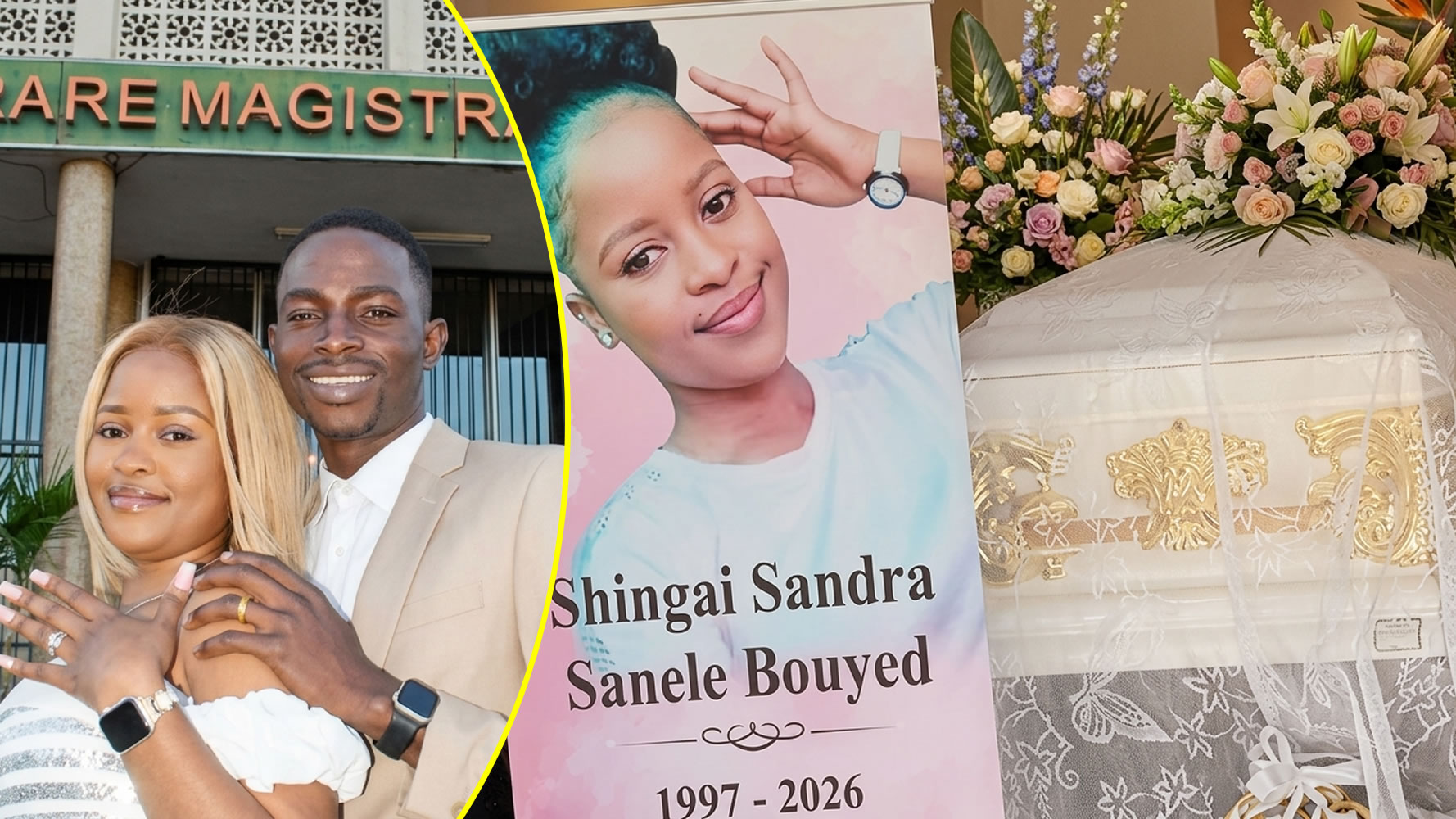
THE BRIDE WHO SAID ‘I DO’ AND THEN GOODBYE: A HARARE TRAGEDY
HARARE – The morning of April 16, 2026, was supposed to be the beginning of a new chapter for Sandra Shingai Sanele Bouyd. After years of living in the United Kingdom, the twenty-nine-year-old had returned to her homeland with a secret mission: to formalise her love for her long-time, on-and-off boyfriend, Valentine Chasokela. By midday, they had exchanged vows at the Harare Magistrates’ Court. By evening, Sandra was dead, and the streets of Glen Norah C were left to piece together a tragedy that has since become a grim spectacle for social media.
The accident occurred in an area of Glen Norah C popularly known as “kumasimbi.” Sandra, her new husband Valentine, and her cousin Nicole Kambalazi were travelling in a hired inDrive vehicle, a Toyota Aqua driven by thirty-eight-year-old Benard Hukuimwe. Witnesses say the driver attempted a reckless U-turn directly in front of an oncoming kombi. The resulting collision was violent. Sandra was rushed to Sally Mugabe Central Hospital, but her injuries were too severe. She succumbed shortly after arrival, leaving behind a young son, Mudiwa, and a family now grappling with more than just grief.
As the news of her death spread, the digital space was quickly flooded with speculation. H-Metro reporter Arron Nyamayaro noted that the tragedy had become “fodder for social media busybodies who are linking the tragedy to suspected rituals.” In Zimbabwe, where the veil between the physical and spiritual worlds is often seen as thin, such sudden deaths are rarely viewed as mere accidents. Widespread reports suggest that the court wedding had been kept a secret from most of the couple’s friends and, crucially, some of their family members.
The secrecy of the union has added fuel to the fire. Sources close to the family indicate that Sandra had travelled from the UK specifically to surprise her mother, arriving just ten days before the fatal crash. While the surprise visit was a moment of joy, the subsequent secret wedding has exposed underlying tensions. Some family members were reportedly unaware that the couple, whose relationship had been turbulent in the past, were planning to legalise their union. In the Zimbabwean cultural context, a wedding without the full blessing and knowledge of the family is often seen as a precursor to misfortune, a sentiment that is now being echoed across social media platforms.
Valentine Chasokela, who turned thirty-one on February 14, according to his social media profiles, survived the crash but remains injured and undoubtedly traumatised. The irony of the date – a man born on Valentine’s Day losing his bride hours after their wedding – has not been lost on the public. Yet, amidst the condolences, there are whispers of “juju” and “spiritual spouses,” common tropes in Zimbabwean folklore used to explain why a bride might be “taken” on her wedding day. These beliefs, while dismissed by many as superstition, hold significant weight in the collective psyche of the community, leading to a frenzy of online commentary that often borders on the insensitive.
However, the cold reality of Harare’s roads offers a more terrestrial explanation. The “kumasimbi” area is notorious for its chaotic traffic, and the rise of unregulated ride-hailing services like inDrive has seen an increase in accidents involving drivers who are often in a rush to complete as many trips as possible. Benard Hukuimwe’s alleged U-turn is a maneuver seen daily on the city’s roads, often with disastrous consequences. The lack of stringent oversight for these digital transport platforms has created a Wild West environment where safety is often sacrificed for speed and convenience.
This incident is not an isolated tragedy in the Zimbabwean wedding landscape. In March 2025, a couple from Dzivarasekwa was killed in a road accident just weeks before their planned April wedding. Similarly, in August 2025, a newly married couple in the Gurugu area lost their lives in a fatal crash shortly after their ceremony. These recurring tragedies highlight a disturbing pattern of road carnage that often claims lives during moments of celebration. The coincidence of such events often fuels the very superstitions that investigators try to dispel with forensic evidence.
The social media reaction to Sandra’s death has been a mix of genuine mourning and cruel speculation. On platforms like TikTok and Facebook, videos of Sandra’s “surprise visit” from the UK have been repurposed into memorials, while others use her story to warn against “secret marriages” or “marrying without parental blessing.” One YouTube video even falsely claimed she had married a “Nigerian man,” a common xenophobic trope used to add a layer of “suspicion” to the story. In reality, Valentine Chasokela is a Zimbabwean, and the tragedy appears to be a case of human error compounded by the poor safety standards of local transport.
Sandra’s body has been taken for a post-mortem examination, and she is expected to be buried at Zororo Memorial Park. As her family prepares for a funeral that should have been a wedding reception, the questions remain. Was this a tragic accident, or, as some believe, a consequence of “spiritual interference”? The tension between these two narratives – the scientific and the supernatural – is a defining characteristic of how modern Zimbabweans process grief and tragedy.
For those who knew her, Sandra was a vibrant young woman who simply wanted to build a life with the man she loved. Her son, Mudiwa, now faces a future without the mother who had travelled thousands of miles just to be with her family. The driver, Benard Hukuimwe, may face charges of culpable homicide, but no legal outcome can restore the life lost in that split-second decision on the Glen Norah roads. The legal system will take its course, but the emotional scars left on the survivors and the community will take much longer to heal.
The rise of ride-hailing apps in Zimbabwe has brought both convenience and chaos. While inDrive and similar services offer cheaper alternatives to traditional taxis, the lack of a robust regulatory framework means that many drivers are operating without adequate training or insurance. This systemic failure is a recurring theme in recent accidents across Harare. In early 2026, another inDrive driver lost his vehicle to a passenger in Chitungwiza, further highlighting the risks associated with these platforms. The safety of both passengers and drivers is increasingly under threat, yet the demand for affordable transport remains high.
Furthermore, the “kumasimbi” area itself has a history of being a hotspot for traffic incidents. Local residents have long called for better road signage and more frequent police patrols, but these pleas have largely gone unanswered. The intersection where the accident occurred is particularly dangerous, with many drivers attempting illegal U-turns to avoid long detours. This environmental factor, combined with the driver’s alleged recklessness, created a perfect storm that led to Sandra’s death.
In the end, the story of Sandra Shingai Sanele Bouyd is a sobering reminder of the fragility of life. It is a story of a bride who said her vows and then, through a cruel twist of fate, said her final goodbye. While the “busybodies” on social media continue to debate the spiritual causes, the reality remains a grieving family, an orphaned child, and a husband whose wedding ring is now a symbol of a life that ended before it truly began. The tragedy has left the nation reflecting on the intersection of tradition, modernity, and the harsh realities of daily life in Zimbabwe.
The investigation into the crash continues, but for the community of Glen Norah C, the “kumasimbi” area will forever be associated with the day the music stopped for a UK-based bride who just wanted to come home. As the sun sets over Harare, the city continues its relentless pace, but for one family, time has stood still. The memories of Sandra’s laughter and the joy of her surprise visit will eventually replace the trauma of the accident, but the void she left behind can never be filled.
In the days following the accident, more details have emerged about the couple’s history. Valentine and Sandra had been together for several years, navigating the challenges of a long-distance relationship while Sandra was in the UK. Their decision to marry was seen by those close to them as a commitment to finally being together in the same country. The secrecy of the wedding, while controversial, was reportedly an attempt to avoid the often-protracted negotiations and expenses associated with traditional Zimbabwean marriage rites. This modern approach to marriage, while efficient, ultimately left the couple vulnerable to the cultural backlash that followed the tragedy.
The role of the Zimbabwe Republic Police (ZRP) in investigating such high-profile accidents is also under scrutiny. In many cases, the lack of detailed forensic analysis means that the full story of an accident is never told, leaving room for the very rumors and speculations that have plagued Sandra’s story. As the country moves towards a more digital and connected future, the need for professional, transparent, and thorough investigative processes has never been more apparent.
As we conclude this report, we are reminded of the words of a local elder who, upon hearing of the tragedy, remarked, “In our culture, we say that a person does not just die. There is always a reason.” Whether that reason is a reckless U-turn, a lack of regulation, or something more spiritual, the outcome is the same: a life cut short, a family shattered, and a nation left wondering how such a beautiful day could end in such a devastating goodbye.