


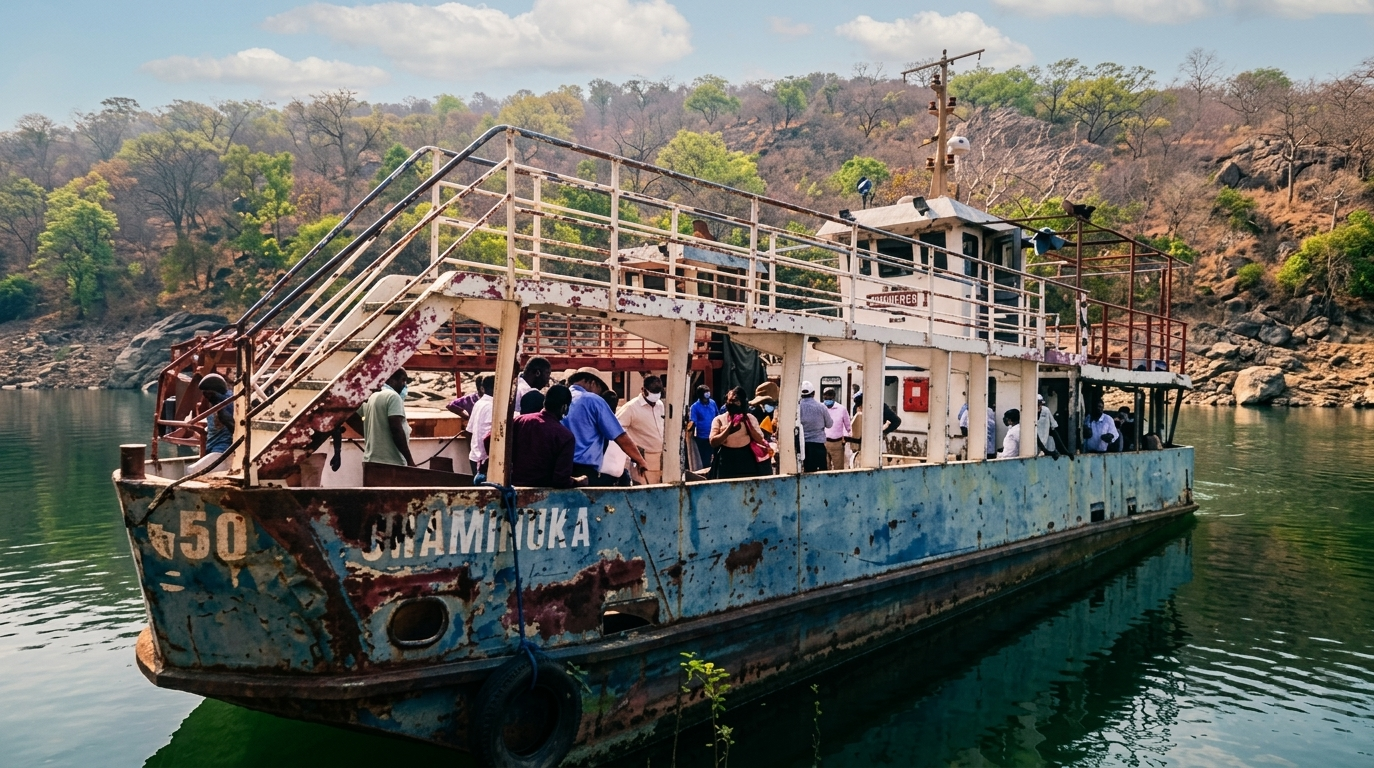
Lake Kariba ferry disaster: 15 dead as passenger count raises urgent questions over a 90-seat vessel
KARIBA – Fifteen people have been confirmed dead after the Mbuya Nehanda ferry capsized on Zimbabwe’s Lake Kariba, while 77 people were rescued and at least 27 remained unaccounted for as search teams prepared to continue work beneath the water.
The disaster occurred on the afternoon of August 11 as the ferry travelled from Kariba towards the Chalala fishing camps, with Long Island on its route. What began as an ordinary crossing for lake communities has become an emergency defined not only by grief, but also by a basic and troubling question: how many people were on board, and who allowed the vessel to leave shore?
The latest official account from the Civil Protection Unit is stark. Ticket records confirmed 114 adult passengers and five crew members — at least 119 people in all — on a vessel with a stated carrying capacity of 90 people. The same official account says an undisclosed number of children below ticketing age may also have been aboard. That means 119 is not a final total of everyone on the ferry; it is the minimum established by the records available so far.
The difference is already substantial. The ticketed adults and crew alone were 29 above the declared capacity, roughly 32% more than the number the vessel was said to be able to carry. That comparison does not establish why the ferry capsized. The cause has not been officially determined. But it sets an unavoidable line of inquiry for investigators examining whether loading, vessel condition, weather, route decisions, safety equipment or the speed and readiness of the rescue response played a part.
|
Latest verified position
|
Figure or status
|
What it means
|
|
Confirmed deaths
|
15
|
Bodies recovered from the lake; the toll may change as the search continues.
|
|
Rescued
|
77
|
Survivors were first taken to Long Island before arrangements were made to bring them ashore.
|
|
Unaccounted for
|
At least 27
|
This remains provisional because the full number of people aboard is not known.
|
|
Ticketed adults
|
114
|
Confirmed through ticket records, according to the Civil Protection Unit.
|
|
Crew
|
5
|
Added to the ticketed passenger count.
|
|
Children
|
Unknown
|
The official account says children below ticketing age may have been aboard but were not recorded in the ticket tally.
|
|
Stated ferry capacity
|
90
|
The benchmark against which the confirmed 119 adults and crew must be assessed.
|
A rescue effort that is still an identification effort
The figures must be read carefully. Early police information referred to a DDF boat with 90 people and five crew members. Later information attributed to the Civil Protection Unit set out the more detailed ticket record: 114 adult passengers, five crew members and children below ticketing age whose number was not known. Police have warned against treating unverified totals circulating online as fact.
Commissioner Paul Nyathi, the national police spokesperson, said at the start of the operation: “The ZRP reports that a DDF boat with 90 people and five crew members has capsized in Lake Kariba. Rescue efforts are currently underway. More details on the situation will be released in due course.”
In a later appeal, police said the public should be “cautionous of releasing the total figures of the victims either injured or dead to allow the ZRP and the government authorities to manage the situation professionally without interference or distortion of figures”.
That warning reflects a hard practical problem. When children travel without tickets, a ticket register cannot serve as a complete passenger manifest after an accident. Families searching for relatives may know someone boarded the boat even when that person does not appear in the accounting records. The recovery operation is therefore also an exercise in establishing who was there.
New Zimbabwe reported that survivors were rescued by Matusadonha rescue teams and other responders and were on Long Island while boats were mobilised to bring them to land. It also reported that a sub-aqua unit had been airlifted to the scene for search and rescue work. Funeral service providers Nyaradzo and Doves were engaged to collect recovered bodies for processing, according to the provincial report.
For relatives, the most reliable route to information is through the Zimbabwe Republic Police and the Civil Protection Unit, rather than posts listing names or casualty totals on social media. Families reporting a missing person should give the person’s full name, age, home community, known travel plans, whether they had a ticket and any identifying details to police or civil-protection officials at the Kariba response point. The first confirmed victim list should come from the agencies managing identification and recovery, not from an unofficial tally.
The journey and the questions left in its wake
The Mbuya Nehanda is used by rural communities travelling along Lake Kariba between Kariba town and the fishing camps. Lake Kariba is not a narrow inland crossing. It forms part of the border between Zimbabwe and Zambia, stretches for more than 200 km and reaches up to 40 km across in places. Its size makes weather conditions central to any decision to sail.
Early reporting said the ferry overturned near Long Island. Local reports and video accounts referred to strong waves, while another report described the ferry as having encountered turbulence. Neither description is a final cause. Weather may be an important part of the inquiry, but it does not eliminate the need to examine the vessel’s load, the decision to depart, the route chosen, the skipper’s assessment and the standard of emergency preparation.
A provincial Civil Protection Unit report described the passenger records in direct terms: “This report serves to advise you that a DDF (District Development Fund) boat capsized on Lake Kariba this afternoon of 11 August 2026. It had 114 adult passengers on board (confirmed through tickets from the accounts), 5 crew members and undisclosed children below ticketing age,” Chitiyo said in the report.
The reference to DDF concerns the organisation now known as the Rural Infrastructure Development Agency, or RIDA. It is essential that the public receives a clear account from the agency, or the authority responsible for the ferry, of the vessel’s maintenance record, last inspection certificate, licensing status, crew qualifications, route plan, equipment inventory and procedures for rough water. Those documents can help establish whether the ferry was fit to operate and whether rules that existed on paper were followed in practice.
The age of the vessel has also been raised in reports, with claims that it may have been in service since the 1980s. That has not been independently verified from maintenance or registration records and should not be treated as fact until the operator or investigators publish evidence. The same caution applies to claims that far more people were aboard than the ticket figures show. In a disaster, rumours travel faster than documents. The inquiry needs to follow the documents.
|
Timeline of the known response
|
What is confirmed
|
|
August 11, afternoon
|
The Mbuya Nehanda capsized on Lake Kariba while travelling from Kariba towards the Chalala fishing camps; early reporting located the incident near Long Island.
|
|
Initial response
|
Police announced a rescue operation. ZBC footage later showed speedboats near an overturned vessel and a helicopter above the lake.
|
|
Later August 11 account
|
The Civil Protection Unit reported 77 rescues, 15 recovered bodies and at least 27 people unaccounted for.
|
|
After rescues
|
Survivors were on Long Island; boats were mobilised to take them ashore. A sub-aqua unit was deployed for continuing search work.
|
|
Current position
|
The search and identification effort continues. The full number aboard, including children below ticketing age, has not been established.
|
Accountability without prejudice
The most important question is not whether one factor alone explains the capsizing. Major transport disasters usually require investigators to test several possible failures at once. Did the passenger load exceed a legal or operational limit? Was capacity calculated as passengers only, or as all people on board including crew? Were children deliberately excluded from ticketing, and is that standard practice? Were life jackets sufficient in number, usable and distributed before departure? Was there an official weather warning, and if so, who received it and what decision followed? Did the crew have clear authority to delay or cancel the voyage?
The inquiry should also establish the time of the first distress call, the location and availability of rescue boats, the condition of communications equipment, and whether the island transfer was the fastest safe option.
This is not simply an argument about one crossing. Remote communities depend on water transport because the lake separates homes, fishing grounds, services and markets. The same dependence has made ferry safety a regional concern. In October 2024, at least 78 people died after an overcrowded boat believed to have carried 278 people capsized on Lake Kivu in the Democratic Republic of Congo. The toll there was also provisional as people remained unaccounted for. Congolese authorities opened an investigation, while officials cited overcrowding, lack of life jackets, negligence and a storm as possible factors in that separate disaster.
The Lake Kivu case does not prove anything about Kariba. Its relevance is different: it shows why passenger manifests, life jackets, weather decisions, route dependence and enforcement must be tested openly after a boat disaster. It also shows why provisional numbers should never be converted into final facts simply because they are repeated online.
Cecilia Chitiyo, who was identified in the provincial report as the chair of the Mashonaland West Provincial Civil Protection Unit, recommended that the Kariba accident be declared a state of disaster. At the time of writing, a recommendation is not the same as a declaration.
If the Government formally declares a state of disaster, Zimbabwe’s Civil Protection Act provides the legal framework for national civil-protection action and a National Civil Protection Fund for civil-protection purposes. The law also requires the minister to communicate a declaration to Parliament when it next sits. A declaration would not determine legal blame for the capsizing; it would formalise the emergency response and the governmental arrangements around it.
For now, the legal and moral question lies closer to the shore from which the ferry departed. Before any children are counted, the official ticket record points to at least 119 adults and crew on a boat described as having room for 90. The search teams on the lake must first bring families answers. But the inquiry that follows will have to answer another question just as plainly: who was responsible for ensuring that a 90-seat public vessel did not leave shore carrying at least 119 adults and crew?