Mnangagwa urged to back independent Chivayo crash probe as flight-recorder accounts diverge
Zimbabwean engineer Jacob Kudzayi Mutisi has appealed to President Emmerson Mnangagwa to protect the independence of the investigation into Wicknell Chivayo’s fatal helicopter crash, as an unresolved contradiction over the aircraft’s cockpit voice recorder deepens questions about the official account.
Mutisi’s open letter to Mnangagwa asks the President to ensure that no person improperly influences or undermines the work of investigators. It does not claim that the crash was deliberate. Instead, it argues that the victims’ families and the public need a thorough, professional account of what happened.
The key question now concerns a cockpit voice recorder, or CVR, carried by the Bell 430 helicopter, registration Z-PED. In the first public account after the crash, aviation officials were reported to have recovered an intact “black box” from the wreckage. But the Ministry of Transport and Infrastructural Development’s preliminary accident report, released on 16 November, says the CVR was not recovered.
“The aircraft was fitted with a Cockpit Voice Recorder (CVR). However, the CVR was not recovered among the wreckage and is presumed to have been destroyed,” the report states.
The difference between those accounts has become a central issue for the investigation. The report does not identify a separate flight data recorder, nor does it explain what object officials initially described as an intact black box. It says the missing CVR is presumed to have been destroyed, but provides no detailed account of when the recorder was last seen, who examined the wreckage, or how the conclusion about its loss was reached.
The opening-day account said investigators found the recorder intact and took it away for analysis. The written report, issued weeks later, gives a different picture. Resolving the discrepancy would help establish whether officials were referring to the same device and what evidence was available to investigators as they built their account of the flight’s final minutes.
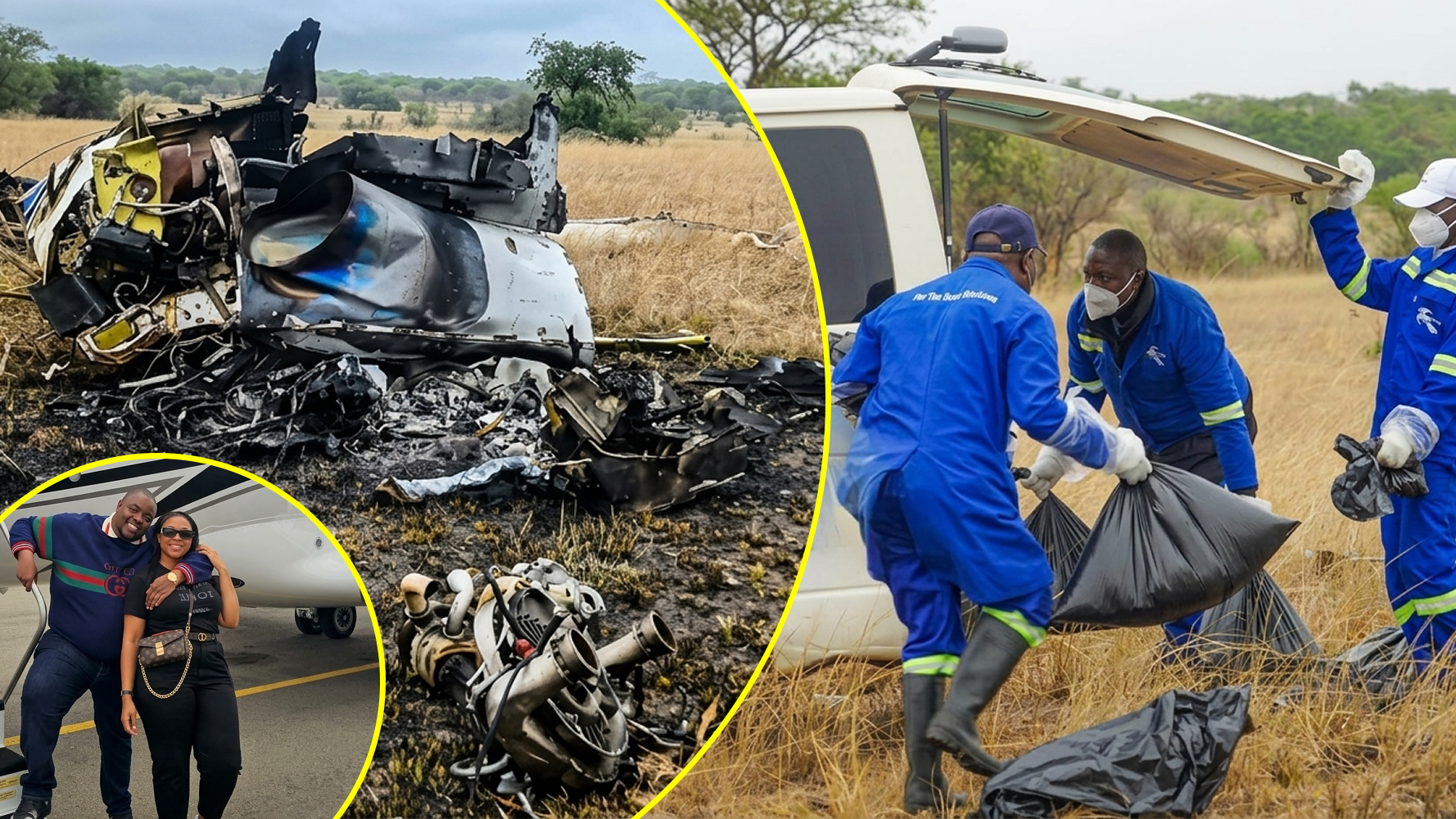
The crash happened at about 17:00 local time on 30 September at Kudenga Farm, about 22km south-west of Marondera, next to Waddilove School. The official report records 5 deaths: Chivayo, his wife Lucy Muteke, aide Sanelisiwe Magagula, pilot-in-command Captain Kelvin Tafirei Soda and co-pilot Courage Mutavirwa. The Bell 430 had departed Gandami Village in Mashonaland East on a private flight to Marondera.
The helicopter had been flying in formation with a Bell 407, registration Z-OSM. Both aircraft were operating under visual flight rules, which rely on pilots being able to see the surrounding conditions. About 10 minutes after take-off, a low cloud layer approached from the east. The Bell 407 turned west to avoid it. The Bell 430 continued north-east, reporting that the route in that direction was clear.
The last radio transmission recorded in the report indicated that the Bell 430 had entered another layer of cloud and had not yet come out of it. Witnesses at Kudenga Farm later heard a helicopter overhead but could not see it through drizzle and dense fog. The sound continued for about 10 minutes, followed by a loud impact and silence. Police were notified at 17:00 and reached the farm 15 minutes later, where the aircraft was still partly burning.
Weather information forms a substantial part of the preliminary findings. The Zimbabwe Meteorological Services Department had issued a severe-weather advisory for 29 September to 1 October, warning of thunderstorms, lightning, strong gusts and localised heavy rainfall. Observations around Harare recorded low cloud ceilings of about 1,500 to 2,000 feet. Witness accounts from the crash site described heavy fog, drizzle and very poor visibility.
The report classifies the event as unintended flight into instrument meteorological conditions and controlled flight into or towards terrain. It says the helicopter remained intact until it hit the ground, with no evidence of an in-flight break-up or an explosion before impact. Wreckage was spread across a field measuring about 170 metres by 75 metres. The impact and a fire after the crash destroyed the aircraft, and the report says the accident was not survivable because of the force of the impact and the fire.
Those are preliminary findings, not the final account. Investigators say wreckage has been moved to a secure facility for further examination. They have collected aircraft and safety records, interviewed crew from the accompanying Bell 407, witnesses and first responders, and obtained copies of recent maintenance records. A detailed inspection of the full maintenance file is still to be carried out. The final report is expected to include more analysis and any safety recommendations.
The report identifies the Bell 430’s pilot as a 44-year-old commercial helicopter licence holder with 2,756 total flying hours, including 614 hours on that model. His medical certificate was valid. Investigators say they have so far found no evidence that illness or incapacitation affected the crew. They also say no management or operational deficiencies have been identified to date. These findings sit alongside the report’s weather evidence, but the investigators have not yet issued a final cause.
Mutisi’s appeal calls for the President to support the independence of both investigative and judicial institutions and to prevent interference in their work. He writes that “the investigation involving businessman Wicknell Chivhayo presents an important opportunity for Zimbabwe to demonstrate that investigations involving prominent or influential individuals can be conducted independently, professionally and transparently.”
The letter says it is not about political ties or the reputation of one person. It is about whether evidence is preserved, whether an inquiry can proceed without interference and whether its conclusions are communicated clearly. Mutisi also refers to earlier high-profile deaths in Zimbabwe, including Herbert Chitepo, who died in a car-bomb explosion in Lusaka in 1975; General Josiah Tongogara, who died in a road accident in Mozambique in 1979; General Solomon Mujuru, who died in a house fire in 2011; and businessman Douglas Munatsi, who died in an apartment fire in Harare in 2021.
The letter stresses that these deaths occurred in different circumstances and should not automatically be treated as criminal cases. Mutisi writes: “I do not suggest that these deaths were necessarily the result of criminal activity or that official findings should automatically be rejected.” He cites them to argue for clear explanations and credible investigations when deaths of prominent people attract enduring public questions.
The call for scrutiny is also being made against the background of claims about Chivayo’s relationship with state security. In 2024, unnamed intelligence sources were quoted as saying that officials regarded his repeated approaches to President Mnangagwa and alleged breaches of close-protection procedures as a security concern. One source said: “Clearance is a leash, not a crown.” Another warned: “if he doesn’t quiet down, he’s in danger of elimination”.
Those statements were attributed to intelligence sources and described an alleged plan involving a staged road accident. They were not official findings about the helicopter crash. The available preliminary aviation report points to worsening weather and the helicopter’s entry into cloud, and it says no pre-impact explosion or break-up was found. The earlier warnings do not, on their own, establish a connection to the crash; the preliminary report does not cite them.
Chivayo’s public profile had been built around high-value state-linked business, conspicuous wealth and political access. His company Intratrek was awarded a US$172 million solar project in Gwanda, which was followed by years of legal disputes. He was also drawn into scrutiny over procurement for Zimbabwe’s 2023 elections. The Zimbabwe Anti-Corruption Commission closed its investigation in 2025, saying it had found no evidence linking him or the Zimbabwe Electoral Commission to wrongdoing in the contracts. The commission’s decision ended that particular inquiry, while debate over opaque public procurement remained a separate matter. The history of the election-procurement inquiry and its closure is set out in the available account of the commission’s decision.
His death has also left questions about the companies and projects associated with him. Recent reporting on the future of his business interests has described uncertainty over corporate records, company governance and the continuity of energy projects in Zimbabwe and neighbouring countries. Those matters are distinct from the aviation investigation, but they underline how much of Chivayo’s business world was tied to his personal role as dealmaker and public face.
For the crash inquiry, the immediate task is more concrete: explain the recorder discrepancy, complete the technical examination of the wreckage and maintenance records, and publish the final findings. Mutisi’s letter asks Mnangagwa to ensure the investigation is not “sabotaged, compromised, influenced or undermined”. The preliminary report’s account of fog, low cloud and the final radio transmission provides a clear line of inquiry. The missing CVR, and the conflicting statements about its recovery, leave a major evidential question to be answered.