

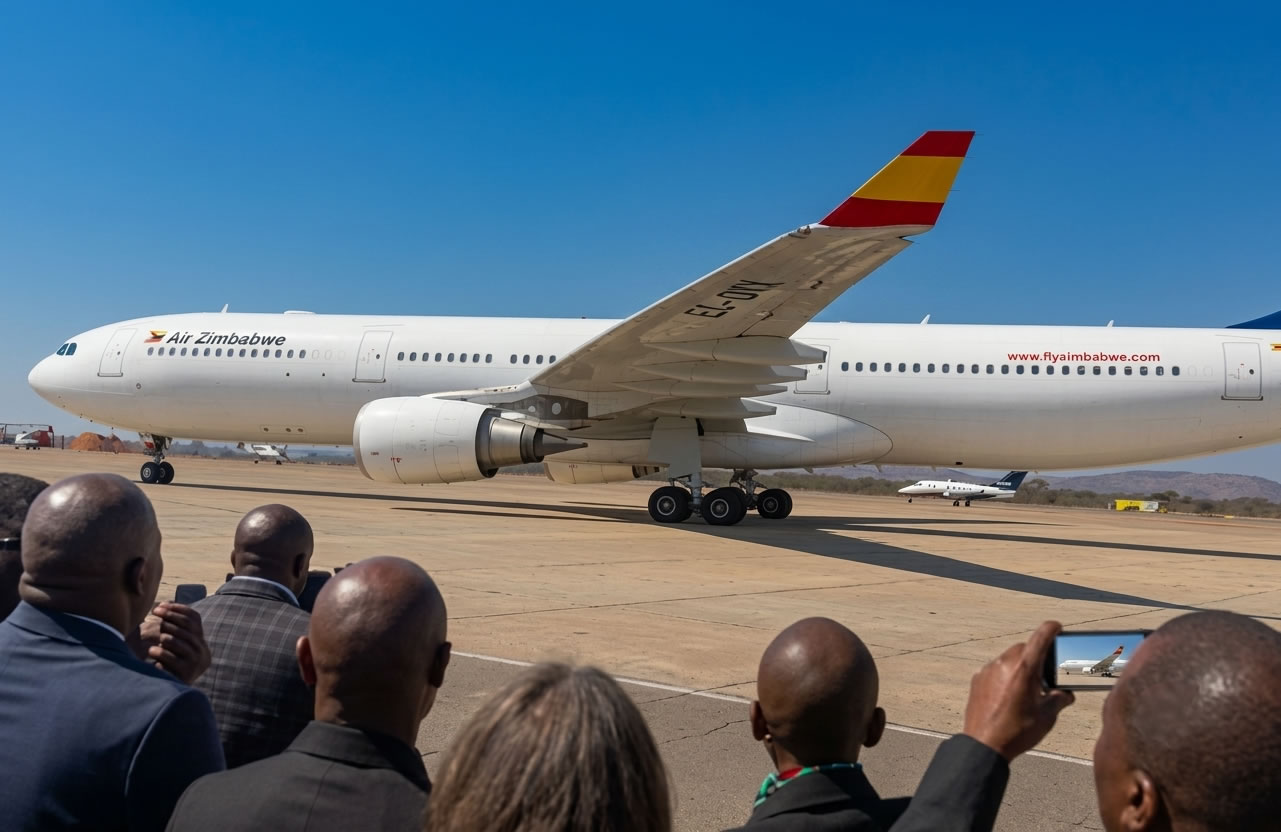
Air Zimbabwe’s Harare-London flights grounded as the aircraft deal encounters serious challenges
Air Zimbabwe’s direct flights between Harare and London have been thrown into uncertainty after Spanish airline Plus Ultra reclaimed the Airbus A330 aircraft leased to the national carrier.
The aircraft had been operating three weekly flights between Robert Gabriel Mugabe International Airport and London Gatwick. On Monday evening, instead of flying back to Harare as scheduled, it left London for Madrid, where it was parked. The move left passengers facing major disruption and placed the future of Air Zimbabwe’s recently restored London service in doubt.
The aircraft withdrawal came only three days after Air Zimbabwe announced plans to increase the route from three flights a week to four. The airline had cited “increased customer demand” ahead of the Christmas and New Year travel period, when thousands of Zimbabweans living in the United Kingdom traditionally travel home.
That expansion is now in jeopardy. Air Zimbabwe had returned to the route on 22 July, ending a 14-year absence from the United Kingdom. The service was presented as an important step in the airline’s recovery and as a direct link for Zimbabweans travelling between the two countries.
The latest disruption has exposed the risks of relying on a single leased aircraft and an overseas operating partner for a long-haul route. Air Zimbabwe does not provide the aircraft or crew itself. Under the wet-lease agreement, Plus Ultra supplies the aircraft, pilots, cabin crew, maintenance and insurance, while Air Zimbabwe sells the tickets and manages the commercial side of the service.
With the leased aircraft now back in Spain, Air Zimbabwe’s ability to continue flying to London depends on whether the two airlines can resolve the dispute or secure another aircraft and operating crew.
By Monday night, Air Zimbabwe had not issued a public statement explaining the aircraft’s withdrawal. Its website was still accepting bookings for the London route, adding to uncertainty for passengers who had already paid for flights or were planning to travel during the festive season.
The grounding follows an earlier disruption that affected the route less than two weeks after its launch. On 1 August, the scheduled 10.40pm flight from Harare to London was cancelled after an issue involving a crew member. Staff told passengers there was “an issue with one of our crew members”.
One of the pilots assigned to the Airbus A330 had reported sick, and there was no standby pilot available in Harare. Because the aircraft was being operated under the Plus Ultra wet-lease arrangement, the absence of a replacement crew member meant the flight could not leave as planned.
Air Zimbabwe later described the cancellation as a postponement caused by “operational reasons”. The flight was moved to the following evening, departing Harare at 9pm and arriving at London Gatwick at about 6am on Sunday. The return service was also rescheduled, leaving London at 8am and reaching Harare at about 7pm the same day.
In a statement issued after the disruption, the airline said:
“Air Zimbabwe wishes to advise its valued customers that the Harare-London flight scheduled for Friday, 1 August 2026 has been postponed due to operational reasons.”
The airline also said:
“The London-Harare flight, originally scheduled for Saturday, will now depart London Gatwick at 8:00am on Sunday and is expected to arrive in Harare at 7:00pm the same day.”
The carrier then attempted to reassure passengers that its normal timetable had been restored.
“All Air Zimbabwe flights are operating as scheduled. Tonight’s (yesterday) departure to London will operate on schedule. Passengers travelling on Flight UM724 should proceed with their travel plans as planned and present themselves for check-in three hours before departure.”
The August cancellation was the first major setback after the route’s return. The latest aircraft withdrawal is more serious because the A330 was the only aircraft being used for the direct London operation.
The route had been running three times a week, with flights leaving Harare on Sundays, Wednesdays and Fridays. Return flights from London were scheduled for Mondays, Thursdays and Saturdays. Air Zimbabwe had planned to add a fourth weekly service as passenger numbers grew.
The direct connection was welcomed by the Zimbabwean diaspora, which had been forced to use connecting flights through Johannesburg, Addis Ababa, Kigali, Luanda and Dubai for more than a decade. The route also opened a faster option for business travellers, tourists and exporters moving cargo between Zimbabwe and the United Kingdom.
No other airline flies non-stop between Harare and London, leaving one-stop connecting carriers—led by Ethiopian Airlines, Emirates, Qatar Airways, Kenya Airways, Uganda Airlines, and RwandAir—as the primary ways to travel the route.
While Air Zimbabwe has been the sole operator of non-stop flights between Harare (HRE) and London Gatwick (LGW) since July 2026, its service was disrupted on November 23, 2026, after its wet-lease partner, Plus Ultra, suspended operations. All other options require at least one layover.
British Airways ended its direct London–Harare flights on October 28, 2007, citing heavy financial losses, severe aviation fuel shortages, and spiraling operating costs during Zimbabwe’s economic crisis.
Regional BA-branded flights between Johannesburg and Harare—operated by its South African franchise partner, Comair—continued until May 2022, when Comair suspended operations and entered liquidation.
Traffic between the two countries has remained strong despite the lack of a non-stop service. Passenger data used during the planning of the relaunch showed about 190,000 two-way travellers between the United Kingdom and Zimbabwe in 2025. Harare and London accounted for the largest share of that traffic, with about 108,000 passengers travelling between the two cities.
The service was also expected to carry cargo, including fresh produce and other goods that are sensitive to delays. For exporters, a dependable direct flight can reduce handling time and avoid the extra costs associated with sending goods through another country.
However, the route was launched using a temporary solution rather than Air Zimbabwe’s own long-haul aircraft. The 13-month wet-lease agreement with Plus Ultra began on 1 July. It allowed Air Zimbabwe to return to the United Kingdom despite restrictions affecting its own aircraft.
Air Zimbabwe has been listed on the European Union Air Safety List since May 2017 and is prohibited from operating commercial services to, from or within the United Kingdom with its own aircraft. The wet-lease arrangement enabled it to use a Spanish-registered aircraft and a European operating crew that met the relevant requirements for the route.
The arrangement also offered Air Zimbabwe a way to restart the service without immediately buying or leasing a long-haul aircraft on its own. The national carrier has faced years of financial pressure and has had limited fleet capacity. At the time the London relaunch was being planned, the airline had only a small number of active aircraft serving a limited domestic and regional network.
But the same arrangement left the new London service dependent on the financial and operational strength of Plus Ultra.
The Spanish carrier has been under increasing pressure in recent months. Rising fuel prices, higher operating costs and a shortage of cash have forced it to reduce its scheduled network. It has suspended services to several destinations in Latin America and has begun negotiations with creditors under a restructuring process in Spain.
Plus Ultra filed for preliminary creditor protection on 13 November. The process gives the airline time to agree a restructuring plan with its creditors and deal with its financial obligations. The company has also been preparing to reduce its scheduled passenger network, cut jobs and concentrate more heavily on ACMI and charter work.
Plus Ultra operates a fleet of Airbus A330 aircraft from Madrid. Its scheduled network has been reduced sharply, with only a small number of services continuing while the company reviews its operations. The airline has blamed rising fuel costs linked to the conflict in the Middle East, along with accumulated losses and difficulties attracting new investment.
The company received €53 million in state-backed support during the Covid-19 pandemic. It has since faced pressure over repayments and has been involved in a wider investigation in Spain concerning the bailout and the airline’s ownership structure. Those issues have added to the pressure surrounding its restructuring.
The financial trouble has raised immediate questions about every contract that depends on Plus Ultra aircraft. A wet lease can provide a quick way for an airline to launch a new route, but it also means the customer airline is exposed if the supplier loses an aircraft, reduces its fleet or struggles to keep crews and maintenance teams available.
Air Zimbabwe’s return to London was already facing pressure from higher fares. During the promotional period, one-way tickets were sold for about US$495, while return fares started at around US$900. After the promotion ended, one-way fares rose to about US$720 or £689. Return tickets increased to about US$1,412 or £1,056.
The fare increase came after the August cancellation and other operational delays, making the timing difficult for passengers who had supported the relaunch. Many travellers had chosen the service because of the convenience of flying directly between Harare and London. Higher prices combined with uncertainty over the schedule could make it harder for the airline to retain that confidence.
Air Zimbabwe’s problems also revive memories of the events that ended its previous London operation. In December 2011, one of the airline’s Boeing 767 aircraft was impounded at Gatwick after an American aviation company pursued the carrier over an unpaid US$1.2 million bill for aircraft spares.
The aircraft remained on the ground and the incident became a public symbol of the airline’s worsening financial position. Air Zimbabwe’s debts were estimated at about US$40 million at the time. The carrier later withdrew from the route and remained absent from the United Kingdom for 14 years.
The airline’s current debt has been estimated at about US$380 million. The government has been working to assume the debt through the Mutapa Investment Fund, while Air Zimbabwe has also outlined a fleet renewal programme valued at US$775.5 million.
Those long-term plans do not solve the immediate problem facing passengers. The London service needs an aircraft that is available now, a qualified crew, maintenance support and a schedule that can be relied upon.
If the Plus Ultra aircraft is not returned to service for Air Zimbabwe, the national carrier will need to find another wet-lease provider. That would involve securing a suitable long-haul aircraft, obtaining a complete crew and putting maintenance and insurance arrangements in place. The replacement operator would also need regulatory approval to fly between Zimbabwe and the United Kingdom.
Such a move could take time, particularly during the busy Christmas travel season when long-haul aircraft and crews are in high demand.
The latest crisis therefore goes beyond one cancelled flight. Air Zimbabwe’s direct London service has been built around an aircraft it does not own and an operator facing its own serious financial difficulties. The airline’s plans for additional flights, its ticket sales and its promise of a stable international service now depend on whether that arrangement can be repaired or replaced.
For passengers, the immediate concern is whether booked flights will operate, whether schedules will be changed and how the airline will manage travellers affected by the aircraft’s departure. For Air Zimbabwe, the challenge is to keep the route alive after investing heavily in its return.
The national carrier spent years trying to re-establish a direct connection with London. The route finally returned in July, but within four months it has been hit by a crew-related cancellation, rising fares, a restructuring crisis at its Spanish partner and the removal of the aircraft at the centre of the deal.
With the festive travel period approaching, Air Zimbabwe now faces a race to secure a dependable aircraft and prevent its London comeback from becoming another short-lived chapter in the airline’s troubled history.