
Air Zimbabwe races to keep London route alive after Plus Ultra collapse
Air Zimbabwe has turned to Portuguese airline EuroAtlantic Airways to keep its direct Harare–London service operating after the sudden collapse of its wet-lease arrangement with Spain’s Plus Ultra left passengers stranded and disrupted the carrier’s plans for the busy festive season.
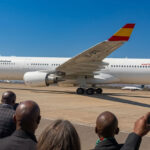
EuroAtlantic began operating the route on Thursday, 26 November, using an Airbus A330-300 supplied with its own crew, maintenance and insurance. The aircraft replaced the Plus Ultra Airbus that had been withdrawn after the Spanish carrier suspended all flight operations amid a deepening financial crisis.
The new aircraft is scheduled to operate Air Zimbabwe’s three weekly flights between Robert Gabriel Mugabe International Airport and London Gatwick. The airline’s planned fourth weekly service in December remains on the schedule, despite the disruption that had threatened to bring the recently restored route to a standstill.
“Air Zimbabwe is pleased to announce the engagement of Portugal-based EuroAtlantic Airways as its new wet-lease partner, marking an important step in strengthening operational resilience and ensuring continuity of the airline’s London–Harare service.
“The new partnership follows an unexpected operational disruption affecting the airline’s previous wet-lease arrangement with Plus Ultra earlier this week, which necessitated alternative operational arrangements for the London – Harare route,” Air Zimbabwe said.
The carrier had been forced to reschedule flights after Plus Ultra stopped operating on 23 November. A flight from London due to arrive in Harare on Monday was cancelled, followed by the return service from Harare on Wednesday. Air Zimbabwe said the affected Monday flight would operate on Thursday, while the Harare–London service originally scheduled for Wednesday was moved to Friday.
Passengers affected by the cancellations were transferred to other airlines to continue their journeys. Others were accommodated in hotels in Harare and London as the national carrier sought a replacement aircraft and crew at short notice.
The disruption came only days after Air Zimbabwe announced that it would increase flights on the route from three to four in each direction from 1 December. The extra service was introduced to meet demand from travellers expected to move between Zimbabwe and the United Kingdom over the Christmas and New Year period.
The route normally operates from Harare on Wednesdays, Fridays and Sundays, with return flights from London on Mondays, Thursdays and Saturdays. The published schedule for the EuroAtlantic operation includes an evening departure from Harare and overnight flights to Gatwick, as well as services returning from London on Mondays, Thursdays and Sundays.
The aircraft supplied by EuroAtlantic is a 15-year-old Airbus A330-300 registered CS-TGJ. It had been parked in Porto, Portugal, after being delivered from Malaysia Airlines about a month before it was assigned to Air Zimbabwe. The aircraft has 27 business-class seats and 263 economy seats, with inflight entertainment included.
That gives the Portuguese aircraft a larger cabin than the Airbus previously supplied by Plus Ultra and provides Air Zimbabwe with a replacement capable of carrying both passengers and cargo on the long-haul route. EuroAtlantic will provide the aircraft, pilots and cabin crew, as well as maintenance and insurance under the new ACMI, or wet-lease, agreement. The length and financial terms of the arrangement have not been disclosed.
John Mangudya, chief executive of the Mutapa Investment Fund, which owns Zimbabwe’s state enterprises, confirmed the new partnership.
“We have partnered EuroAtlantic on the route,” Mangudya said.
Air Zimbabwe’s switch to EuroAtlantic followed the indefinite suspension of Plus Ultra’s operations after the Spanish airline failed to secure the resources needed to continue flying. Plus Ultra said intensive negotiations and efforts to improve its financial position had not produced a workable solution, although it intended to continue restructuring efforts and talks with creditors.
The company had accumulated losses of about €31 million (about US$34 million) by August 2026, while its projected fuel bill had risen from €69 million to €105 million. It had also failed to repay a €19 million instalment on a government-backed loan that fell due in March. Plus Ultra received €53 million in financial support from Spain’s state-owned industrial holding company, SEPI, in 2021 under a programme created to help businesses affected by the Covid-19 pandemic.
The airline had operated a fleet of seven leased aircraft and specialised in long-haul services between Spain and Latin America. It served destinations including Venezuela, Colombia and Peru, but had reduced its scheduled network as its financial problems worsened. A collective redundancy plan was being prepared that could affect its entire workforce of 679 employees.
The withdrawal of the aircraft supplied to Air Zimbabwe exposed how heavily the London service depended on the financial health of an outside operator. Under a wet lease, Air Zimbabwe sells the tickets and markets the route, while the partner airline supplies the aircraft, pilots, cabin crew, maintenance and insurance. The arrangement allowed the Zimbabwean carrier to restore a long-haul service without acquiring its own aircraft and crew, but it also meant that a crisis at the supplier could immediately affect Air Zimbabwe’s passengers.
The route had returned on 22 July after a 14-year absence from the United Kingdom. Its relaunch restored a direct connection for Zimbabweans living in Britain and for travellers moving between the two countries for business, family visits, tourism and trade.
For more than a decade, passengers travelling between Harare and London had generally needed to connect through cities such as Johannesburg, Addis Ababa, Kigali, Luanda or Dubai. Ethiopian Airlines, Emirates, Qatar Airways, Kenya Airways, Uganda Airlines and RwandAir remained among the main carriers offering one-stop alternatives when the Air Zimbabwe service was interrupted.
British Airways ended its direct London–Harare flights on 28 October 2007 after reporting heavy financial losses, severe fuel shortages and rising operating costs during Zimbabwe’s economic crisis. British Airways-branded regional flights between Johannesburg and Harare continued through its South African franchise partner Comair until May 2022, when Comair suspended operations and entered liquidation.
The demand for a direct service did not disappear. Passenger figures used in planning Air Zimbabwe’s return indicated that about 190,000 people travelled between Zimbabwe and the United Kingdom in both directions during 2025. About 108,000 of those journeys were between Harare and London, making the two cities the largest traffic pair in the market.
The direct route was also expected to support cargo shipments, including fresh produce and other goods that lose value when delayed. A non-stop flight reduces handling through another country and can shorten the time needed to move goods between exporters and buyers.
Yet the return to London was always built around a temporary operating model. Air Zimbabwe did not bring the route back using a long-haul aircraft from its own fleet. Instead, its 13-month wet-lease arrangement with Plus Ultra supplied the aircraft and crew needed to fly into Gatwick.
Regulatory restrictions were central to that arrangement. Air Zimbabwe has been on the European Union Air Safety List since 2017 and cannot use its own aircraft to operate commercial services to, from or over the European Union. The European Commission’s current list includes carriers subject to operating bans or restrictions because they do not meet international aviation safety standards. The Commission allows a banned carrier to use a wet-leased aircraft from an operator that is not subject to the ban, provided the relevant safety requirements are met.
The arrangement with Plus Ultra enabled Air Zimbabwe to operate under the Spanish carrier’s aircraft and European operating crew. The new EuroAtlantic agreement follows the same broad model, allowing the route to continue while the aircraft, crew and operational support are provided by a partner carrier.
The immediate disruption was not the first setback since the London service returned. On 1 August, a scheduled Harare–London flight was postponed after an issue involving a crew member. One of the pilots assigned to the Airbus A330 had reportedly fallen ill, and no standby pilot was available in Harare. Because the aircraft was being operated under the wet-lease agreement, the absence of a replacement crew member prevented the flight from departing on time.
Air Zimbabwe later moved the flight to the following evening and changed the return service from London. In a statement issued at the time, the airline said:
“Air Zimbabwe wishes to advise its valued customers that the Harare-London flight scheduled for Friday, 1 August 2026 has been postponed due to operational reasons.”
It added:
“The London-Harare flight, originally scheduled for Saturday, will now depart London Gatwick at 8:00am on Sunday and is expected to arrive in Harare at 7:00pm the same day.”
The airline also sought to reassure passengers that its wider timetable had been restored.
“All Air Zimbabwe flights are operating as scheduled. Tonight’s (yesterday) departure to London will operate on schedule. Passengers travelling on Flight UM724 should proceed with their travel plans as planned and present themselves for check-in three hours before departure.”
The November aircraft withdrawal was more serious because the Airbus assigned to the London route was the only aircraft being used for the direct operation. When Plus Ultra suspended its flights, Air Zimbabwe had to find not only another aircraft but also a complete long-haul crew, maintenance cover, insurance and the regulatory clearances needed to operate between Zimbabwe and the United Kingdom.
The carrier was also facing pressure from rising fares. During the promotional period, one-way tickets were sold for about US$495, while return fares began at approximately US$900. After the promotion ended, one-way fares rose to about US$720, or £689, and return fares increased to roughly US$1,412, or £1,056.
The higher prices arrived as passengers were dealing with cancellations and schedule changes. Many had chosen the service because it removed the need for a connecting flight, particularly during the festive season when family visits create heavy demand and seats on alternative routes become harder to find.
The latest problem has revived memories of Air Zimbabwe’s previous difficulties on the London route. In December 2011, one of the airline’s Boeing 767 aircraft was impounded at Gatwick after an American aviation company pursued the carrier over an unpaid US$1.2 million bill for aircraft spares. The aircraft remained on the ground, and Air Zimbabwe later withdrew from the route.
At that time, the airline’s debts were estimated at about US$40 million. Its current debt has been estimated at about US$380 million, while the government has been working to assume the burden through the Mutapa Investment Fund. Air Zimbabwe has also outlined a fleet renewal programme valued at US$775.5 million.
Those longer-term plans remain separate from the immediate task of keeping passengers moving. The London route requires an aircraft that is available, a qualified crew, dependable maintenance and a schedule that travellers can trust. EuroAtlantic’s arrival gives Air Zimbabwe a new operating platform, but the carrier must now maintain the service through the peak travel period and deliver the additional flights promised for December.
For passengers who were caught by the Plus Ultra suspension, the key issues are whether booked flights will operate as scheduled, whether further changes will be made and how the airline will manage travellers affected by any future disruption. For Air Zimbabwe, the EuroAtlantic agreement is an attempt to protect a route that took years to restore and that carries commercial importance well beyond the tickets sold on each flight.
The direct Harare–London connection is operating again, but its first months have been marked by a crew-related cancellation, fare increases and the collapse of the airline that supplied its aircraft. With EuroAtlantic now providing the A330-300 and the operational support behind it, Air Zimbabwe has moved quickly to prevent the London service from becoming another short-lived return.