
A prophecy that Wicknell Chivayo would one day become Zimbabwe’s president has resurfaced after the businessman’s death in a helicopter crash, adding a striking new detail to the story of a man who built his public image around political access, extravagant gifts and an unmistakable belief in his own influence.
The claim was made by South Africa-based preacher Proff EX, who said he had been shown a vision before Chivayo died. He said two prominent prophets had told the businessman that he would eventually take power and had given him instructions for building a political base without formally campaigning.
“Before Sir Wicknell passed away, God showed me a vision, and in this vision, one of the major prophets in Zimbabwe prophesied to him that he would become president one day and gave him spiritual instructions,” Proff EX said.
He said the instructions centred on cultivating relationships with people who carried influence in Zimbabwean society, from entertainers and religious leaders to other public figures. The purpose, he claimed, was to make Chivayo’s name familiar in every institution capable of shaping public opinion.
“The spiritual instruction was that he had to first capture the majority of influential figures, and he had to make sure his name was in each and every institution that commands authority, be it celebrities, be it artists, or be it religious figures, and doing so it was going to become easy for him to win the support, love and affection of people without him having to campaign a single day,” he explained.
The preacher also linked Chivayo’s well-publicised gifts to that alleged political roadmap.
“The two prophets told him he will one day be in power and they drew a road map for him, all the activities he was doing, be it giving cars was to influence the people,” Proff EX added.
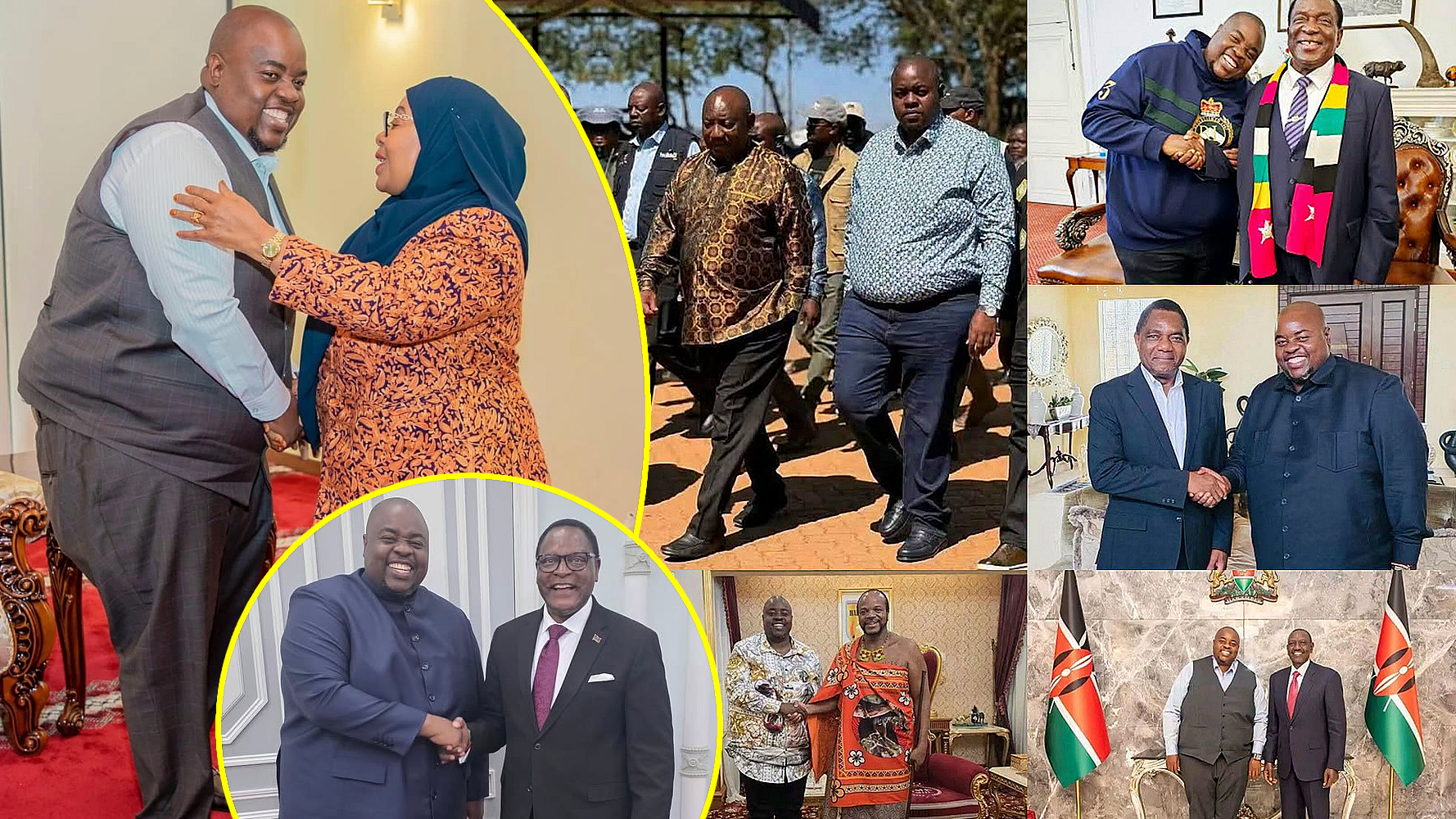
That account has gained attention because Chivayo’s public life already looked like an informal political campaign. He gave luxury vehicles to musicians, church figures and other celebrities. He handed out money, posted images of high-profile meetings and cultivated an online persona built around wealth, access and generosity. His social-media pages showed a steady stream of cars, cash, designer clothing and encounters with powerful people.
For supporters, the gifts made him a generous businessman who used his fortune to help people who had been overlooked. For critics, they were part of a carefully managed public profile that turned private wealth into public loyalty. The presidential prophecy has now given those activities a new meaning, with the preacher presenting them as steps towards power rather than simply displays of personal wealth.
Chivayo’s relationship with President Emmerson Mnangagwa was central to his public image. He was photographed with the President and other African leaders, appeared at major public events and spoke openly about his closeness to the centre of power. At one point, a remark attributed to him in Shona, “ndakachibata kuti dzvii”, was understood as a boast that he had a firm grip on the President.
That confidence had also drawn concern within the security establishment. A warning said to have been issued in 2024 has resurfaced alongside the prophecy. Intelligence figures were said to have considered Chivayo a security risk because of the way he displayed his access to the President and publicised movements around sensitive locations.
One intelligence operative with more than 20 years in state security was quoted as saying: “He thinks the rules of gravity don’t apply to him anymore.” Referring to a photograph of Chivayo with Mnangagwa, the source added: “That isn’t just flexing. That’s a breach of state security protocols.”
When it was suggested that Chivayo must have had permission to appear so frequently with the President, the officer replied: “Clearance is a leash, not a crown.”
The warning became even more disturbing after the crash. The same source was quoted as saying: “if he doesn’t quiet down, he’s in danger of elimination”. An accident was said to have been discussed as one possible way of removing him, with the concern focused on his access to the President and his habit of exposing details about that access.
On 30 September, Chivayo, his wife Lucy Muteke, her aide Sanelisiwe Magagula, pilot Captain Kelvin Tafirei Soda and co-pilot Courage Mutavirwa died when a Bell 430 helicopter crashed at Kudenga Farm in Waddilove, about 22 kilometres south-west of Marondera in Mashonaland East.
The helicopter, registered Z-PED and operated by Sky Helicopters Private Limited, had left Gandami Village in Chikomba District with a second aircraft, a Bell 407 registered Z-OSM. The two helicopters were travelling in formation towards Harare via Marondera.
The flight took place as weather conditions deteriorated across the area. A severe-weather advisory had warned of thunderstorms, lightning, strong wind gusts, low cloud and poor visibility. About 10 minutes after departure, the Bell 407 turned west to avoid a cloud bank. The Bell 430 continued north-east after its crew reported that the route ahead appeared clear.
The final radio message from the Bell 430 indicated that the aircraft had entered another layer of cloud and had not yet emerged. Witnesses at the farm later described hearing rotor blades in dense fog and drizzle. The sound continued for about 10 minutes before a loud impact. Police were alerted and arrived to find parts of the aircraft still burning.
The preliminary investigation said the helicopter struck the ground intact. Its wreckage was scattered across an area measuring about 170 metres by 75 metres, and investigators found no evidence of an in-flight breakup or a pre-impact explosion.
“There is no evidence of an in-flight breakup or pre-impact explosion.”
The report classified the occurrence as an unintended flight into instrument meteorological conditions and controlled flight into or towards terrain. It said the crash was unsurvivable because of the impact forces and the fire that followed. Further technical work, including examination of maintenance records, was still required before a final report could be issued.
The missing cockpit voice recorder has become the most troubling feature of the investigation. Within hours of the crash, officials and people close to the family said an intact black box had been recovered from the wreckage. The device was expected to help investigators establish what was said in the cockpit, what warnings were heard and what happened during the final minutes of the flight.
The later preliminary report gave a different account.
“The aircraft was fitted with a Cockpit Voice Recorder (CVR). However, the CVR was not recovered among the wreckage and is presumed to have been destroyed.”
The contradiction has left a gap in the official narrative. A cockpit voice recorder can preserve radio transmissions, crew conversations, alarms, engine sounds and other clues that may help reconstruct an accident. Without it, investigators have lost a potentially important record of the aircraft’s final moments.
Civil Aviation Authority of Zimbabwe director-general George Mashababe has rejected responsibility for the investigation and said he could not explain what happened to the recorder.
“We were not involed in the investigation. I initially got to the scene of the crash entirely by coincidence because I was driving in the Marondera area when the crash happened. I was close to the scene and I went there with other people to see what had happened. We came back the following day with others because Caaz is a statutory body responsible for regulating and overseeing the civil aviation industry in Zimbabwe. It is mainly concerned about safety, air traffic control and adherence to aviation standards. The body responsible for the investigation operates under the Ministry of Transport (Aircraft Accidents and Incidents Investigation Department),” Mashababe said.
The authority’s director-general said his organisation did not collect physical wreckage, environmental data, digital recordings or witness evidence from the site. He said those materials were gathered by the ministry’s Aircraft Accidents and Incidents Investigation Department.
Questions have also been raised about the identification of the co-pilot. Mutavirwa was identified immediately after the crash as the second pilot, and his burial took place shortly afterwards. Later official documents listed the co-pilot entry as “N/A”, without explaining why the earlier identification had changed.
The condition of the victims’ remains added to the public unease. Family representatives said Chivayo and Muteke were buried without their heads after forensic teams failed to recover the cranial remains from the wreckage. The preliminary report did not include a detailed forensic explanation for the missing remains, nor did it provide complete toxicology findings or a full account of metallurgical testing on the engine.
The crash has therefore become inseparable from Chivayo’s wider public history. His rise was connected to state-linked business deals, including the long-running Gwanda solar project awarded by the Zimbabwe Power Company. He was arrested in 2018 over the alleged misuse of an advance payment linked to the project, although the case was later struck off the court roll after delays by prosecutors.
He was also drawn into controversy over the procurement of election materials for Zimbabwe’s 2023 elections. A later inquiry into contracts involving South African printing company Ren-Form was closed after investigators said they had found no evidence linking Chivayo or the Zimbabwe Electoral Commission to wrongdoing.
Those disputes, his proximity to political power and the scale of his visible wealth made him one of Zimbabwe’s most recognisable businessmen. He was not merely rich; he made his wealth public. Cars, donations and meetings with leaders became part of a carefully repeated image, one that made the idea of a future presidential bid appear less distant to some observers than it would have seemed a few years earlier.
The administration of his estate has now added another pressure point. His sister Esther Chivayo and former wife Sonja Louise Madzikanda were appointed co-executrices on 9 November. They are responsible for identifying assets, dealing with liabilities and considering claims against the estate.
People and businesses claiming that Chivayo owed them money have been given until 13 December 2026 to submit their claims. Anyone who owes money to the estate has also been directed to settle outstanding debts by the same date, while people holding property belonging to the estate have been told to surrender it to the representatives.
The notice comes after reports that several Harare dealerships were owed millions of US dollars for luxury vehicles supplied to Chivayo. The businesses involved were said to include Faramatsi Motors, Exquisite Cars and Enterprise Car Sales, with the combined amount reported at about US$5.1 million. The figures have not been accepted by every business named. One dealership owner said the amount attributed to his company was greatly exaggerated and that anything owed had been written off.
South African dealerships were also reported to be pursuing unpaid amounts for vehicles supplied to the businessman. The estate must now establish which claims are valid, identify the assets available to meet them and determine what remains for his family and beneficiaries.
That financial reckoning is unfolding at the same time as a prophecy about power and a disputed investigation keep Chivayo’s name at the centre of public attention. Before his death, he presented himself as a man who had already reached the inner circle of Zimbabwean influence. The preacher’s account suggests that he was preparing for something even larger: the presidency itself.
The helicopter crash ended that ambition before it could be tested in public life. What remains is a trail of political connections, lavish gifts, warnings, unanswered questions about the aircraft and an estate now facing a December deadline.
The final report into the crash is expected to provide a fuller account of what happened at Kudenga Farm. Until then, the prophecy remains the last and most dramatic portrait of the future Chivayo was said to have been promised: not simply a wealthy businessman close to power, but Zimbabwe’s future president.