


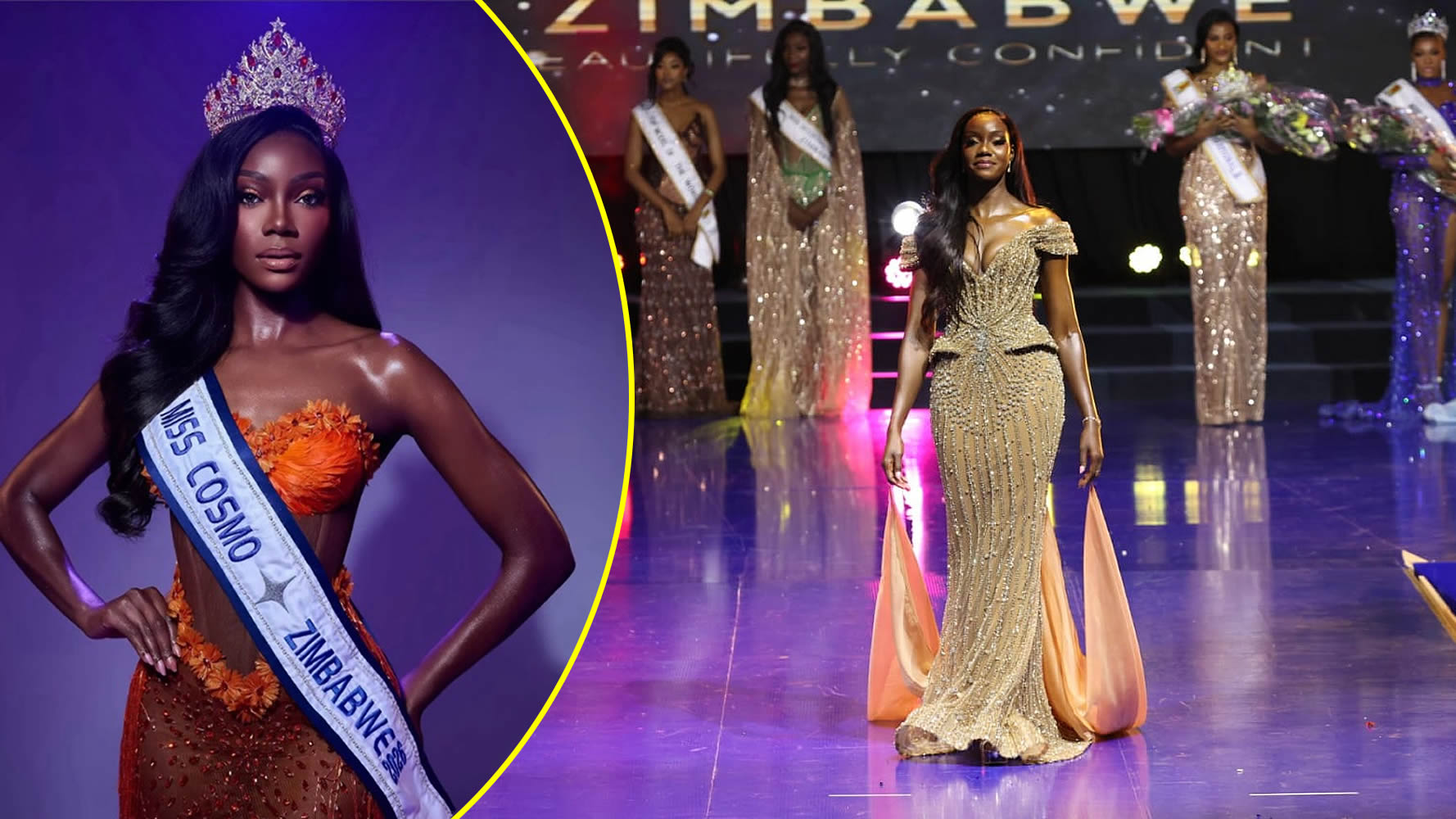
Malaika Mushandu takes Miss Cosmo Zimbabwe dethronement fight to court
Malaika Mushandu’s brief reign as Miss Cosmo Zimbabwe 2026 has moved from a pageant stage in Harare to the High Court, after the former queen filed an application seeking to overturn the decision that stripped her of the title.
Mushandu was crowned on June 6, 2026, as one of seven Zimbabwean queens selected to represent the country in major international pageants. Just 11 days later, her tenure was terminated, although the organisation only made the decision public on August 22. The announcement said she had ceased to be the recognised Miss Cosmo Zimbabwe titleholder with effect from June 23.
The organisation cited misconduct and ineligibility, saying Mushandu had failed to meet the standards, requirements and contractual obligations of both Miss Cosmo Zimbabwe and the international Miss Cosmo organisation. It did not give details of the alleged conduct or explain the specific eligibility issue that led to the decision.
That silence left supporters, pageant followers and social media users searching for answers. The controversy grew as competing accounts of what happened circulated online, with public attention focusing not only on the decision itself but also on the way the organisation handled the matter.
Mushandu initially did not respond publicly. Her first detailed account has now come through a court application filed at the High Court of Zimbabwe in Harare on August 26. She is asking the court to set aside the decision revoking her title and to order her reinstatement as Miss Cosmo Zimbabwe 2026.
At the centre of her application is the claim that she was not given a fair opportunity to answer the allegations before the title was taken away. Mushandu says she was invited to what she understood to be an ordinary meeting on July 3, only to discover that it was, in her account, a disciplinary hearing concerning her conduct after the coronation and her subsequent availability to the organisation.
She says that, after returning from a business trip to Victoria Falls, her manager told her that Tendai Bongani Hunda had raised concerns about her. A meeting was then arranged. Mushandu says neither her manager nor her legal representatives were given sufficient information about the purpose of the meeting or the allegations to be discussed.
Her lawyers wrote to the organisation and Patience Lusengo, who was coordinating the meeting, warning that any disciplinary process should provide proper notice, enough time to prepare and the opportunity to be represented. Mushandu says Lusengo assured her that the meeting was not a disciplinary hearing. She attended, believing she was taking part in an ordinary discussion.
In the court filing, Mushandu described what happened next in stark terms.
“Patience Lusengo assured me that the meeting was not intended to constitute a disciplinary hearing. Trusting in that assurance, I attended the meeting in good faith. The assurance proved illusory. What had been presented as an ordinary meeting was, in truth, a disciplinary enquiry concealed beneath the guise of a meeting. At no stage was I informed that disciplinary proceedings had commenced or that I stood accused of conduct capable of attracting so grace a consequence as the forfeiture of my title.”
The allegations she understood to have been raised were that she left the stage prematurely after her coronation and later became unavailable. Mushandu denies both the conduct and the suggestion that she was given a proper chance to challenge the case against her.
“Although the merits of the allegations are not material to the determination of this application, which principally concerns the serious procedural irregularities that characterised the purported disciplinary proceedings, it appears that the Respondents’ complaint was that I allegedly left the stage prematurely following my coronation and thereafter rendered myself unavailable.
“Those allegations are wholly denied. More importantly, I was never afforded a proper opportunity to address them on their merits. No evidence was led in support thereof, nor was I afforded a fair opportunity to challenge or cross examine any evidence or to call witnesses.”
Mushandu says she only learnt that the meeting had been treated as a disciplinary hearing when she received the written determination revoking her title. She argues that the decision was reached without the basic safeguards she had requested in advance.
“It was only upon receipt of the determination that the true nature of the meeting was revealed. I learnt, not from a hearing conducted in accordance with law, but from written determination itself, that the meeting was a disciplinary hearing and that my title as Miss Cosmo Zimbabwe 2026 had been revoked. Thus, the first notice I received that I had stood trial was the letter informing me that judgement had already been given against me. It is my respectful view that the hearing was therefore conducted in a manner fundamentally inconsistent with the audi alteram partem principle and the rules of natural justice.”
The former queen also says the loss of the crown has consequences that cannot be measured only by money. Mushandu has spent more than a decade in modelling and pageantry and has a public record that includes becoming the youngest person to win Miss Zimbabwe in 2011. She also states that she finished in the top 10 at Miss World 2011, was first runner-up at Top Model of the World 2012 and won World Supermodel International.
“I am an intentionally accomplished Zimbabwean model whose career has, for over a decade been defined by distinction, achievement and public recognition. In 2011, I made history by becoming the youngest person ever to be crowned Miss Zimbabwe. That achievement was followed by further national and international recognition, including being the 2011 Miss World (top 10), 2012 Top Model of the World (First Runner Up) and winner of World Supermodel International, amongst many other achievements.
“My crowning as Miss Cosmo Zimbabwe 2026 was therefore not merely the acquisition of a title, but the continuation of a long-standing career and reputation built upon pageantry, modelling and public representation. It is important, that the loss of the title is not reviewed only as a matter of financial prejudice. The title carries with it prestige, recognition, publicity, professional standing, branding opportunities, and the ability to represent Zimbabwe on international platforms. These intangible benefits are central to the value of the title and, by their very nature, cannot only be adequately quantified in monetary terms.”
The dispute began against the backdrop of a busy and closely watched national pageant. At the June 6 finale at the Harare Hippodrome, 34-year-old Roseanna Hall of Shurugwi won the Miss Universe Zimbabwe crown. Brunette Makanyiso was named Miss World Zimbabwe, while Mushandu received the Miss Cosmo Zimbabwe title. Virginia Nyambe, Jemima Mandemwa, Nicole Nyawera and Ruvimbo Njomboro were selected for the Miss Intercontinental, Top Model of the World, Miss Supranational and Miss International titles respectively.
The event itself was marked by confusion when judges appeared to revisit the Top 10 list during the live announcement. The production also struggled to coordinate the crowning of seven queens, with several transitions appearing disjointed. Attention later shifted to a stage appearance by former Norton legislator Temba Mliswa, who showered Hall with US$100 notes shortly after she had been crowned.
Those incidents did not directly establish why Mushandu was later removed, but they formed part of the public backdrop to a pageant whose winners were expected to carry Zimbabwe’s image to international competitions. Hall and Makanyiso were due to receive Mercedes-Benz vehicles and prize money, while the other titleholders were expected to receive Honda Fit vehicles and sponsor packages.
The latest dispute has also revived memories of earlier title controversies in Zimbabwe. In 2014, Thabiso Phiri lost her crown after nude photographs surfaced and after the pageant organisation said she had breached its rules. The following year, Emily Kachote was dethroned as Miss World Zimbabwe after acknowledging that she had previously posed nude. The Miss Zimbabwe Trust said at the time that contestants had signed rules governing conduct and eligibility, and first princess Annie Grace Mutambu replaced Kachote.
Mushandu’s case is different in the issue she has placed before the High Court. Her application is not centred on a request for the organisation to publish every detail of the accusations. Instead, she is challenging the procedure used to reach the decision and arguing that a title with professional, public and commercial value was revoked without a properly disclosed case being put to her.
After receiving the determination, Mushandu says her legal practitioners wrote to the respondents on July 28, setting out the alleged procedural failures and demanding that she be reinstated. She says the respondents did not address the substance of that correspondence or take steps to reverse the decision.
“The Respondents have neither answered the substance of that correspondence nor taken any steps to remedy the unlawful decision. Their silence has left standing, a determination reached through a process lacking in fairness and contrary to the principles of justice. It is the continuing failure to correct the decision that has compelled me to see the intervention of this Honourable Court,” said Mushandu in the court filing.
The respondents listed in the application include the Miss Cosmo Zimbabwe organisation, Hunda, Joshua Taderera, Simbarashe Chinyemba, Denny Marandure, Lusengo, Apphia Musavengana, Zodwa Mnkandla, Danya Kabwebwe, Tafadzwa Zimoyo, Kevin Zhou, Jane Mutamangira and Gracious Matara.
The organisation’s August 22 statement said the decision was necessary to protect the integrity and credibility of the Miss Cosmo Zimbabwe title. It also said Mushandu no longer had authority to represent herself as the reigning queen or to represent the organisation in that capacity. The organisation said its statement was intended to clarify her status rather than humiliate or prejudice her.
The court application now puts the events surrounding the short reign, the July meeting and the dethronement at the centre of a formal dispute. For Mushandu, the case is a fight to recover a title she says was earned on the pageant stage and removed through a process she was not allowed to properly confront. For the organisation, the decision remains a declaration that she no longer represents Miss Cosmo Zimbabwe.
The next stage will determine whether the crown remains an organisational decision or becomes the subject of a court order. Until then, the title that Mushandu held for only 11 days remains at the heart of one of Zimbabwe’s most closely followed pageant disputes in recent years.