


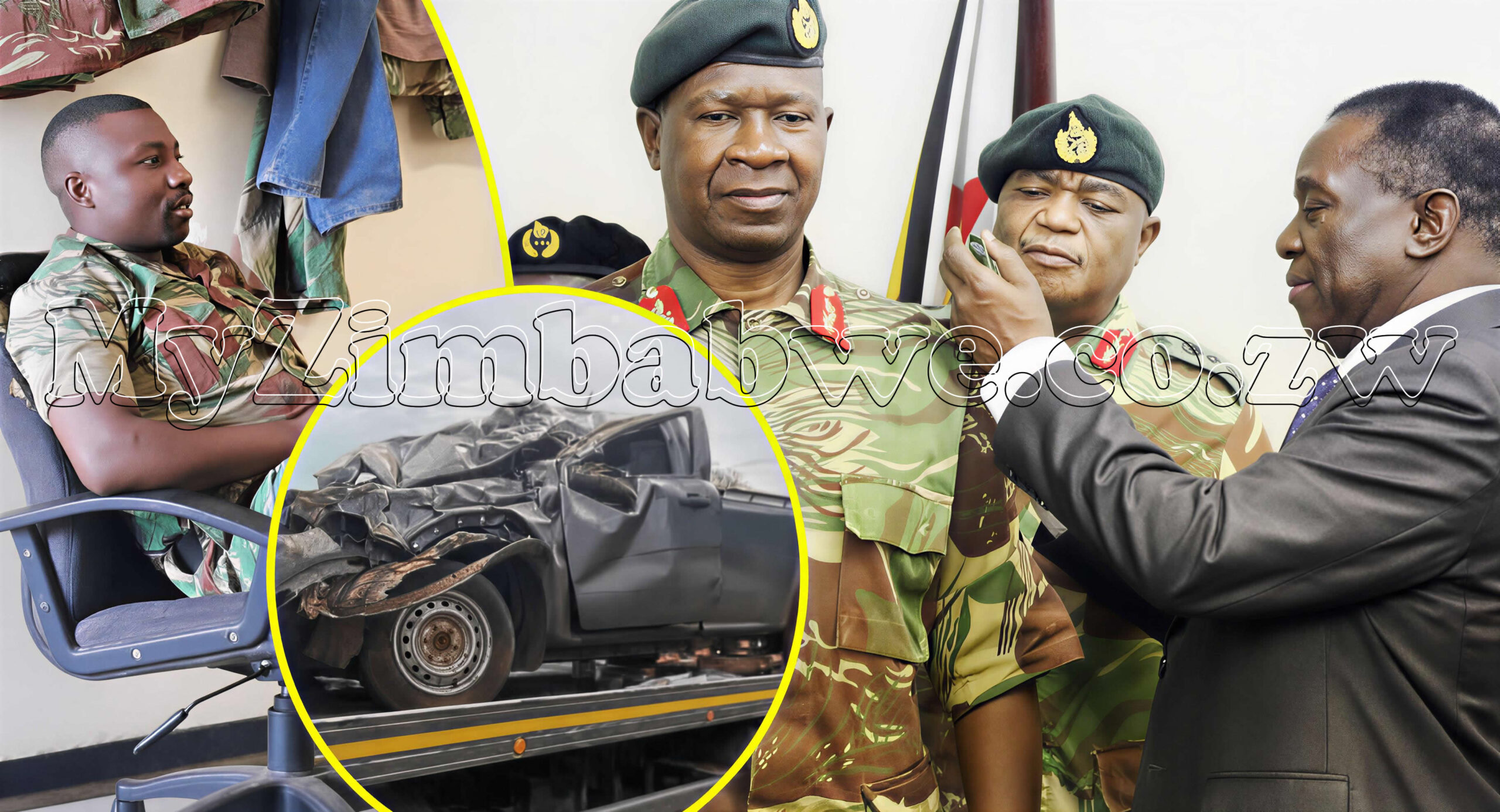
A pall of unease has descended upon Zimbabwe’s security establishment following the tragic death of Sergeant Chiutsi, the driver of Zimbabwe Defence Forces (ZDF) Commander, General Phillip Valerio Sibanda. The accident occurred along the notorious Bulawayo–Harare highway, a road known for its high-speed collisions and unpredictable hazards. While General Sibanda was not in the vehicle at the time, the incident has ignited intense speculation and anxiety within military and political circles, given the driver’s close association with one of the country’s most senior and respected military figures.
News of the tragedy first broke via ZimEye, citing multiple high-level military sources who confirmed Sergeant Chiutsi’s death from injuries sustained in the crash. Despite the absence of official communication from the ZDF hierarchy, insiders have insisted on the accuracy of the reports, though the precise circumstances surrounding the accident remain shrouded in mystery.
According to sources who spoke on condition of anonymity due to the sensitivity of the matter, the incident involved Sergeant Chiutsi’s vehicle overturning. “He overturned, he overturned,” one senior military source told ZimEye, repeating the phrase with a sense of urgency and distress before declining to elaborate further. This brief confirmation has only deepened the mystery, leaving many questions unanswered. It remains unclear whether other vehicles were involved, if weather or road conditions played a role, or if mechanical issues contributed to the fatal crash.
The death of Sergeant Chiutsi has reportedly deeply affected the military community, particularly those working closely with top command. As General Sibanda’s driver, the sergeant held a position of trust and specialised skill within the Defence Forces. Drivers assigned to high-ranking officials undergo rigorous vetting and training, blending logistical responsibilities with security-sensitive duties. Losing such a figure disrupts operations and carries emotional weight, given the personal working relationship often shared with commanders.
General Phillip Valerio Sibanda, widely respected as a disciplined and strategically astute military leader, was reportedly away on official business when the accident occurred. While unharmed himself, the incident has inevitably drawn attention to the risks faced by personnel operating in close proximity to national leaders. Political analysts suggest that the death of a senior commander’s driver often prompts thorough internal reviews to assess security implications and examine whether structural issues, such as vehicle maintenance, protocols, or travel procedures, require tightening.
This tragic event occurs amidst a backdrop of significant changes within the ZDF. Sources indicate that President Emmerson Mnangagwa is poised to retire General Sibanda and appoint a new commander within the coming weeks. General Sibanda’s current term is set to expire on November 23, 2025.
President Mnangagwa extended General Sibanda’s contract on December 24, 2024, through General Notice 15 of 2025, after General Sibanda reached the mandatory retirement age of 70 last year. The extension, granted at Mnangagwa’s discretion, was for a single year.
However, sources suggest that this extension was not initially Mnangagwa’s intention, as the military boss reportedly resisted retirement bids late last year, highlighting the significant influence the military holds in Zimbabwe’s political landscape.
The extension of Sibanda’s term of office was flagged by legal experts as a flagrant violation of the law by Mnangagwa.
In a notice published in the Government Gazette, Chief Secretary to the President and Cabinet, Martin Rushwaya, said Sibanda’s extended term was with effect from December 24, 2024, his birthday, and was set to last until November 23, 2025.
Rushwaya said Mnangagwa acted in terms of the Defence (Regular Force) (Officers) Regulations, 1988, published in Statutory Instrument 152 of 1988, in extending Sibanda’s tenure.
Prominent lawyer Advocate Thabani Mpofu described it as “flawed” and an “absurdity”.
Mpofu said by reaching the age of 70, Sibanda was automatically retired “by operation of law.”
“A term that has already expired cannot be extended. That’s why there are no oxygen canisters at the cemetery…” Mpofu said.
“General Sibanda has reached the mandatory retirement age of 70. He cannot be retired and be in active service at the same time. It is one thing to recycle dead wood, it is quite another to plant a dead log.”
Sources said Sibanda flatly rejected his retirement while citing certain parts of the Statutory Instrument which he argued gave Mnangagwa legal room to extend his term.
The source said Attorney General Virginia Mabhiza was summoned to State House where she met Rushwaya and a meeting was arranged with Mnangagwa, who was on his annual leave at the time, to discuss the matter.
Mabhiza, according to the source, gave the legal position that Sibanda’s time was up “but PV was having none of it, citing the SI.”
A compromise was then reached that his term be extended by another year.
Minister of Defence, Oppah Muchinguri-Kashiri, initially requested questions in writing but subsequently ceased responding after the questions were submitted. The Ministry’s Permanent Secretary, Aaron Nhepera, stated that the matter was “above his paygrade” and directed inquiries to Muchinguri-Kashiri and the ZDF.
ZDF Director (Public Relations), Colonel Charles Mutizhe, dismissed the story, asserting that “For now no official communication has been done regarding the matter and should the General retire, the media will be made aware through a Press statement that we would release.”
An analyst, speaking anonymously, noted that changes are occurring rapidly within the security arms, making this development unsurprising.
Sources suggest that Mnangagwa is keeping the identity of the next commander closely guarded as he consolidates his power, particularly in relation to his political rivals, including his Deputy, General Constantine Chiwenga. It is also rumoured that Sibanda may be offered a Ministerial post upon his retirement.
General Sibanda has held the position of ZDF Commander since 2017, succeeding General Chiwenga, who transitioned to the role of Vice President.
Recent changes within the security apparatus include the replacement of Commissioner General Godwin Matanga with Stephen Mutamba, and Fulton Mangwaya’s appointment as Director General of the Central Intelligence Organisation (CIO), replacing Isaac Moyo.
Just a week before Sibanda’s term was ended by 1 year, Mnangagwa retired police commissioner general Godwin Matanga and replaced him with Stephen Mutamba.
He also removed Central Intelligence Organisation director general Isaac Moyo and replaced him with former Zimbabwe National Parks and Wildlife Management Authority director general Fulton Mangwanya.
These shifts have been linked to efforts by Mnangagwa’s loyalists to extend his term beyond 2028.
In March, President Mnangagwa retired Zimbabwe National Army commander Lieutenant General Sanyatwe, appointing him as Minister of Sport, Recreation, Arts and Culture, replacing Kirsty Coventry.
Sanyatwe, previously a trusted figure under Robert Mugabe, was controversially linked to the shooting of protesters following the disputed 2018 elections. He later served as Zimbabwe’s ambassador to Tanzania before returning to command the Zimbabwe National Army.
Shortly after, Major General Emmanuel Matatu, a ZPRA veteran, was appointed as the new commander of the Zimbabwe National Army. At 72, Matatu’s appointment is not viewed as long-term, but rather as a strategic move by Mnangagwa amid concerns of a potential coup by former allies.
Mnangagwa has placed security services on high alert to prevent planned anti-government strikes, and Matatu is expected to play a crucial role should the military be deployed to quell protests.
Sanyatwe, 68, was sworn in as sports minister in front of Mnangagwa and vice presidents Kembo Mohadi and Constantino Chiwenga at State House.
The impending retirement of General Sibanda and the appointment of a new ZDF commander mark a significant moment for Zimbabwe’s military and political landscape.
Adding to the complexities surrounding General Sibanda’s position, it’s worth recalling a past incident involving the Commander’s vehicle. In 2021, Desmond Sinoia, a Harare man, was jailed for 12 months after admitting to recklessly ramming into General Sibanda’s car at the intersection of Glenara and Samora Machel in Harare.
Harare magistrate Mrs Barbra Mateko also banned Sinoia from driving for the eight months that followed.
Sinoia rammed into CDF General Sibanda’s car which was being driven by his aide on 23 August 2021.
Interestingly, the motorist jailed for a year for crashing into a vehicle carrying Zimbabwe Defence Forces commander General Phillip Valerio Sibanda was released on bail by the High Court a week later pending the outcome of his appeal.
Justice Webster Chinamhora of the Harare High Court said Sinoia Desmond’s appeal had bright prospects of success as he ordered him released on Z$50,000 bail.
Desmond pled guilty to reckless driving over the 23 August 2021 incident when he ploughed into General Sibanda’s chauffeur-driven Mercedes. Harare magistrate Barbra Mateko sent him to prison after ruling that he did not give any special circumstances that caused him to drive recklessly.
A week after being sentenced to 1 years in prison, Justice Chinamhora said Desmond’s chances on appeal against both sentence and conviction were high.
Desmond’s lawyers Lovemore Madhuku and Tawanda Takaendesa had argued that the lower court “improperly exercised its discretion in respect of sentence in that an effective sentence of 12 months imprisonment is so manifestly excessive and so disturbingly inappropriate in all the circumstances of this case as not only to induce a sense of shock but also as an instance of an exercise in irrationality.”
The argument was upheld by the upper court.
Madhuku and Takaendesa also said having decided on an effective custodial sentence of less than 24 months, the magistrate grossly misdirected herself and erred at law in imposing a custodial sentence without giving serious consideration to a non-custodial sentence such as a fine or community service.
The lawyers said the Road Traffic Act (Chapter 31:11) provides for a penalty of a fine or imprisonment for the crime of reckless driving, but Mateko improperly exercised her discretion in imposing imprisonment with giving full consideration to the option of a fine.
Desmond’s trial heard that just before 5PM on August 23 in 2021, he was driving on a side road parallel to Samora Machel Avenue going towards Msasa with one passenger.
Desmond failed to give way at the intersection of Samora Machel and Glenara Avenue and ploughed into the side of Sibanda’s Mercedes Benz driven by Mandlenkosi Mpofu.
General Sibanda was sitting at the back and on the left side which was impacted by Desmond’s vehicle. Sibanda’s aide, Squadron Leader Mark Pride Mangwende, was the other passenger in the Mercedes.
No-one was injured in the crash but prosecutor Caroline Mutimusakwa – who argued for a custodial sentence – said General Sibanda was “almost killed”, adding: “Desmond wanted to plunge the nation into mourning by killing the commander of the Zimbabwe Defence Forces.
“He was negligent for failing to observe a regulatory provision, failing to give way at a Give Way sign, travelling at a speed which was excessive under the circumstances and failing to stop or act reasonably when accident or collision seemed imminent.”
Furthermore, there has been speculation that Sibanda could be elevated to the vice presidency, but without a vacancy Mnangagwa would need to remove either Chiwenga or his other deputy, Kembo Mohadi, to accommodate him.
Precedent would suggest that Zimbabwe National Army commander Lieutenant General Emmanuel Matatu – appointed only in March – would succeed him. But at 72, well past retirement age, Matatu could also be heading for the exit.
That scenario would clear the path for Major General Walter Tapfumaneyi, appointed chief of staff in May after leaving his post as deputy director general of the Central Intelligence Organisation.
The changing of command at the apex of Zimbabwe’s military is never a routine administrative matter. Since independence in 1980, the armed forces have been deeply intertwined with the politics of the ruling Zanu PF, functioning not just as a security institution but as one of the central levers of political power.
Senior commanders have openly declared they would not salute anyone without liberation-war credentials, a position that has shaped national politics for more than two decades.
The military has also played an outsized role in elections, frequently accused by opposition parties and civil society of voter intimidation, mobilising ruling party structures and directing state institutions behind the scenes.
In 2008, the military intervened after the late opposition leader Morgan Tsvangirai defeated Mugabe in the first round of presidential voting, triggering a violent runoff that forced Tsvangirai to withdraw. The 2017 coup that removed Mugabe cemented the military’s status as kingmaker, with generals proclaiming their takeover a defence of the revolution and the ruling party.
Since then, Mnangagwa’s authority has rested partly on maintaining the loyalty and balance of competing military factions. Control of the command structure is central to managing Zanu PF’s succession battles.
Some analysts say Mnangagwa has sought to sideline generals perceived as loyal to Chiwenga, who opposes a plan by the president’s loyalists to force through constitutional amendments and extend his term beyond 2028.
The choice of Sibanda’s successor – and the political alliances they bring – will have ramifications not only for the military’s internal balance but for Zimbabwe’s wider political direction as Zanu PF edges towards its elective congress in 2027 and general elections in 2028.