


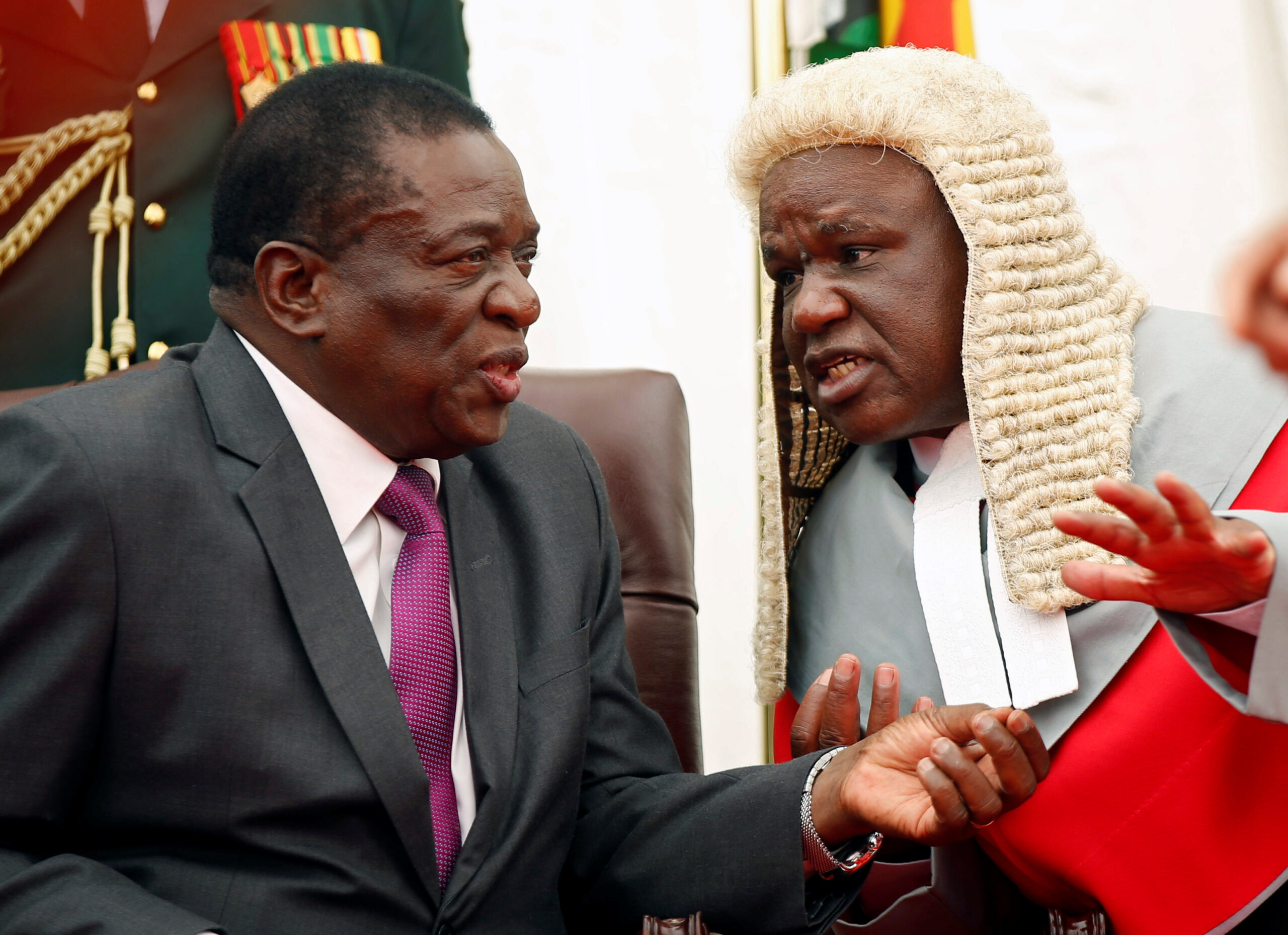
Harare – Chief Justice Luke Malaba, a legal practitioner whose tenure has been marked by profound legal and political controversy, is once again nearing the mandatory retirement age for judges. As May approaches, the legal profession in Zimbabwe watches with bated breath for signals of his impending departure, a moment laden with significance given the nation’s turbulent judicial history and the ruling Zanu PF party’s recent constitutional manoeuvres.
Malaba is set to turn 75 on May 15, marking his second encounter with the judicial retirement age. His first brush with retirement came in May 2021, when he reached the then-mandatory age of 70. However, a contentious amendment to the constitution by the ruling Zanu PF party saw the retirement age for Constitutional and Supreme Court judges extended to 75, effectively allowing him to remain in office. This move ignited a fierce legal battle that exposed deep divisions within the judiciary and raised serious questions about judicial independence.
The Battle for Tenure: A Constitutional Amendment and High Court Reversal
The saga of Chief Justice Malaba’s tenure extension began with the passing of Constitutional Amendment (No. 2) Act in 2021. This amendment, among other things, granted the President the power to extend the term of office for judges of the Constitutional and Supreme Courts beyond 70 years, up to 75 years, subject to a medical fitness certificate. Critics argued that this amendment was specifically tailored to benefit Chief Justice Malaba, allowing him to continue in his influential role.
Immediately, this move was challenged in court. On May 15, 2021, a three-judge bench of the High Court in Harare delivered a landmark ruling that sent ripples through the country’s legal and political landscape. The High Court declared that Chief Justice Malaba had ceased to be a judge at midnight on May 15, 2021, having reached the age of 70. The court explicitly stated that the constitutional amendment could not retrospectively apply to judges who were already in office and had reached the age of 70, thereby making President Emmerson Mnangagwa’s five-year extension of Malaba’s tenure illegal.
This High Court judgment was a significant blow to the government and was widely celebrated by legal activists and opposition figures who viewed it as a victory for constitutionalism. However, the jubilation was short-lived. The government swiftly appealed the High Court’s decision to the Supreme Court. In a dramatic turn of events, the Supreme Court overturned the High Court’s ruling, effectively reinstating Chief Justice Malaba. The Supreme Court’s decision was then confirmed by the Constitutional Court in September 2021, which affirmed the extension of Chief Justice Luke Malaba’s tenure of office beyond 70 years for five more years. This reversal was met with dismay by those who had hoped the High Court’s decision would uphold the principle of judicial independence against executive overreach. The episode left many questioning the judiciary’s impartiality and its susceptibility to political influence.
The 2018 Election Challenge: A Defining Moment
Prior to the tenure extension controversy, Chief Justice Malaba had already presided over one of the most politically charged cases in Zimbabwe’s recent history: the 2018 presidential election challenge. Following the harmonised elections on July 30, 2018, opposition MDC-Alliance leader Nelson Chamisa challenged the results, alleging widespread rigging in favour of the incumbent, President Emmerson Mnangagwa. The case was heard by the Constitutional Court, with Chief Justice Malaba leading the bench of nine judges.
Chamisa’s petition presented a litany of allegations, including vote-buying, the existence of ghost polling stations, the disenfranchisement of 40,000 teachers, skewed media coverage by public broadcasters, and the inflation of vote figures. He argued that these irregularities fundamentally undermined the credibility and fairness of the election.
On August 24, 2018, Chief Justice Malaba delivered the Constitutional Court’s unanimous judgment, dismissing Chamisa’s application and upholding President Mnangagwa’s victory. In his detailed 137-page judgment, Malaba asserted that the onus was on Chamisa to provide clear, sufficient, direct, and credible evidence to prove the alleged irregularities, an onus which, in the court’s view, he failed to meet.
Chief Justice Malaba stated:
“In the final analysis, the Court found that the applicant failed to place before it clear, sufficient, direct and credible evidence to prove the irregularities he levelled against the Commission. He also failed to prove the allegation of electoral malpractices he levelled against the first respondent. The applicant did not prove the alleged irregularities as a matter of fact. It would be unnecessary in the circumstances to ask and answer the question whether the alleged irregularities affected the result of the Presidential election.”
He further emphasised the court’s role, stating:
“It is not for a court to decide elections; it is the people who do so. It is the duty of the courts to strive in the public interest to sustain that which the people have expressed as their will.”
Malaba highlighted Chamisa’s failure to produce primary evidence, such as the contents of ballot boxes, and noted that the opposition leader’s claims about V11 forms (results forms) being signed but not populated were proven false by the Zimbabwe Electoral Commission (ZEC). The court concluded that there appeared to have been a “deliberate fabrication of evidence with an intention to mislead the court”. This judgment solidified Mnangagwa’s presidency but left a significant portion of the electorate feeling disenfranchised and deepened the political polarisation in the country.
Legacy and Future Implications
Chief Justice Malaba’s involvement in both the 2018 election challenge and the controversial extension of his own tenure has inextricably linked his legacy to the ruling Zanu PF party. Lawyers within the legal fraternity have expressed concerns that such actions could permanently stain the career of a jurist once widely regarded as accomplished and principled.
As his second retirement approaches, the political stakes remain high. The ruling Zanu PF party is reportedly pushing for yet another constitutional amendment, this time to extend President Mnangagwa’s second and final term from 2028 to 2030. Any such amendment is almost certain to face legal challenges, and the matter would ultimately land before the Constitutional Court, potentially placing Malaba in a decisive position over its legality, should he still be in office. This scenario fuels fears among some lawyers that Zanu PF might again manipulate constitutional provisions, perhaps by removing the age cap for judges altogether, thereby allowing Malaba to remain indefinitely.
Traditionally, a retiring Chief Justice uses the official opening of the legal year to signal their departure and bid farewell to the profession. Malaba notably did not do so in 2023, a move interpreted by many as reflecting prior knowledge of efforts to extend his tenure. Furthermore, senior lawyers observe that it is customary for a Chief Justice not to assign themselves new matters in their final year, a practice that will be closely watched as Malaba’s second retirement date draws near.
Amidst this uncertainty, there are indications that Chief Justice Malaba is quietly preparing for his exit. ZimLive understands that he has approached the Judicial Service Commission (JSC) seeking working space in Bulawayo, which insiders have tellingly referred to as “the office of the retired Chief Justice.” He has also reportedly undertaken renovations at his home in Kumalo suburb, actions that some interpret as an acceptance that his tenure is indeed coming to an end. The JSC, however, has declined to comment on the Chief Justice’s retirement plans.
Conclusion
Chief Justice Luke Malaba’s impending second retirement marks a pivotal moment for Zimbabwe’s judiciary. His tenure has been characterised by landmark rulings and constitutional battles that have profoundly shaped the country’s legal and political landscape. While his supporters commend his firm leadership, critics argue that his actions have undermined judicial independence and the rule of law. As the legal profession and the nation at large await his final exit signals, the focus remains on the future of Zimbabwe’s judiciary and its ability to uphold justice impartially, free from political influence. The legacy of Chief Justice Malaba will undoubtedly be debated for years to come, serving as a critical chapter in Zimbabwe’s ongoing constitutional journey.