


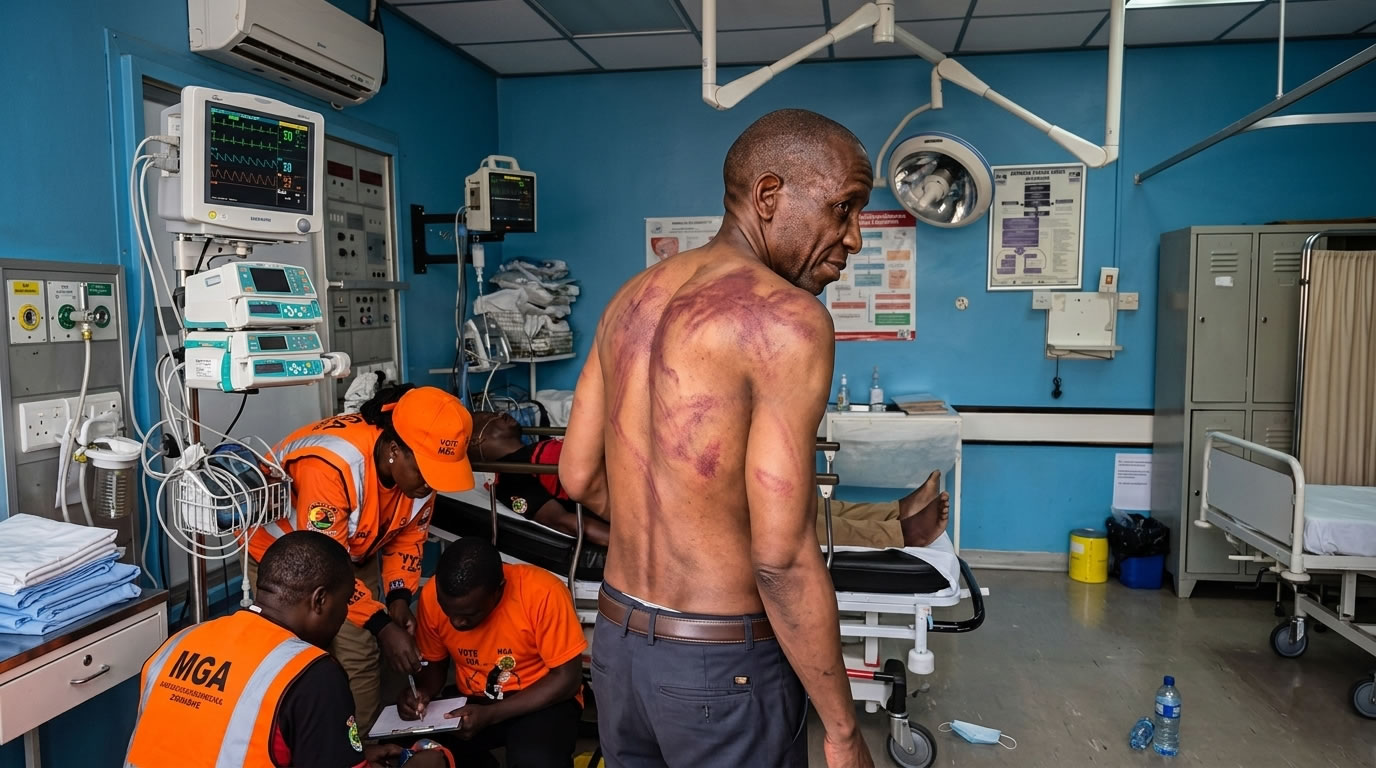
HARARE – On the first day of March 2026, a chilling incident unfolded in the heart of Zimbabwe’s capital, Harare, leaving citizens questioning the very foundations of justice and order. Professor Lovemore Madhuku, a prominent lawyer and the steadfast leader of the National Constitutional Assembly (NCA), was subjected to a brutal assault at his offices. Yet, the most disturbing aspect of this violent episode was not merely the ferocity of the attack, but the inexplicable inaction of uniformed police officers who reportedly witnessed the entire ordeal without lifting a finger.
Eyewitnesses recounted a scene of organised thuggery: a group of approximately five men, their faces obscured by balaclavas – a sinister hallmark often associated with the country’s feared “Third Force” – stormed the NCA premises. This investigative report delves into the identities of these masked assailants and scrutinises the apparent impunity with which they operate. We will analyse the precise timing of this attack, which conspicuously aligns with Professor Madhuku’s vocal and unyielding opposition to the controversial “ED2030” term extension plot. Is this a grim resurgence of state-sponsored terror, a calculated manoeuvre designed to silence dissent ahead of pivotal political machinations? Our investigation suggests a coordinated effort to suppress constitutional experts who dare to challenge the legality of proposed amendments, with the “balaclava men” reportedly arriving in vehicles that bore a striking resemblance to those utilised by elite security units.
The Attack Unfolds: A Witness to Inaction
The events of Sunday, 1 March 2026, at the NCA offices on 348 Herbert Chitepo Avenue, Harare, paint a stark picture of targeted violence. Professor Madhuku had convened a consultative meeting of the NCA leadership from across the country. The agenda was clear: to deliberate on Constitutional Amendment No. 3 and to reaffirm the party’s resolute opposition to it. “We wanted to look at the Constitutional Amendment No. 3 and we wanted to confirm our stance that we are opposed to it and we will do everything to stop it,” Madhuku later recounted, his voice strained but defiant.
According to Madhuku, police presence was noted for a significant portion of the meeting. However, when the balaclava-clad men made their move, the situation took a sinister turn. “The five or so guys came in with balaclavas and ordered everyone to leave. Then they came straight for me and started beating me up,” he stated. The assailants, wielding baton sticks, delivered blows across his body, all while shouting, “You want to create problems for us.” The brutality was undeniable, leaving Madhuku with visible injuries. Yet, what followed was perhaps even more alarming: “The police were with them. There were two police vehicles there. The police did nothing. They just stayed seated there.” This direct quote from Professor Madhuku underscores the central mystery of the incident: the inexplicable passivity of law enforcement in the face of blatant violence.
Following the assault, Professor Madhuku received treatment at an undisclosed hospital in Harare. Despite his injuries, he maintained a defiant posture, telling journalists, “I just have pain all over, but I’m okay.” The Zimbabwe Republic Police (ZRP), through national police spokesman Commissioner Paul Nyathi, subsequently issued a statement denying any involvement in the incident. Commissioner Nyathi asserted, “No police personnel were deployed to oversee or monitor the meeting in question. The ZRP is keen to know what actually transpired on the alleged attack on Professor Madhuku and his team.” This denial, however, stands in stark contrast to Madhuku’s eyewitness account and raises serious questions about accountability and transparency within the police force.
The Shadowy Operatives: Unmasking the ‘Third Force’
The appearance of men in balaclavas immediately invoked fears of Zimbabwe’s notorious “Third Force.” This term has historically been used to describe shadowy, often state-aligned, groups that operate outside official legal frameworks, employing violence and intimidation to achieve political objectives. The use of balaclavas serves a dual purpose: to conceal identity and to instil terror, creating an atmosphere of fear and uncertainty. The fact that these assailants reportedly arrived in vehicles resembling those used by elite security units further fuels suspicions of state complicity or, at the very least, state sanction.
Such tactics are not new to Zimbabwe’s political landscape. Throughout its history, particularly during periods of heightened political tension, allegations of a “Third Force” being deployed to suppress opposition and silence critics have been recurrent. The current incident, therefore, is not an isolated act of random violence but appears to be part of a broader, more systematic campaign of intimidation. The chilling message is clear: challenge the ruling establishment, and face severe consequences, often delivered by anonymous agents operating with apparent impunity.
A Disturbing Pattern: The Crackdown on Dissent
The assault on Professor Madhuku is not an isolated event but rather the latest in an escalating series of violent acts targeting those who dare to oppose Constitutional Amendment No. 3. This legislation, if passed, would significantly extend President Emmerson Mnangagwa’s rule beyond its scheduled end in 2028, pushing it through to 2030. Critics argue that the ruling Zanu PF party is employing these tactics of intimidation to force through changes that would undermine democratic limits on presidential power.
Just days before Madhuku’s attack, on 26 February 2026, two other NCA members, Naboth Sirora and Innocent Taruona, experienced a similarly harrowing ordeal. After attending a meeting at the NCA offices concerning the same constitutional amendments, they were seized, blindfolded, and taken to an undisclosed location. There, they were subjected to a brutal beating before being unceremoniously dumped, stripped of their clothes, in the affluent suburb of Highlands. This act of stripping, a clear tactic of psychological warfare, was designed to humiliate and instil profound fear, sending an unequivocal message to anyone contemplating opposition to the government’s agenda.
Another victim of this disturbing pattern is Baird Gore, an activist with the Constitution Defenders Forum (CDF), a civic group vehemently opposed to the proposed constitutional amendment. On the night of 17 February 2026, Gore was abducted from his home in Glen Norah by armed men in an unmarked vehicle – a black Ford Raptor, a model frequently associated with clandestine security operations in Harare. Eyewitnesses and a detailed statement from the CDF revealed the brutality of the abduction. “When the armed men first arrived at his residence, Baird was not at home as he had gone to the shops. They violently assaulted his brother while demanding to know his whereabouts,” the CDF statement read. Upon his return, Gore walked directly into the ambush, was seized, blindfolded, and bundled into the waiting vehicle.
The torture inflicted upon Gore was both physical and psychologically scarring. The CDF alleged that Gore sustained a suspected broken hand and other severe injuries, including to his back, from being beaten with switches and batons. Most disturbingly, Gore claimed that his captors deliberately ran over his legs with their vehicle – a tactic designed to inflict lasting physical and psychological trauma. After hours of abuse, Gore was dumped at the City Sports Centre, just outside Harare’s central business district. His ordeal, however, did not end there. After seeking medical attention, he was forcibly removed from his hospital bed by uniformed and plain-clothes officers from Machipisa Police Station, who then took him into custody. The CDF condemned this “coordinated pattern of abduction, torture and re-arrest,” asserting that their organisation was under siege.
The ED2030 Plot: A Threat to Democracy
The political backdrop to these escalating acts of violence is the highly contentious “ED2030” term extension plot. This initiative seeks to amend the constitution to allow President Emmerson Mnangagwa to remain in power beyond his current term, which is set to expire in 2028. The proposed Constitutional Amendment No. 3 includes sweeping changes, such as repealing the section that provides for the direct election of the president by voters. Instead, it proposes a system where the president would be elected by Members of Parliament sitting jointly. Furthermore, it aims to extend both presidential and parliamentary terms from five to seven years. These proposed changes are viewed by many as a direct assault on democratic principles and a blatant attempt to consolidate power.
Professor Madhuku has been at the forefront of the legal challenge against this amendment. He has filed a Constitutional Court application on behalf of six war veterans, seeking to halt the amendment process. This legal battle, alongside the public protests and advocacy by groups like the NCA and CDF, represents a significant challenge to the government’s agenda. The targeting of these individuals and organisations suggests a desperate attempt by certain elements within the state to quash any form of opposition to their constitutional reform agenda.
Police Response and the Erosion of Trust
The police’s denial of involvement in Professor Madhuku’s assault, despite his clear eyewitness account, severely erodes public trust in law enforcement. The presence of police vehicles at the scene, coupled with their alleged inaction, raises serious questions about their impartiality and adherence to their constitutional mandate to protect all citizens. This incident, along with the forced removal and re-arrest of Baird Gore from a hospital, paints a troubling picture of a police force that may be complicit in, or at least unwilling to challenge, acts of political violence.
Rights activists have warned that this violence will only intensify as opposition parties and pro-democracy groups continue to resist the proposed amendments. The incident serves as a stark reminder of the fragility of civil liberties in Zimbabwe and the lengths to which certain elements will go to maintain control. It leaves citizens to ponder the true architects of these brutal acts and the profound implications for Zimbabwe’s democratic future. The message to those contemplating dissent is chillingly clear, and the silence of the police in the face of such brutality speaks volumes about the state of human rights and the rule of law in the nation.
Professor Madhuku, undeterred by the assault, had vowed before the attack to mobilise Zimbabweans into “massive protests.” He declared, “You should expect to see me again in the streets. I’m able to do that and I will lead members of my party and I will join others who will be doing that.” His resolve, and that of other activists, highlights the ongoing struggle for democratic accountability in Zimbabwe, even in the face of severe personal risk.