


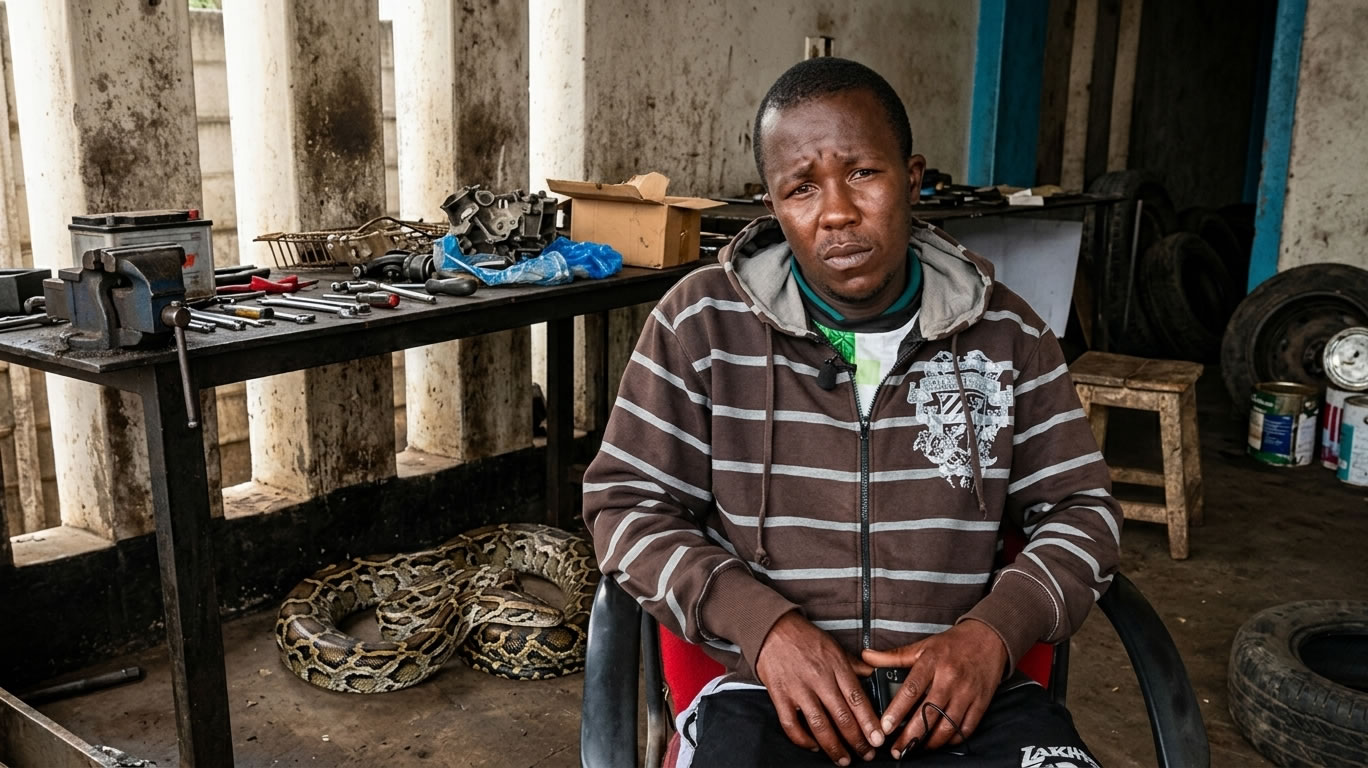
Mutare – A chilling and deeply disturbing account has emerged from the quiet village of Chipakanwa, under Headman Chipakanwa in Chief Marange’s area, Bocha, Mutare. Archford Chikwariro, a 29-year-old man, claims to be trapped in a horrifying cycle of forced intimacy with a python snake, an ordeal that began with terror but has, by his own admission, evolved into a strange form of enjoyment. His story, a complex tapestry of spiritual belief, alleged witchcraft, and profound personal suffering, casts a stark light on the unexplained phenomena that continue to baffle communities across Zimbabwe.
Chikwariro’s nightmare reportedly began while he was working in South Africa, living with a cousin. The catalyst, he recalls, was a bewildering encounter with a relative from home. “This problem started when I was in South Africa, where I was working and staying with my cousin. On the day it started, I saw a close relative, who was here at home, and I was shocked as to when and how he had arrived in South Africa. I did not greet this man even though I tried to welcome him. He just left the place where I had seen him and left, and I started encountering this snake that very day,” Chikwariro recounted, his voice laden with a mixture of fear and resignation. From that day forward, his life was irrevocably altered.
He describes the snake as an entity that appears to him while he is fully awake, often accompanied by seizures. The encounters are graphic and relentless. “The snake comes when I am awake, opens its mouth, and grabs my genitals. I then start to feel pleasure, and it sucks me until I ejaculate,” he stated, detailing the disturbing nature of the attacks. The python, he claims, exerts a terrifying control over him. “Sometimes, if I try to resist what it wants me to do, it ties my legs together like a python, throws me to the ground, faces me towards my genitals, and grabs them. When I ejaculate, it swallows the semen,” Chikwariro revealed, painting a picture of utter helplessness.
Attempts to evade the creature have proven futile. He once tried sleeping on his stomach to protect himself, but the snake, he says, adapted its approach. “I have returned home, and this problem has worsened to the point that I no longer have rest, day or night; it just comes whenever it wants and is intimate with me. The area where I relieve myself is always sore because it does not give me rest,” he lamented. The duration of these encounters is equally harrowing, sometimes lasting for hours on end. “If it starts in the morning, it can stay with me until evening, and if it starts at night, it enjoys me all night long. I have no peace,” he added.
The toll on Chikwariro’s life has been immense. Unmarried, he was forced to abandon his work in South Africa and return to Mutare, seeking solace and assistance from his family. However, his pleas for help fell on deaf ears. His mother, he noted, “eventually died and left things as they were,” and his father, he claims, “ran away from home for a reason he claims he does not know.” This left Chikwariro isolated, living alone in a dilapidated homestead, his seven siblings having long since departed – the girls married, and his brother having moved out. “Some uncles, his father’s brothers and sisters, say go and get help from your biological father. His aunts, his father’s sisters, are also not doing anything,” he explained, highlighting the profound abandonment he has faced.
His education also suffered, with Chikwariro dropping out of Form 4, the highest level he attained. The constant torment has left him physically and emotionally drained. “My body is wasting away because of being intimate with this snake,” he confessed. He also spoke of other strange occurrences at his home, “At our home, there are mysterious things that happen; invisible people walk around at night.” The snake itself, he says, has grown to an alarming size. “Regarding this snake issue, it has grown so large that it is like a log, and when it constricts me, as it is being intimate with me, I run out of breath; I cannot even cry out; my voice is gone,” he described, emphasising the physical danger he endures.
Perhaps the most unsettling aspect of Chikwariro’s testimony is his admission of a perverse shift in his feelings. “He says he now enjoys being intimate with the snake more than with women,” the original report noted, a statement that underscores the psychological manipulation and trauma he has undergone. Desperate for a solution, Chikwariro eventually fled his home, seeking refuge and a platform to share his story. “I came from Mutare on a bus that carried me for free, wanting to tell my story to the media,” he explained. Even in Harare, the torment continued. “Right now, while I was waiting for you (the news crew), this snake came and was intimate with me. One man whose phone I asked to use to call you ran away when I told him that the snake had come, but he did not see it,” he revealed, highlighting the invisible nature of his tormentor.
Indeed, Chikwariro asserts that the snake is visible only to him. “He says that the snake is only visible to him; even when it is being intimate with him, other people who are present do not see it; they just see his body twitching.” This invisibility further isolates him, making his claims difficult for others to comprehend or believe. He has sought various explanations for his plight. “Where I walk alone, I am told it is because of evil spirits from our village, and elsewhere I am told it is a vengeful spirit that was unleashed in our village. Elsewhere, I am told that this problem is being caused by witches. What is difficult is that I see this snake when it is already in my legs, and when it is done with me, it just disappears, so I am suffering; I am also looking for someone to help me,” Chikwariro pleaded, his desperation palpable.
In the absence of concrete scientific explanations, traditional beliefs often fill the void. Mr. Jimson Nyasala, 45, from Harare, offered a chilling interpretation of Chikwariro’s predicament. He suggested that Chikwariro might be an unwitting pawn in a ritualistic scheme.
“The swallowing of his semen by this snake is for the purpose of making money for some of his relatives. He needs help urgently,” echoed a prominent Harare Sangoma, Sekuru Kanengo in a statement that points towards the dark practice of semen harvesting for wealth rituals, a belief that is quite common in certain parts of Zimbabwe.
Chikwariro’s harrowing experience, while unique in its specifics, resonates with other inexplicable occurrences reported across Zimbabwe, where the line between the natural and the supernatural often blurs. A recent case from Glen View 3, Harare, highlights the pervasive fear and confusion surrounding such phenomena. The Goredema family, residing at number 4791, 69 Crescent, found themselves terrorised by a persistent infestation of large, brownish snakes, locally known as “madzvoti.” These creatures, some exceeding two metres in length, appeared daily under their beds, forcing the family of seven to abandon their two-roomed wooden house and sleep outdoors.
Blessing Goredema, the 18-year-old eldest son, vividly described their ordeal. “Since last week, we haven’t had peace at home because of these madzvoti snakes. They’re brown and can be two metres or more long. We find them under the beds, making us too afraid to stay inside, so we’re sleeping outside. Even at night, we’re too scared to sleep in the house.” What made these snakes particularly terrifying was their unusual resilience. “These snakes don’t die, even when we hit them with metal or wood. We carry them outside after smashing their heads, only to find them still alive and changing colour as we burn them,” Blessing revealed, a detail that defies conventional understanding of snake behaviour.
Adding to the mystery, the Goredema family’s home was surrounded by a brick wall and situated in an area devoid of nearby forests or bushes, making the origin of the snakes inexplicable to them and their neighbours. Lydia Mutemachani, Blessing’s aunt, voiced the family’s deep concern: “This snake problem is so serious that we don’t know if it’s witchcraft or just a strange occurrence. It’s terrifying for my sister, brother-in-law, and family to continue living here.” The parents, Protersia and Maxwell Nhutu, expressed their desperation, seeking help from prophets and traditional healers, suspecting witchcraft.
Traditional healers like Martha Tapfuma, known as Mbuya Shumba, a respected sangoma in Harare, often attribute such occurrences to deeper, unresolved issues. “This situation requires the family to be open and honest, as there’s more to this than meets the eye. There might be some unresolved issues between the parents, the use of charms, witchcraft, or family conflicts. The constant appearance of snakes suggests deeper underlying issues,” Mbuya Shumba posited, reflecting a common interpretation within traditional belief systems.
However, official explanations often diverge. Tinashe Farawo, spokesperson for the Zimbabwe Parks and Wildlife Management Authority (ZimParks), offered a more scientific perspective on the general increase in snake sightings. He attributed it to a recent heatwave, which drives snakes out of their burrows and into homes. While this explains increased snake activity, it struggles to account for the supernatural resilience and specific, targeted nature of the attacks reported by both Chikwariro and the Goredema family.
The cases of Archford Chikwariro and the Goredema family underscore a profound societal challenge in Zimbabwe, where traditional beliefs in witchcraft and spiritual manipulation often intersect with, and sometimes overshadow, scientific understanding. For individuals like Chikwariro, caught in a terrifying and isolating ordeal, the lack of conventional explanation or effective intervention leaves them vulnerable and desperate. The stories serve as a poignant reminder of the enduring power of the unexplained and the urgent need for compassion and support for those who find themselves at its mercy. Whether rooted in psychological distress, elaborate hoaxes, or genuine supernatural phenomena, these accounts demand careful consideration and a nuanced approach to understanding the complex realities faced by many within the community.
His desperate plea for help, “I am also looking for someone to help me,” echoes the silent cries of many who grapple with similar inexplicable torments. The lack of support from his own family and the community further highlights the stigma and fear associated with such claims, leaving victims in a harrowing state of isolation. The prevalence of such narratives in local media suggests a deep-seated cultural context where these occurrences are not easily dismissed, but rather become subjects of intense speculation and fear. The contrasting explanations from traditional healers and wildlife authorities further illustrate the dual lens through which such events are often viewed, leaving those affected in a bewildering limbo between the tangible and the intangible.
The sheer terror and desperation expressed by both Chikwariro and the Goredema family paint a vivid picture of lives consumed by fear and the relentless pursuit of answers and relief. The incidents serve as a stark reminder of the challenges faced by communities grappling with phenomena that defy easy categorisation, demanding a broader understanding that encompasses both scientific inquiry and cultural perspectives. Ultimately, the human cost of such experiences is immeasurable, leaving individuals and families shattered and searching for an end to their torment.