


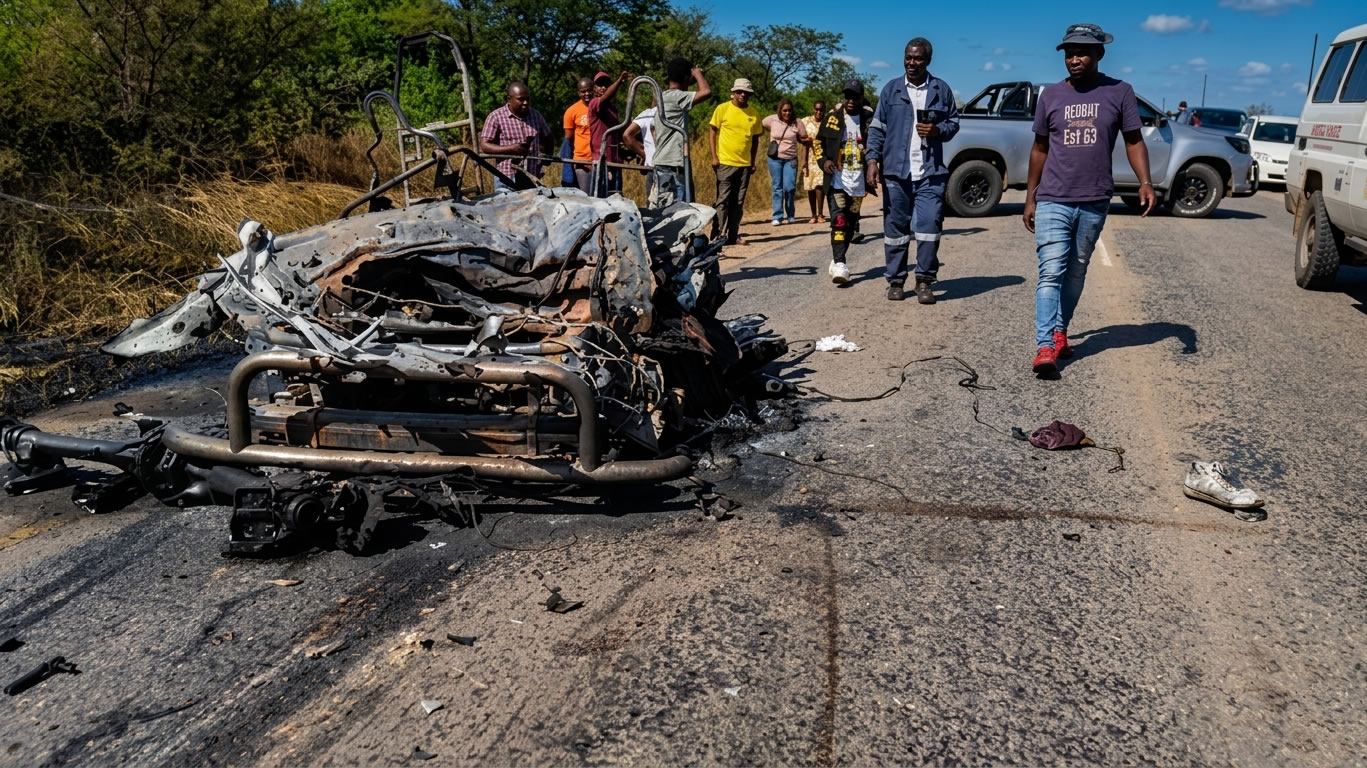
BULAWAYO – A horrific incident unfolded on Thursday afternoon, 16 April 2026, along the busy Bulawayo-Beitbridge Road, claiming the lives of approximately 18 individuals. A commuter omnibus, commonly known as a kombi, burst into flames and exploded between Chipangali Wildlife Orphanage and the Gwanda tollgate, leaving a scene of utter devastation. The Zimbabwe Republic Police (ZRP) has confirmed the tragic loss of life, with investigations now underway to ascertain the precise cause of this catastrophic event.
National Police Spokesperson Commissioner Paul Nyathi issued a statement regarding the incident, confirming the grim details. “The ZRP reports the death of plus or minus 18 people when a kombi exploded into fire between Chipangali and Gwanda tollgate along the Bulawayo-Beitbridge Road between 1300 hours and 1400 hours today. More details will be released in due course,” Commissioner Nyathi stated. The exact number of passengers on board at the time of the explosion remains unclear, adding to the somber uncertainty surrounding the tragedy.
The Bulawayo-Beitbridge Road, a vital artery connecting Zimbabwe to South Africa, is unfortunately no stranger to fatal accidents. This highway has earned a grim reputation as a ‘black spot’ due to the frequent and often severe road traffic incidents that occur along its stretch. The latest disaster underscores the persistent dangers faced by commuters and highlights the urgent need for enhanced road safety measures and stricter enforcement of traffic regulations.
While the official cause of the explosion is yet to be determined, preliminary reports and past incidents suggest several potential factors. One recurring concern in such kombi infernos is the illegal transportation of flammable substances, such as petrol or liquefied petroleum gas (LPG) cylinders. These substances, often carried to circumvent fuel shortages or for illicit resale, turn commuter vehicles into potential death traps. The sheer intensity of the fire, which reportedly reduced the kombi to a burnt-out shell, points towards a highly combustible source.
This incident tragically echoes a similar catastrophe that occurred on 16 November 2018, along the same highway near West Nicholson, where a gas cylinder explosion on a bus resulted in the deaths of 42 passengers. That devastating event served as a stark reminder of the perils associated with carrying such volatile materials in public transport vehicles. Furthermore, in November 2019, eight people were burnt to death in a kombi inferno after it side-swiped a lorry while allegedly carrying flammable substances, illustrating a disturbing pattern of similar accidents.
The broader context of road safety in Zimbabwe paints a worrying picture. The nation continues to grapple with a high incidence of road traffic accidents, many of which are attributed to reckless driving, speeding, overloading, and mechanical faults. Statistics from 2025 reveal a staggering 2,423 deaths and 11,564 injuries from road traffic accidents across the country. These figures highlight a systemic problem that goes beyond individual incidents, pointing to issues within the public transport sector and overall road infrastructure.
The recent Easter holiday period in 2026 further underscored the severity of the situation, with 30 road fatalities recorded nationwide. This increase in deaths occurred despite a slight decrease in the total number of accidents compared to 2025, indicating that the accidents that do occur are often more severe and deadly. Just days before the kombi explosion, on 3 April 2026, seven people were killed and four injured at the 51km peg along the Bulawayo-Beitbridge Road when a truck tragically ran over individuals who were at the scene of an earlier accident. This particular incident highlights the secondary dangers that can arise at accident sites, further complicating the already perilous road conditions.
Commuter omnibuses, or kombis, are a primary mode of public transport in Zimbabwe, ferrying thousands of people daily. However, their operation is frequently marred by concerns over safety standards. Drivers are often accused of speeding and reckless behaviour, sometimes driven by the pressure to meet daily targets or avoid law enforcement. The condition of these vehicles is also a point of contention, with many kombis reportedly operating with inadequate maintenance, increasing the risk of mechanical failures that can lead to tragic outcomes.
The Bulawayo-Beitbridge Road itself presents numerous challenges. While it is a crucial economic corridor, sections of the highway are known for poor road surfaces, inadequate signage, and a lack of proper lighting, especially at night. These environmental factors, combined with human error and potentially illicit practices like carrying dangerous goods, create a deadly cocktail for travellers.
As the nation mourns the loss of 18 lives, questions are being raised once again about the efficacy of current road safety regulations and their enforcement. There is a pressing need for a comprehensive review of public transport safety, including stringent inspections of vehicles, stricter penalties for traffic violations, and robust campaigns to educate both drivers and passengers about the dangers of carrying flammable materials. The authorities’ promise of releasing more details in due course is awaited with bated breath, as families seek answers and the nation grapples with yet another preventable tragedy on its roads.