


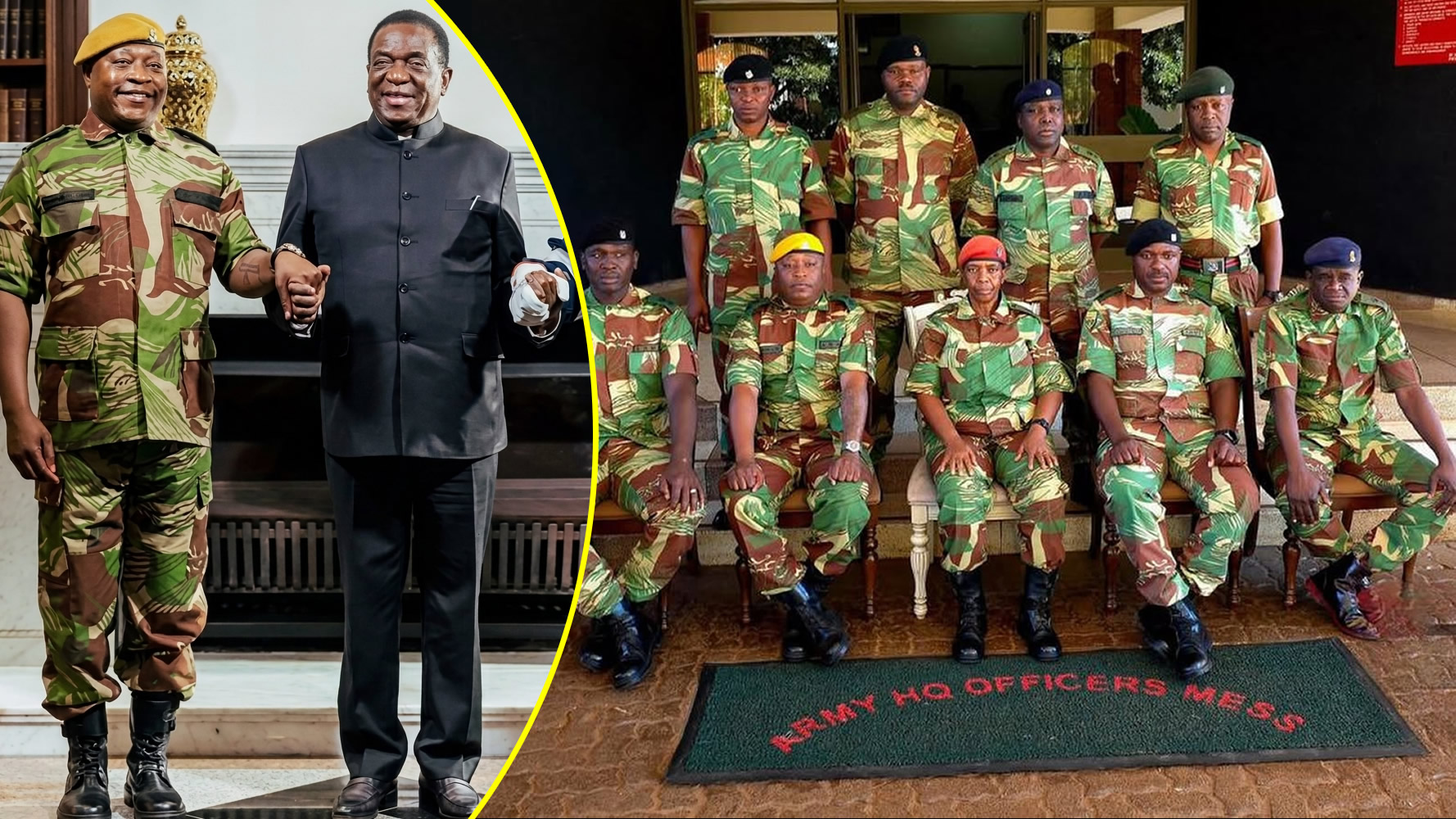
HARARE – In a move that has intensified the internal friction within Zimbabwe’s high command, President Emmerson Mnangagwa has officially promoted his son, Sean Mnangagwa, to the rank of Lieutenant-Colonel. The promotion, confirmed on 29 April 2026, places the 39-year-old officer in the sixth-highest tier of the Zimbabwe National Army (ZNA), a position that carries significant weight within the nation’s delicate security cluster.
While the government maintains that the elevation is based on merit, seasoned observers and military insiders view the development through the lens of “coup-proofing”. This promotion comes at a time when the President is aggressively pushing for a constitutional amendment to extend his rule to 2030, a move that has reportedly deepened a rift between the executive and a faction of the military elite still loyal to Vice President Constantino Chiwenga.
In the high-stakes game of Zimbabwean political chess, the elevation of the President’s son is seen as a strategic counter-move to secure the “last line of defence”—the Presidential Guard (PG). The timing of the promotion is particularly noteworthy. It follows the recent demotion of Vice President Chiwenga’s wife, Miniyothabo Baloyi-Chiwenga, from her own high-ranking position within the military structures. Baloyi-Chiwenga was last month reportedly removed from her position in the Zimbabwe National Army’s Military Intelligence Department and reassigned to the commander’s pool – a unity where officers are placed without specific duties. The decision comes after concerns raised by Professor Jonathan Moyo about the leaks in the intelligence system and criticism from Themba Mliswa who has been accusing Chiwenga’s wife of running a faction within the Army.
The Strategic Power of a Lieutenant-Colonel
To the uninitiated, the rank of Lieutenant-Colonel might seem like just another rung on the military ladder, but in the context of power dynamics and tactical execution, it is arguably one of the most pivotal positions in any army. In the Zimbabwe National Army, a Lieutenant-Colonel typically commands a battalion, a unit consisting of anywhere between 300 and 1,000 soldiers.
The significance of this command cannot be overstated. While Generals sit in high-level meetings and formulate broad strategies, it is the Lieutenant-Colonel who has the direct, personal connection with the men on the ground. They are the highest-ranking officers who still live and breathe the same air as the frontline troops. In military history, the Lieutenant-Colonel is often referred to as the “sweet spot” of power. They are senior enough to understand the political and strategic landscape, yet junior enough to be the ones the soldiers actually follow when an order is given to “move the tanks” or “secure the state broadcaster”.
By promoting Sean to this rank, President Mnangagwa has effectively handed his son the keys to a significant portion of the military’s operational power. Within the Presidential Guard, a Lieutenant-Colonel is a formidable figure. They do not just oversee administration; they control the tactical deployment of elite troops whose primary mission is the protection—or the removal—of the head of state. Having a son in this role provides the President with a direct, blood-related bypass of the traditional chain of command, ensuring that at least one battalion of the most elite soldiers in the country is under the direct control of his own family.
A Divided Front: The Chiwenga vs. Mnangagwa Factions
Rumours from within the barracks suggest that the Zimbabwe National Army is currently more divided than at any point since the 2017 military intervention that removed the late Robert Mugabe. Unlike the unified front presented by General Chiwenga seven years ago, today’s military hierarchy appears split between two competing centres of power.
Reports indicate that while a majority of the traditional military elite remains aligned with General Chiwenga’s faction, a considerable number of younger army bosses and strategic unit commanders have gravitated towards President Mnangagwa and his son, Sean. This internal fragmentation has created a climate of suspicion, with both sides closely monitoring the other’s movements.
“The latest development confirms that nine officers have been promoted from Major to Lieutenant-Colonel. Among them is Sean Mnangagwa,” noted a source close to the developments. This expansion of the Lieutenant-Colonel rank allows the President to embed loyalists across various departments, diluting the influence of those seen as “Chiwenga men”.
Political analyst Tendai Ruben Mbofana suggests that this strategy may be flawed. “This comes against a widespread belief that Vice President Constantino Chiwenga continues to enjoy deep military roots and is opposed to Mnangagwa’s desire to extend his stay in office to 2030,” Mbofana stated. “However, it would be naïve to imagine that placing a perceived ally at the top of the army is genuine coup-proofing.”
The Return of the ‘CIO Man’: General Tapfumaneyi
Central to this reshuffling is the figure of Lieutenant-General Asher Walter Tapfumaneyi. A former Deputy Director-General in the Central Intelligence Organisation (CIO) and the mastermind behind the Forever Associates Zimbabwe (FAZ) group, Tapfumaneyi was recently brought back to the army and appointed as Commander of the ZNA in November 2025.
Tapfumaneyi’s return is viewed as a masterstroke in Mnangagwa’s coup-proofing playbook. As the head of FAZ, he is credited with securing the President’s 2023 election victory through a sophisticated and often controversial parallel structure. His elevation to the top of the army hierarchy signals a shift where intelligence networks are being embedded directly into military command.
However, Tapfumaneyi’s appointment has not been universally welcomed within the barracks. There are strong indications that once an army boss leaves the department to join the CIO, his return to the military is met with coldness. Many regular officers view such individuals as “sell-outs” or, more specifically, as CIO informants rather than traditional soldiers. This sentiment is deeply rooted in the army’s preference for its own intelligence unit, the Military Intelligence Department (MID), which they respect and trust far more than the civilian-led CIO.
“He is a long-serving intelligence operative… Few individuals in government understand the intersection of intelligence, politics and military strategy as intimately as he does,” says Gabriel Manyati, a political analyst. Manyati believes the move “suggests an army being brought into closer alignment with the executive, with intelligence networks embedded at the heart of military command.”
MID vs. CIO: A Decades-Old Rivalry
The friction surrounding Tapfumaneyi and Sean Mnangagwa is rooted in a rivalry that has defined the Zimbabwean security sector for decades. The army has historically viewed the CIO with a degree of suspicion, seeing it as a political tool of the presidency rather than a professional intelligence agency.
This divide was most apparent during the final years of the Mugabe era. When Mugabe was eventually removed from power, the CIO was largely aligned with the G40 faction supported by the former President and his wife, Grace. In contrast, the MID was the backbone of the Lacoste faction, to which both Mnangagwa and Chiwenga then belonged.
The events of November 2017 serve as a stark reminder of this rivalry. When the coup was launched, one of the first actions taken by the army was to neutralise the police and the CIO. This was a tactical necessity designed to avoid a possible gunfire exchange between the different branches of the security cluster. The military knew that the CIO remained loyal to Mugabe’s inner circle and had to be sidelined before the transition could proceed.
Today, the roles appear to have shifted. With Mnangagwa now in the top seat, he is using the CIO—and individuals like Tapfumaneyi who bridge the gap—to keep a watchful eye on the MID and the regular army. This reversal of roles has only served to heighten the sense of betrayal among the military rank and file, who see the “intelligence-heavy” approach as an affront to traditional military values.
Sean Mnangagwa: The Rise of the ‘President’s Shield’
Lieutenant-Colonel Sean Mnangagwa is not merely a beneficiary of nepotism; he is a well-trained soldier whose career has been meticulously managed to prepare him for this role. His military training has been extensive, involving programmes in Zimbabwe, China, Russia, and Mozambique.
In 2009, Sean participated in a rigorous military training programme at a base in Mozambique, followed by further specialised training in China. His placement within the Presidential Guard—a special unit tasked with the personal protection of the President—is no coincidence. By rising to the rank of Lieutenant-Colonel, Sean now holds significant command authority over the very troops who would be the first to respond to any threat against the executive.
The role of a Lieutenant-Colonel in the Presidential Guard is particularly sensitive. They are responsible for the immediate tactical security of the President, overseeing the personnel who control access to the President’s person and his official residences. In the event of an attempted coup or civil unrest, the orders given by a Lieutenant-Colonel in the PG are the ones that determine whether the gates are held or opened.
“Major Sean Mnangagwa is a commissioned officer who has gone through the ranks and got promoted from rank to rank on merit,” supporters of the President argue. Yet, in the current political climate, “merit” is often indistinguishable from “loyalty”. His promotion ensures that the “shield” around the President is led by someone with the ultimate vested interest in the regime’s survival.
The 2030 Agenda and the Shadow of Impeachment
The urgency of these military reshuffles is driven by the President’s controversial “2030 Agenda”. In February 2026, the Cabinet approved draft legislation to change the constitution, extending presidential terms from five to seven years. This would allow Mnangagwa to remain in power until at least 2030, effectively bypassing the two-term limit.
This move has met with fierce resistance, not just from the political opposition, but from within the ZANU-PF structure itself. Six liberation war veterans have already taken the “2030 Agenda” to court, a move widely interpreted as a proxy battle launched by the Chiwenga faction. The two factions are set for a major legal face-off on 20 May 2026.
The President’s strategy appears to be one of total consolidation. By firing the previous army chief in March 2025 and replacing him with loyalists, and now promoting his own son to a key operational rank, Mnangagwa is attempting to insulate himself from the kind of internal revolt that claimed Mugabe.
Mbofana warns that this approach may be short-sighted. “Mugabe’s downfall in 2017 showed exactly that. He [Mugabe] believed that Mnangagwa and several senior military commanders were his loyal allies even when Jonathan Moyo had warned him that the same people were plotting against him. Mugabe dismissed it – yet it was precisely those long-trusted allies who removed him.”
A Precarious Chessboard
As the 2030 court case looms and the divisions within the army become more pronounced, the promotion of Sean Mnangagwa stands as a symbol of the President’s deepening distrust of the traditional military hierarchy.
The strategy of “coup-proofing” by promoting family members and intelligence operatives into military roles is a high-risk gamble. It may provide a temporary sense of security, but it also risks alienating the professional soldier who values the MID’s autonomy and resents the encroachment of the CIO.
“In short, reshuffling the army does not guarantee loyalty,” Mbofana concludes. “It only rearranges the starting positions on a very unpredictable chessboard.”
For the people of Zimbabwe, these “treacherous shenanigans” at the top of the security cluster are a reminder of the fragility of the nation’s political stability. As the President’s son dons his new Lieutenant-Colonel insignia, the question remains: is he a shield for the President, or a target for those who feel the military’s traditional honour has been compromised?
The ghost of 2017 still haunts the corridors of power in Harare. Then, as now, the military held the ultimate key to the country’s future. But with the army now divided and the President’s own family taking up the sword, the next chapter of Zimbabwe’s history promises to be even more volatile than the last.
Table: Key Figures in the Zimbabwe Security Reshuffle (2024-2026)
|
Name
|
Current Rank/Position
|
Faction Alignment
|
Background/Role
|
|
Emmerson Mnangagwa
|
President & Commander-in-Chief
|
Mnangagwa/Lacoste
|
Seeking to extend term to 2030 through constitutional changes.
|
|
Constantino Chiwenga
|
Vice President
|
Chiwenga/Military Elite
|
Former ZDF chief; retains deep roots in the regular army.
|
|
Sean Mnangagwa
|
Lieutenant-Colonel (ZNA)
|
Mnangagwa (Son)
|
Promoted April 2026; stationed in the Presidential Guard.
|
|
Asher Walter Tapfumaneyi
|
Commander of the ZNA
|
Mnangagwa/CIO
|
Former CIO Deputy Director; head of the FAZ group.
|
|
Emmanuel Matatu
|
Commander of the ZDF
|
Mnangagwa (Bridge)
|
Appointed Nov 2025; seen as a transitional figure due to age.
|
|
Philip Valerio Sibanda
|
Retired General
|
Potential VP Role
|
Succeeded by Matatu; rumoured to be moving into the political executive.
|
Historical Comparison: 2017 vs. 2026
|
Feature
|
2017 Coup Context
|
2026 Current Context
|
|
Military Unity
|
Highly unified under General Chiwenga.
|
Deeply divided between Chiwenga and Mnangagwa factions.
|
|
Primary Rivalry
|
Lacoste (Mnangagwa) vs. G40 (Grace Mugabe).
|
Mnangagwa Faction vs. Chiwenga Faction.
|
|
Intelligence Role
|
CIO supported G40; MID supported Lacoste.
|
CIO being integrated into ZNA command by Mnangagwa.
|
|
Coup-Proofing
|
Mugabe relied on CIO and Police.
|
Mnangagwa relies on Presidential Guard and CIO.
|
|
Outcome/Goal
|
Removal of Mugabe to save Lacoste faction.
|
Consolidation of power to enable 2030 term extension.
|
The Role and Power of a Lieutenant-Colonel (Lt-Col)
|
Aspect
|
Description
|
Why it Matters for Mnangagwa
|
|
Command Scope
|
Battalion Commander (300-1,000 soldiers).
|
Direct control over a significant force of elite troops.
|
|
Troop Connection
|
Highest rank with daily frontline troop contact.
|
Soldiers follow the Lt-Col’s direct orders in real-time.
|
|
Tactical Execution
|
Responsible for “moving the tanks” or “securing buildings”.
|
Critical for immediate response to threats or seizing control.
|
|
Gatekeeping
|
Often serves as a senior staff officer or executive assistant.
|
Controls information flow and access to higher-ranking Generals.
|
|
Operational Autonomy
|
Can make independent tactical decisions in the field.
|
Allows for rapid action without waiting for a complex chain of command.
|
“Mugabe was openly told by senior CIOs that the military is not going to easily accept the appointment of Grace. He was warned to be ready for civil war.” — Intelligence Report, 23 October 2017.
The warnings of the past seem to be echoing in the present. As Sean Mnangagwa takes his new seat at the table of the military elite, the lines between family, intelligence, and the military have never been more blurred. In the streets of Harare, the tanks are currently silent, but in the boardrooms and barracks, the battle for the soul of the Zimbabwe National Army has only just begun.