


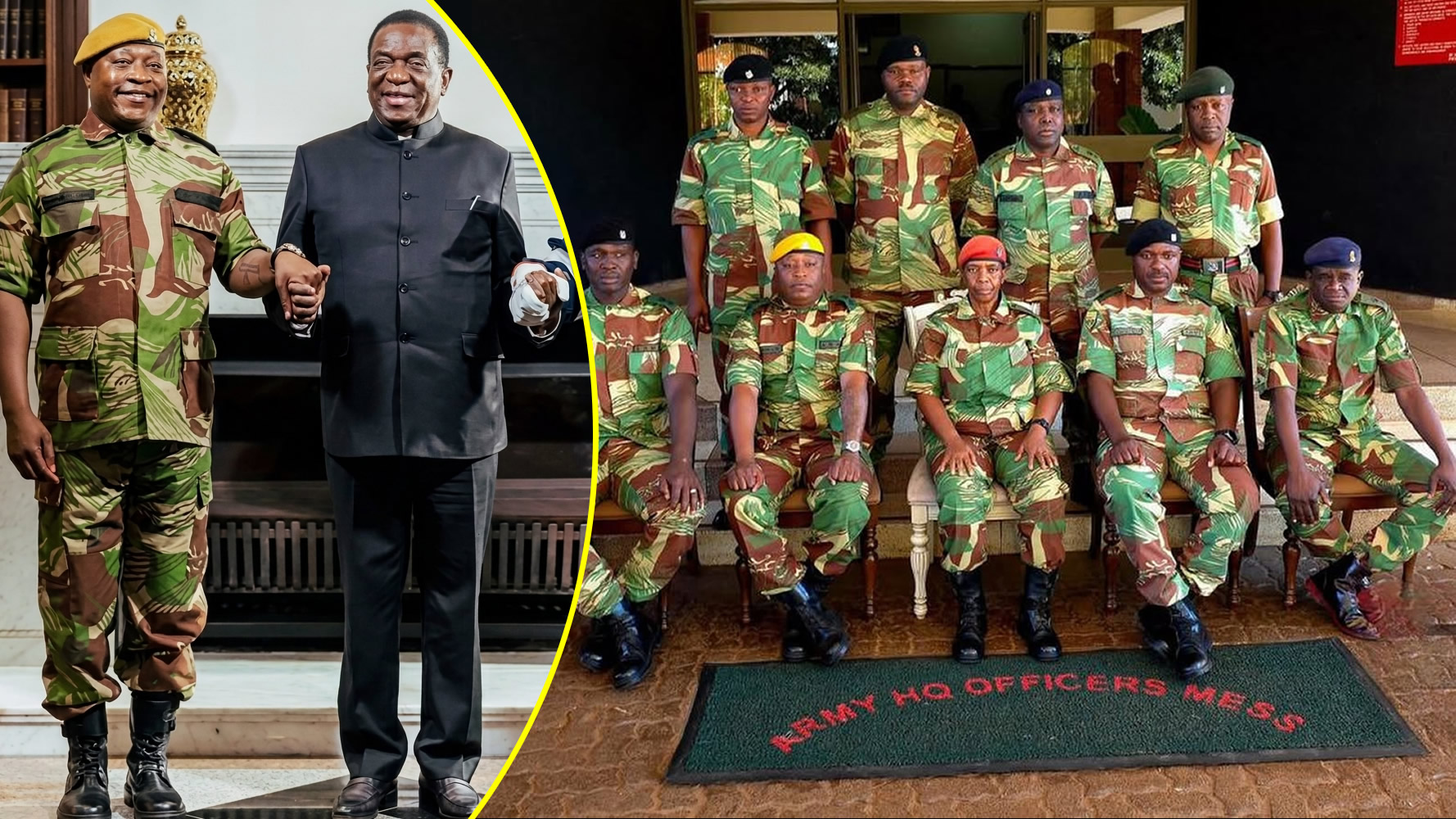
THE FAMILY BATTALION: Mnangagwa’s Son Promoted in Strategic Military Reshuffle as Constitutional Storm Gathers
HARARE – In the early hours of Wednesday, inside the high-walled confines of a Zimbabwe National Army (ZNA) investiture ceremony, a single promotion has ignited a firestorm that threatens to engulf the nation’s legal and political landscape. President Emmerson Mnangagwa has officially elevated his twin son, Sean Mnangagwa, to the rank of Lieutenant-Colonel, a move that veteran constitutional lawyers have branded as “unconstitutional, null and void.”
The promotion, which places the 39-year-old officer in the sixth-highest tier of the military hierarchy, is not merely a family milestone. It is being viewed by seasoned observers as a decisive “coup-proofing” manoeuvre in a high-stakes game of political chess. The elevation comes at a critical juncture for Zimbabwe, as the President aggressively pushes for a constitutional amendment to extend his rule to 2030, a plan that has reportedly deepened a rift between the executive and a faction of the military elite loyal to Vice President Constantino Chiwenga.
A Constitutional Nullity
The legal challenge to this promotion has been swift and uncompromising. Professor Lovemore Madhuku, a renowned constitutional law expert and veteran lawyer, has stated that the President’s direct involvement in his son’s elevation is a flagrant violation of constitutional principles.
“President Mnangagwa is not legally powered to do what he has done. The promotion is null and void. He must leave that to his VPs,” Professor Madhuku told reporters. He argued that the President was under a legal obligation to recuse himself due to a blatant conflict of interest.
“You’re conflicted, so you would have to leave that sort of decision to a Vice President; that is why a vice president exists. If there is conflict of interest, the law requires that decision be taken by someone else who would ordinarily perform the functions of that office in the absence of the President,” Madhuku explained.
According to the legal expert, a president facing such a conflict is effectively in the same position as one who is absent or incapacitated. “You cannot hide behind the public office to say, ‘Well, I am the president, so I have to decide this matter.’ That is not how it operates,” he added. “When a biological child or a spouse is involved, the office holder cannot make decisions of that nature, such as promotions. That responsibility must be handled by a Vice President or another designated authority.”
The Strategic Power of the Lieutenant-Colonel
To those outside the military, the rank of Lieutenant-Colonel might seem like just another rung on the ladder. However, in the context of power dynamics and tactical execution, it is arguably the most pivotal position in the army. A Lieutenant-Colonel typically commands a battalion, a unit consisting of between 300 and 1,000 soldiers.
While Generals sit in high-level meetings formulating broad strategies, it is the Lieutenant-Colonel who maintains the direct, personal connection with the men on the ground. In military history, this rank is often referred to as the “sweet spot” of power. They are senior enough to understand the political landscape, yet junior enough to be the ones the soldiers actually follow when an order is given to “move the tanks” or “secure the state broadcaster.”
By promoting Sean to this rank, President Mnangagwa has effectively handed his son the keys to a significant portion of the military’s operational power. Currently serving in the Presidential Guard and part of his father’s close security team, Sean is now a formidable figure. He does not just oversee administration; he controls the tactical deployment of elite troops whose primary mission is the protection—or the removal—of the head of state.
Coup-Proofing and the Chiwenga Rift
The timing of this promotion is particularly noteworthy, following the recent demotion of Vice President Chiwenga’s wife, Miniyothabo Baloyi-Chiwenga. Last month, Colonel Baloyi-Chiwenga was reportedly removed from her influential position in the Zimbabwe National Army’s Military Intelligence Department (MID) and reassigned to the “commander’s pool”—a unit where officers are placed without specific duties.
This sequence of events—the sidelining of a Chiwenga ally followed by the elevation of the President’s son—suggests a systematic effort to neutralise internal threats. Rumours from within the barracks suggest that the ZNA is currently more divided than at any point since the 2017 military intervention that removed Robert Mugabe.
Reports indicate that while a majority of the traditional military elite remains aligned with General Chiwenga, a considerable number of younger army bosses and strategic unit commanders have gravitated towards the President. This internal fragmentation has created a climate of suspicion, with both sides closely monitoring the other’s movements.
Political analyst Tendai Ruben Mbofana suggests that this strategy of embedding loyalists may be flawed. “This comes against a widespread belief that Vice President Constantino Chiwenga continues to enjoy deep military roots and is opposed to Mnangagwa’s desire to extend his stay in office to 2030,” Mbofana stated. “However, it would be naïve to imagine that placing a perceived ally at the top of the army is genuine coup-proofing.”
The Return of the Intelligence Mastermind
Central to this reshuffling is the figure of Lieutenant-General Asher Walter Tapfumaneyi. A former Deputy Director-General in the Central Intelligence Organisation (CIO) and the mastermind behind the Forever Associates Zimbabwe (FAZ) group, Tapfumaneyi was recently brought back to the army and appointed as Commander of the ZNA in November 2025.
Tapfumaneyi’s return is viewed as a masterstroke in Mnangagwa’s playbook. As the head of FAZ, he is credited with securing the President’s 2023 election victory through a sophisticated and often controversial parallel structure. His elevation to the top of the army hierarchy signals a shift where intelligence networks are being embedded directly into military command.
However, Tapfumaneyi’s appointment has not been universally welcomed. Many regular officers view individuals who move between the CIO and the military with coldness, often seeing them as informants rather than traditional soldiers. This sentiment is deeply rooted in the army’s preference for its own intelligence unit, the MID, which they respect and trust far more than the civilian-led CIO.
“He is a long-serving intelligence operative… Few individuals in government understand the intersection of intelligence, politics and military strategy as intimately as he does,” says Gabriel Manyati, a political analyst. Manyati believes the move “suggests an army being brought into closer alignment with the executive, with intelligence networks embedded at the heart of military command.”
The 2030 Agenda: A Nation at a Crossroads
The promotion of Sean Mnangagwa is inseparable from the broader political battle over the proposed Constitutional Amendment Bill. On 10 February 2026, the Zimbabwean cabinet approved draft legislation that would allow President Mnangagwa, now 83, to extend his stay in office until 2030.
Under the current 2013 Constitution, the President is meant to step down in 2028 after serving two five-year terms. The proposed changes aim to extend presidential terms from five years to seven, or simply remove the term limits entirely for the current incumbent. This move has sparked widespread condemnation from opposition groups and civil society.
In early March 2026, Professor Madhuku himself was reportedly assaulted in an attack he blames on police-backed security agents who stormed a meeting discussing the constitutional challenge. Despite such intimidation, the legal battle continues. The Constitutional Court is expected to hear a challenge against the term-limit extension, a case that will test the nation’s separation of powers.
A History of Rivalry
The friction surrounding the current reshuffle is rooted in a rivalry that has defined the Zimbabwean security sector for decades. The army has historically viewed the CIO with suspicion, seeing it as a political tool of the presidency rather than a professional intelligence agency.
This divide was most apparent during the final years of the Mugabe era. When Mugabe was eventually removed from power, the CIO was largely aligned with the G40 faction supported by Grace Mugabe. In contrast, the MID was the backbone of the Lacoste faction, to which both Mnangagwa and Chiwenga then belonged.
The events of November 2017 serve as a stark reminder of this rivalry. When the coup was launched, one of the first actions taken by the military was the disarming and neutralisation of the CIO. Today, the roles appear to have shifted. With the appointment of Tapfumaneyi and the promotion of his son, President Mnangagwa seems to be building a new security architecture—one that bypasses the traditional MID structures and relies on a hybrid of intelligence loyalists and family members.
The ‘Last Line of Defence’
Within the Presidential Guard, a Lieutenant-Colonel is more than just an administrator. They are the guardians of the presidency. Having a son in this role provides the President with a direct, blood-related bypass of the traditional chain of command. It ensures that at least one battalion of the most elite soldiers in the country is under the direct control of his own family.
Critics argue that this nepotism undermines the professionalism of the Zimbabwe National Army. However, for a President who survived a bomb blast in Bulawayo in 2018 and has faced numerous internal challenges to his authority, the promotion of Sean Mnangagwa is likely seen as a necessary insurance policy.
As the legal challenge moves through the courts and the political temperature in Harare continues to rise, the promotion of the “Family Battalion” remains at the centre of the storm. Whether the Constitutional Court will have the courage to declare the promotion “null and void,” as Professor Madhuku suggests, remains to be seen. What is clear, however, is that the lines between family, military, and state have never been more blurred in Zimbabwe’s history.
The nation now watches as the President’s son takes his place among the high command, while the very constitution that governs his appointment is under siege from the man who swore to protect it.
Timeline of Recent Events:
- November 2025: Lieutenant-General Asher Walter Tapfumaneyi appointed as Commander of the ZNA.
- 10 February 2026: Cabinet approves draft legislation to extend presidential rule to 2030.
- March 2026: Colonel Miniyothabo Baloyi-Chiwenga demoted to the “commander’s pool.”
- March 2026: Professor Lovemore Madhuku assaulted during a constitutional discussion.
- 29 April 2026: Sean Mnangagwa officially promoted to Lieutenant-Colonel.
The Shadow of 2017: A Legacy of Intervention
To understand the current tremors within the Zimbabwe National Army, one must look back to the watershed moment of November 2017. The military intervention, famously dubbed “Operation Restore Legacy,” was a rare moment of unity between the military’s top brass and the civilian leadership of the Lacoste faction. At that time, General Constantino Chiwenga led a unified front that successfully navigated the delicate task of removing Robert Mugabe without triggering a full-scale civil war.
However, the transition from military commanders to civilian politicians has been fraught with tension. The “marriage of convenience” between Mnangagwa and Chiwenga, which seemed so solid in the aftermath of the coup, has gradually eroded. Insiders suggest that the current promotion of Sean Mnangagwa is a direct response to the perceived “over-reach” of the military wing that still looks to Chiwenga as its true patron.
The Presidential Guard, where Sean is now a senior officer, has always been the most sensitive unit in the Zimbabwean military. Unlike the regular infantry or the specialised units like the Parachute Regiment, the PG’s primary mandate is the personal safety of the President. During the 2017 coup, the PG was the first unit to be “secured” by the interventionists to ensure Mugabe could not call upon his personal protectors. By placing his son in a position of command within this very unit, Mnangagwa is ensuring that such a scenario cannot be repeated.
The Rise of the ‘Young Turks’
Beyond the immediate family ties, Sean Mnangagwa’s promotion is symptomatic of a broader shift in the ZNA’s demographic and loyalty structures. There is a growing group of “Young Turks”—officers in their late 30s and early 40s—who did not fight in the liberation war but have risen quickly through the ranks under Mnangagwa’s presidency.
These younger officers often feel less beholden to the old guard represented by Chiwenga and the liberation-era generals. They are more aligned with the modern, intelligence-driven approach favoured by the President. The promotion of nine officers alongside Sean, including several known loyalists, is seen as an attempt to create a new layer of command that is personally indebted to the President rather than the institution of the army.
“The military is the only institution that truly matters in Zimbabwean politics,” says a former high-ranking officer who spoke on condition of anonymity. “If you control the Lieutenant-Colonels, you control the battalions. If you control the battalions, you control the capital. It’s that simple. Mnangagwa is not just promoting his son; he is building a parallel command structure that answers only to him.”
The Legal Quagmire: Section 216 and the Commander-in-Chief
The constitutional argument put forward by Professor Madhuku rests on a fundamental interpretation of the President’s role as Commander-in-Chief. Under Section 216 of the Constitution of Zimbabwe, the President has the power to appoint and promote officers. However, administrative law in Zimbabwe, as in many Commonwealth jurisdictions, requires that such powers be exercised reasonably and without bias.
“A public power is a public trust,” Madhuku argued during a recent legal forum. “When the President exercises the power to promote, he is acting as a state official, not a father. The moment he uses that state power to benefit his own biological child, he has breached the fiduciary duty he owes to the people of Zimbabwe.”
The challenge is not just about Sean Mnangagwa; it is about the precedent it sets. If the President can promote his son to Lieutenant-Colonel, what stops him from appointing another relative as a General, or a judge, or the head of the electoral commission? The “null and void” argument is a desperate attempt by the legal community to hold the line against what they see as a slide into dynastic rule.
International Repercussions and the 2030 Question
The international community, particularly regional neighbours in the Southern African Development Community (SADC), is watching these developments with growing unease. Zimbabwe’s stability is crucial for the region, and the prospect of a succession battle that spills over into the military is a nightmare scenario for Pretoria and Lusaka.
The push for the 2030 extension is the ultimate prize in this struggle. For Mnangagwa, 2030 represents the completion of his “Vision 2030” economic plan. For his critics, it is a transparent attempt to remain in power for life. The military reshuffle is the steel reinforcement for this political ambition. Without a compliant military, the constitutional amendment is just a piece of paper. With the “Family Battalion” in place, the amendment becomes an enforceable reality.
The Human Element: Who is Sean Mnangagwa?
Despite his high-profile promotion, Sean Mnangagwa remains a relatively enigmatic figure. Unlike some of his siblings who have been more visible in the business and social spheres, Sean has spent the last 15 years within the disciplined, often secretive world of the military. Joining the ZNA in 2010, he has moved steadily through the ranks, avoiding the public scandals that have sometimes plagued the “First Family.”
His colleagues describe him as a professional officer, but one who is always conscious of his unique position. “He doesn’t throw his weight around,” says a fellow officer who served with him during training. “But everyone knows who he is. You don’t treat the President’s son like just another Major. And now, as a Lieutenant-Colonel, that gap has only widened.”
The burden of being the President’s son in the army is significant. Every promotion is scrutinised, every command is questioned. But in the current climate of Harare, Sean Mnangagwa is more than just an officer; he is a symbol of the President’s determination to hold onto power at any cost.
Conclusion: A Republic or a Dynasty?
As the sun sets over the barracks in Harare, the promotion of Lieutenant-Colonel Sean Mnangagwa stands as a testament to the changing nature of Zimbabwean power. The “veteran lawyer” who first raised the alarm, Professor Madhuku, continues to call for a return to constitutional order, but his voice is increasingly drowned out by the machinery of the state.
The story of this promotion is the story of modern Zimbabwe: a nation caught between the aspirations of its constitution and the cold realities of its political survival. By reshuffling the deck and dealing his own son an ace, Emmerson Mnangagwa has made his move. The question now is whether the rest of the players—the Vice President, the legal community, and the people of Zimbabwe—will fold, or whether they have a counter-move of their own.
One thing is certain: the promotion of Sean Mnangagwa has changed the stakes of the 2030 game. It is no longer just about terms and amendments; it is about the very soul of the Zimbabwe National Army and the future of the republic.