


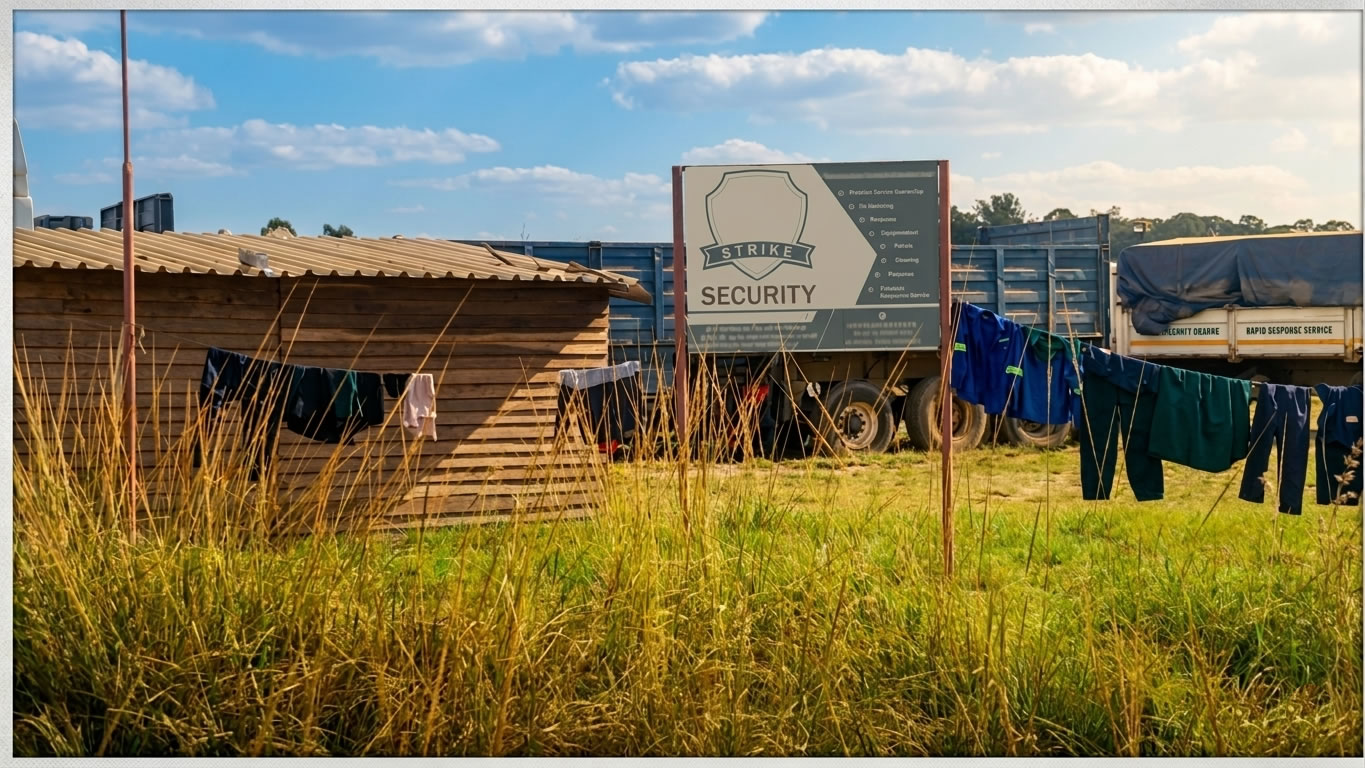
GUARDS OR SLAVES? THE SHOCKING CONDITIONS OF WHERE SOME GUARDS STAY
The tragic death of a 27-year-old security guard has cast a harsh spotlight on the deplorable working conditions and unpaid wages that define the private security industry in Zimbabwe. Kona Mandlenkosi, an employee of Strike Security Company, was brutally murdered by armed robbers while on duty at Hallingbury Primary School in Mabelreign. The attackers, who struck him with crowbars, are believed to be part of a notorious gang that has been terrorising the Greater Harare Suburban District since February 2026.
This devastating incident is not an isolated event but rather a symptom of a much deeper crisis. Security guards, who are entrusted with protecting valuable property and lives, are often subjected to extreme exploitation, living in squalor and going for months without pay. The situation has become so dire that some industry insiders fear the desperation could push guards to turn rogue, colluding with the very criminals they are hired to deter. The combination of severe economic hardship and constant exposure to danger creates a highly volatile environment where the line between protector and accomplice can easily blur.
The grim reality of these working conditions was laid bare when journalists visited a property in Mount Hampden, owned by the director of Strike Security, a man identified only as Kaseke. Here, guards who are off duty or waiting for their delayed wages are housed in tin shacks. The living arrangements are shockingly inadequate. Many of these makeshift dwellings lack basic necessities such as windows, and there are no ablution facilities on the premises. The guards are forced to endure overcrowded and unsanitary conditions, a stark contrast to the professional standards expected of those guarding key installations.
One security guard, who requested anonymity for fear of victimisation, tipped off reporters about the dire situation they face daily.
“Visit at Strike Security in Mt Hampden and see how we are living in tin houses without ablution facilities. You are forced by the situation to stay there, waiting for wages, even when you are off duty.”
When confronted with these allegations, Kaseke confirmed that he provided the accommodation but described it as a favour to his employees. He acknowledged that salary delays sometimes occur, blaming the broader economic environment for the company’s financial struggles.
“I provided accommodation for our security guards at my residential stand. As for their wages, you cannot pay them when the coffers are dry. Employees must not take their issues to media. They must come and meet us over their grievances, not through the media,” said Kaseke.
He further questioned why the guards continued to report for duty if they had not been paid for three months, seemingly dismissing the desperation that keeps many trapped in these exploitative jobs. In a country grappling with high unemployment rates, the reality is that many workers cling to any semblance of employment, even when it means enduring severe abuse and wage theft.
The issue of unpaid wages is rampant across the sector. A former Strike Security guard claimed that employees who dare to confront management about their missing salaries are summarily dismissed. He recounted his own experience of working for three months without pay and being sacked when he finally demanded his dues.
“I worked for three months without salary, upon enquiring about it, I was sacked. They engage agencies who train security guards to replace anyone who demand his or her wages. Senior guards receive their wages on time except junior guards you are forced to beg for transport money.”
This systemic exploitation is not confined to a single company but represents a widespread failure within the private security industry. The Zimbabwe Security Guards Union (ZISEGU) has repeatedly raised alarms about the unsustainable wages and lack of regulatory enforcement in the sector. In November 2024, ZISEGU Secretary General Philemon Nhema petitioned Home Affairs Minister Kazembe Kazembe, highlighting the detrimental impact of Statutory Instrument 58/2024. This legislation allows premise owners to pay extremely low rates for security services. For instance, a 24-hour cover contract can be priced at a paltry USD365. When this amount is divided among the minimum three guards required to cover such a shift, the pay amounts to roughly USD122 per guard, falling far short of a living wage.
Nhema argued that this statutory instrument is entirely inconsistent with the current collective bargaining agreement, which had set the minimum wage at USD210 inclusive of allowances. He pointed out that Zimbabwean security guards are among the lowest paid in the region, earning significantly less than their counterparts in neighbouring countries.
Furthermore, private security guards in Zimbabwe lack essential benefits such as a dedicated pension fund, relying solely on the National Social Security Authority (NSSA), and receive none of the perks afforded to their counterparts working directly under the Ministry of Home Affairs.
“It is our humble request that your esteemed office assist in the plights of security guards such that we avoid violation of workers’ rights in Zimbabwe. The issue of low wages in the security industry is protected by international laws such as the Universal Declaration of Human Rights Article 23(3) and section 65 (1) of the Zimbabwe constitution. Security guards as employees deserve a fair living wage that guarantees a decent life which is dignified and that they avert exploitation,” said Nhema.
The vulnerability of these underpaid and poorly equipped guards is starkly evident in the recent wave of violent crime sweeping across Harare. The gang responsible for Mandlenkosi’s death is suspected of orchestrating a series of brazen and highly coordinated attacks. On the same night he was killed, four schools in the Mabelreign, Westgate, and Marlborough areas were targeted. The gang also raided an orphanage in Westgate, making off with a staggering US$31,000.
Other security personnel have also fallen victim to these violent incursions, highlighting the extreme physical risks associated with the job. Letwin Moyo (25) and Almah Chivanga were reportedly attacked while guarding the ZAOGA Church in Westgate. Enock Mapasarwa (44) of Guard Alert and William Tonderai Makwara (21) of Clemcon Security company were also assaulted during separate armed robberies, with robbers stealing US$987 in the latter incident.
The police have acknowledged the severity of the situation and the escalating threat posed by these organised criminal groups. Harare provincial police spokesperson, Inspector Luckmore Chakanza, confirmed that a dedicated operation is underway to dismantle the gang, which is believed to consist of four highly dangerous individuals.
“The Zimbabwe Republic Police, Harare Province, is investigating a series of robbery cases reported in Mabelreign and the Greater Harare Suburban District since February 2026. Operations are underway to identify and apprehend the suspects,” said Insp Chakanza.
He noted that the criminals have been specifically targeting churches, schools, and private residences, employing extreme violence to subdue their victims. There are also deeply concerning reports that sexual offences may have occurred during some of these robberies, adding another layer of horror to the crime wave.
The police have intensified patrols and deployed additional resources to the affected areas in an effort to restore order. A significant breakthrough in the investigation occurred when a CCTV camera captured a clear image of one of the prime suspects at a crime scene in Mabelreign. The photograph was released to the public, prompting an appeal for assistance in identifying the individual. Bizarrely, the image garnered a disturbing online following, with some social media users praising the suspect’s appearance, a trivialisation of the serious crimes he is accused of committing.
While the police pursue these violent criminals, a broader concern looms over the security industry. The combination of extreme poverty, deplorable living conditions, and constant exposure to danger creates a volatile environment. Sources suggest that some guards, driven by desperation and a profound sense of betrayal by their employers, might be tempted to collaborate with criminal syndicates. The precise knowledge of where cash and valuables are kept makes security guards highly valuable assets to armed robbers, and the failure to pay them a living wage only increases the likelihood of insider collusion.
The recent crackdown by law enforcement has yielded some notable results in the fight against these syndicates. On April 1, 2026, a fierce shootout in Warren Park resulted in the deaths of four suspected armed robbers and the arrest of two others. The deceased were identified as Mike Manyima (37), Office Chanakira (38), and two men known only as Atenzi and Chris. The arrested suspects, Nelson Chitima (28) and Edson Guvira (38), provided crucial information that led to the confrontation. Detectives from CID Homicide Harare had moved on a tip-off to arrest Chitima, who then named his accomplices and assisted in luring Guvira to Mhishi Shopping Centre. The police recovered a Nissan NV350 getaway vehicle, a white balaclava, gloves, and assorted liquor. This specific gang was linked to a string of violent robberies across the capital throughout February and March 2026.
Despite these police successes in apprehending violent criminals, the fundamental issues plaguing the private security sector remain entirely unresolved. The tragic death of Kona Mandlenkosi serves as a grim reminder of the human cost of this exploitation. Security guards are the first line of defence against a rising tide of violent crime, yet they are treated with shocking disregard by the very companies that profit from their labour. They stand between criminals and their targets, often armed with little more than a baton, while facing heavily armed and ruthless gangs.
The narrative of “free housing” in tin shacks without basic sanitation, and the dismissal of legitimate grievances regarding unpaid wages as mere “economic challenges,” ring hollow when lives are being lost. The industry cannot continue to operate on a model that treats its workforce as disposable commodities. Until there is a comprehensive overhaul of the industry’s labour practices—ensuring fair wages, adequate living conditions, proper training, and essential benefits—the men and women who stand guard in the dead of night will continue to be treated more like slaves than the essential professionals they are. The government, industry regulators, and the security companies themselves must be held accountable for this systemic failure, which not only endangers the guards but compromises the safety and security of the entire community they are sworn to protect.