


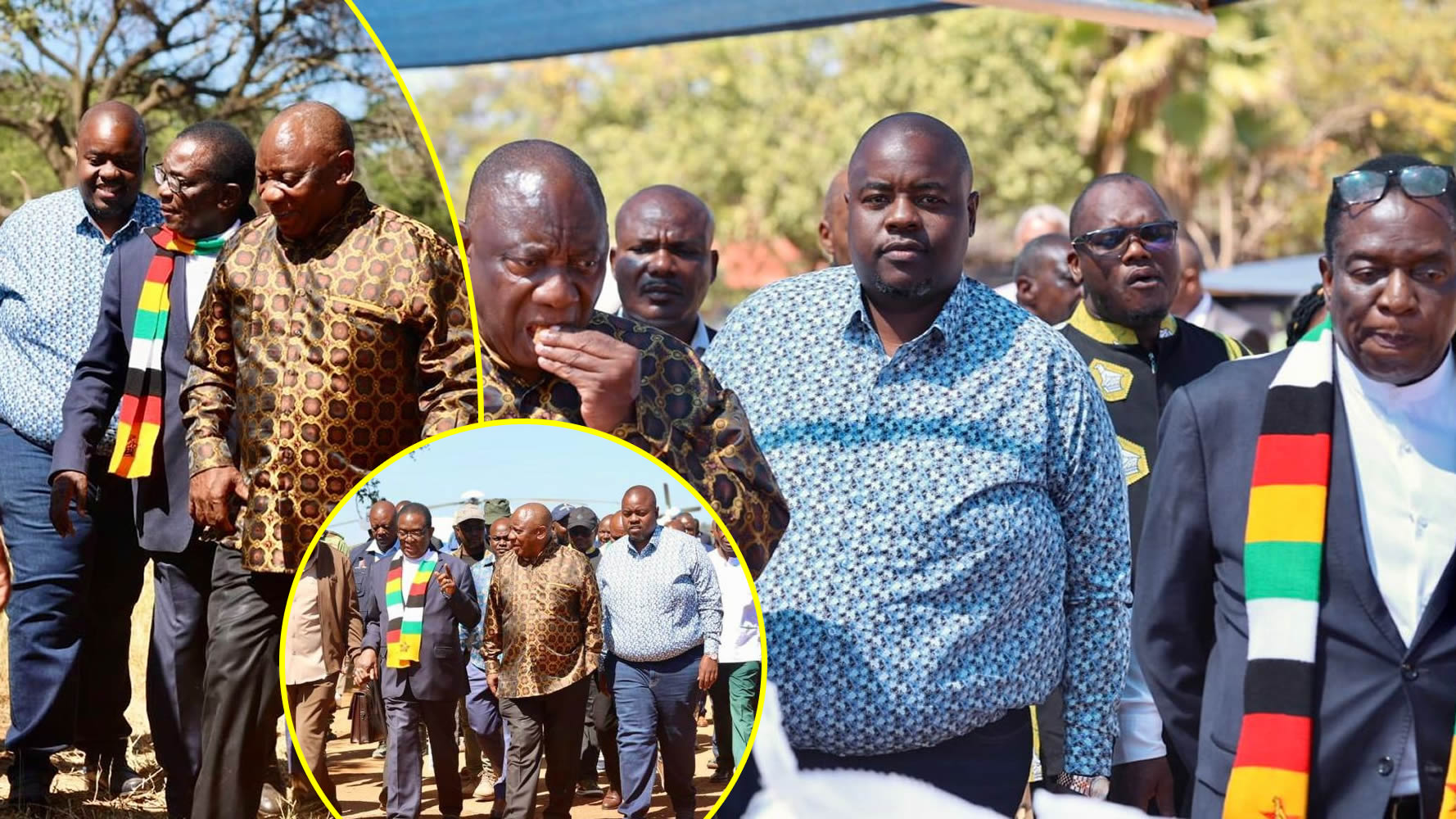
Harare – A seemingly innocuous informal visit by South African President Cyril Ramaphosa to Zimbabwean President Emmerson Mnangagwa’s private Precabe Farm in Kwekwe, Midlands province, has ignited a diplomatic firestorm. What was intended as a relaxed engagement between two heads of state has been overshadowed by the controversial presence of Zimbabwean businessman Wicknell Chivayo, a figure currently under intense scrutiny by South African law enforcement. His appearance alongside both presidents, captured in widely circulated photographs, has not only raised serious questions about security protocols but also exposed the intricate and often murky ties that bind the political and economic elites of the two nations.
The incident, which occurred on Sunday, 3 May 2026, has forced Pretoria into an uncomfortable position, with President Ramaphosa’s spokesperson, Vincent Magwenya, swiftly moving to perform damage control. Magwenya insisted that Ramaphosa was “unaware” of Chivayo’s presence or his significant legal entanglements in South Africa until after the meeting. This explanation, however, has been met with considerable scepticism from observers in both Harare and Pretoria, who view Chivayo’s proximity to a visiting head of state as a calculated display of power and influence within the Zimbabwean political landscape.
Chivayo, a flamboyant businessman known for his ostentatious lifestyle and frequent social media presence, is a person of significant interest to South Africa’s elite crime-fighting unit, the Hawks. He is currently the subject of an active investigation into a staggering R1.1 billion (approximately $60 million) Zimbabwe Electoral Commission (ZEC) tender scandal. The allegations against him are severe, encompassing fraud, money laundering, and contravening South Africa’s Exchange Control Act. Adding to his legal woes, the Gauteng Division of the High Court in Pretoria, under Case No: 2026-006392, has already ordered a freeze on his South African bank accounts across major institutions such as FNB, Absa, and Standard Bank, and has even grounded his private jet.
The R1.1 billion scandal, which first came to light in early 2026, involves suspicious financial flows linked to payments made by the Zimbabwean Treasury to a South African firm, Ren Form CC, for the supply of electoral materials. Investigative insiders suggest that these funds were subsequently channelled through a complex web of companies allegedly linked to Chivayo, triggering the Hawks’ money-laundering probe. The sheer scale of the investigation, and the fact that it involves funds meant for a democratic process, underscores the gravity of the situation. For Chivayo to be seen rubbing shoulders with the very president whose law enforcement agencies are pursuing him is a profound embarrassment for South Africa’s executive.
The stark contrast between South Africa’s aggressive pursuit of Chivayo and Zimbabwe’s apparent protection of him highlights a deep-seated cross-border controversy. The Zimbabwe Anti-Corruption Commission (ZACC) has reportedly “cleared” Chivayo of any wrongdoing in connection with the ZEC tender, claiming a lack of evidence. This move directly contradicts the Hawks’ ongoing probe and has been interpreted by many as a deliberate attempt to shield the businessman. Critics in Zimbabwe have long argued that ZACC has been compromised, acting more as a “toothless bulldog” when it comes to individuals within the president’s inner circle, while South African courts have shown a greater degree of independence in following the money.
Beyond the immediate scandal, the “farm retreat” served as a backdrop for other critical discussions, or perhaps, subtle warnings. There is considerable speculation in Zimbabwe that President Ramaphosa used the informal setting to caution President Mnangagwa against proceeding with plans to amend the country’s constitution. The proposed Constitutional Amendment Bill No. 3 (CAB3) aims to extend Mnangagwa’s presidential term beyond the current two-term limit, allowing him to serve until 2030, a move colloquially referred to as “ED2030.” This potential constitutional bypass has stirred significant discontent and fears of political instability within Zimbabwe, with South Africa reportedly concerned about the potential for a fresh wave of migration and regional destabilisation should such changes be enacted.
The CAB3 proposal, which was approved by the Zimbabwean cabinet in February 2026, has been the subject of heated public hearings across the country. Legal experts note that the bill would not only extend the presidential term but also consolidate executive power, potentially allowing the president to appoint judges and other key officials with less oversight. For South Africa, the prospect of an entrenched leadership in Harare that bypasses constitutional norms is a nightmare scenario. The memory of the 2008 post-election crisis, which saw millions of Zimbabweans flee across the Limpopo River, remains a vivid and painful one for Pretoria’s policymakers.
The presence of Chivayo, alongside other figures like Kudakwashe Tagwirei, a businessman sanctioned by the US Treasury for his alleged ties to corruption and the Zimbabwean ruling party, further underscores the complex web of relationships at play. Tagwirei, like Chivayo, has been linked to high-level governmental officials, including President Mnangagwa, and has faced accusations of using these connections to secure state contracts and preferential access to resources. Their collective presence at such a high-level, yet informal, diplomatic gathering suggests a deliberate message from Harare to Pretoria, subtly reminding South Africa of the deep, often opaque, business and political ties that intertwine the elites of both nations.
Vincent Magwenya’s assertion that President Ramaphosa was genuinely unaware of Chivayo’s background has been met with widespread disbelief. In the world of high-stakes intelligence and diplomatic engagements, it is highly improbable that a visiting head of state would not be thoroughly briefed on key individuals present at a meeting, especially one involving a host president’s private residence. This narrative, therefore, struggles to hold water, suggesting instead a carefully constructed excuse to mitigate the political fallout. The incident raises serious questions about security lapses and the effectiveness of intelligence gathering, particularly when a person of interest to a neighbouring country’s law enforcement is granted such unfettered access to a presidential delegation.
Furthermore, the logistical arrangements for such a visit are typically handled by a sophisticated advance team involving intelligence officers, protocol officials, and security personnel from both countries. The idea that none of these professionals flagged the presence of a man whose assets had been frozen by a South African court just days prior is difficult to reconcile with standard operating procedures. If it was indeed a lapse, it represents a catastrophic failure of the South African State Security Agency (SSA). If it was not a lapse, it suggests a level of complicity or a calculated risk taken by the Zimbabwean hosts to test Ramaphosa’s resolve.
The implications of this meeting extend far beyond mere optics. It highlights a growing divergence between the diplomatic protocols and stated anti-corruption stances of the African National Congress (ANC) in South Africa and the perceived personal interests and political manoeuvres of the Zimbabwe African National Union – Patriotic Front (ZANU-PF) leadership. While President Ramaphosa attempts to maintain a facade of “quiet diplomacy” in addressing regional issues, the brazen display involving individuals like Chivayo forces a direct confrontation with the reality of state capture and cross-border corruption that transcends national boundaries.
This incident also casts a shadow on South Africa’s stance on regional corruption and the rule of law. The Hawks’ active investigation into Chivayo, coupled with the freezing of his assets, demonstrates a commitment to tackling financial crime. However, his prominent appearance with President Ramaphosa, even if allegedly unbeknownst to the latter, could be perceived as undermining these efforts. It sends a confusing signal about the seriousness with which South Africa views such allegations, potentially emboldening those who operate within the grey areas of cross-border financial networks.
The broader context of migration further complicates the narrative. South Africa is currently grappling with significant anti-immigrant sentiment and protests, leading to tensions with other African governments. President Ramaphosa recently met with Mozambican President Daniel Chapo to discuss these pressures, acknowledging that “misgovernance” and instability in some African nations contribute to large-scale migration. Magwenya noted that “the continent needs to work together to address the issues that are behind these levels of migration,” specifically pointing to “conflicts, issues of instability, and in some areas, if we’re being honest, the misgovernance that causes people to migrate in large numbers.” The concerns surrounding Zimbabwe’s CAB3 and the potential for increased instability directly feed into this regional challenge, making the informal discussions at Precabe Farm all the more critical.
The timing of the meeting, just days after the South African High Court’s decisive action against Chivayo’s assets, adds another layer of intrigue. It suggests a deliberate provocation or, at the very least, a profound disregard for South African legal processes by elements within the Zimbabwean establishment. The photographs, far from being accidental, appear to be a calculated visual signal that Zimbabwe’s elite are willing to provide sanctuary and status to those actively pursued by South African state agencies. This “sanctuary” narrative is particularly damaging for Ramaphosa, who is under domestic pressure to show that South Africa’s law enforcement has teeth and that the country is not a playground for regional oligarchs.
Chivayo himself has done little to lower his profile. Known for his “Sir Wicknell” persona, he frequently posts images of himself with luxury vehicles, private jets, and high-ranking officials. His recent “philanthropic” activities, which include gifting expensive cars to various individuals, have been viewed by some as a transparent attempt to buy public goodwill and political protection. However, the source of the funds for these gifts remains a subject of intense speculation, with the Hawks’ investigation providing a potential, and far more sinister, explanation.
The fallout from the Precabe Farm incident is likely to be felt for months to come. In Pretoria, opposition parties are already calling for a full briefing on the matter, demanding to know how such a security and diplomatic lapse occurred. In Harare, the incident is being touted by some as a sign of Mnangagwa’s “unstoppable” momentum towards 2030, with Chivayo’s presence serving as a symbol of the “new dispensation’s” business-friendly, albeit controversial, environment.
Ultimately, the story of Wicknell Chivayo at Precabe Farm is a microcosm of the larger challenges facing Southern Africa. It is a story of how personal wealth, political power, and legal accountability collide in a region where the lines between the state and private interests are often blurred. For President Ramaphosa, the challenge will be to prove that South Africa’s commitment to the rule of law is more than just rhetoric. For President Mnangagwa, the challenge will be to manage the growing regional and domestic pressure as he navigates the treacherous waters of constitutional amendment and succession politics.
In conclusion, the meeting at Precabe Farm, initially framed as a routine diplomatic engagement, has unravelled into a complex saga exposing deep-seated issues of corruption, political influence, and regional instability. The presence of Wicknell Chivayo, a man wanted by South African authorities for serious financial crimes, alongside both presidents, has not only embarrassed Pretoria but also laid bare the challenges of upholding the rule of law in a region where political and business interests often intertwine in opaque ways. The “unaware” narrative offered by President Ramaphosa’s office simply fails to account for the intricate dynamics at play, leaving many to question the true messages exchanged and the long-term implications for bilateral relations between South Africa and Zimbabwe. The silent messages sent between the two capitals on that Sunday afternoon may prove to be far more consequential than any official communique.