
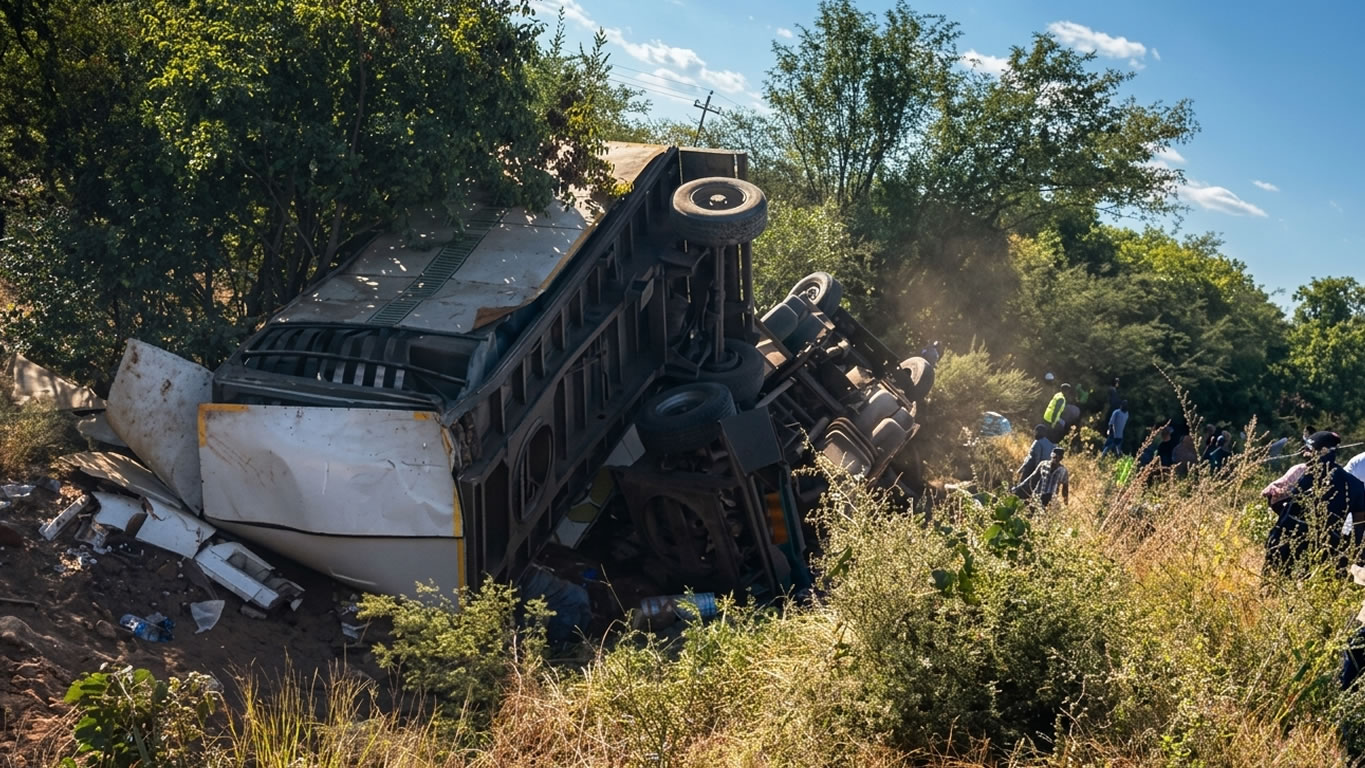

Death Toll Rises to 17 in Mutoko Bus Disaster: The Human Cost of Negligence on the Harare-Nyamapanda Highway
MUTOKO — The dust has barely settled over the 176-kilometre peg along the Harare-Nyamapanda Highway, but the silence now hanging over the Suswe Business Centre is heavier than the mechanical roar of the engines that usually dominate this cross-border artery. What began as a hopeful journey for 63 passengers travelling from the sprawling suburbs of Cape Town, South Africa, to the warmth of their homes in Blantyre, Malawi, ended in a tangled wreckage of steel and shattered lives.
On Tuesday afternoon, May 5, 2026, the BRD Luxury Coach—a vessel that promised comfort across thousands of kilometres—became a tomb for 17 souls. As more details emerge from the investigations conducted by the Zimbabwe Republic Police (ZRP) and the harrowing testimonies of survivors, a disturbing picture of mechanical neglect, ignored warnings, and the lethal pressure of the cross-border transport industry is coming into focus.
The initial reports from the scene were grim, but the tragedy deepened on Wednesday when authorities confirmed that three more victims had succumbed to their injuries, bringing the official death toll to 17. Amongst the deceased is the bus driver, a Zimbabwean national from the Mudzi district, whose final moments were spent struggling to regain control of a vehicle that survivors claim was failing long before it reached the treacherous curves of Mutoko.
A Journey Plagued by Warnings
For those on board, the disaster did not strike without warning. Survivors, still reeling from the trauma at Mudzi and Mutoko District Hospitals, describe a journey that was marred by mechanical failures from the outset. Enock Sisya, a Malawian national who survived the crash but lost relatives in the carnage, spoke with a voice heavy with grief and frustration.
“The accident occurred in the afternoon. In fact, I actually do not know what caused it, but one thing is for sure: the bus was speeding. Before the accident, it had some breakdowns. I am pained by this tragedy. My relatives from Malawi perished in this accident. Some are admitted here with me, and I want to thank God for the protection.”
Sisya’s account is echoed by fellow passenger Solomon Steven, who pointed to specific mechanical defects that should have grounded the vehicle long before it reached the 176-kilometre peg.
“We had broken down earlier and it was repaired, but the bus continued moving fast. It seemed the brakes were not working properly. The vehicle appeared to have brake and shaft problems.”
Witnesses at the Suswe Business Centre watched in horror as the massive coach veered uncontrollably off the tarmac. One villager, who rushed to the scene to pull survivors from the wreckage, noted that the bus seemed to be fighting against itself. “I was seated at my homestead when I saw the bus veering off the road. We rushed to assist the victims,” he said. Another witness alleged that a tyre burst was the final catalyst: “The bus had some mechanical problems and had broken down in Mutoko before coming here. The driver failed to control it after a tyre burst. Some passengers were trapped inside, while others escaped through the windows.”
The Official Response and the State of the Highway
Mashonaland East Provincial Affairs and Devolution Minister, Advocate Itayi Ndudzo, visited the scene and the hospitals where the 35 injured passengers were being treated. His assessment was blunt, confirming that the tragedy was likely rooted in a failure of the machine rather than a mere “act of God.”
“It is with deep sadness and heavy sorrow that we find ourselves in this situation where yesterday a BRB Luxury Coach from South Africa and bound for Blantyre in Malawi, carrying Malawian nationals, although the crew was Zimbabwean, was involved in a terrible accident. We heard that the bus had a mechanical fault and the driver lost control, resulting in the bus veering off the road and overturning, and eventually trapping passengers inside.”
The Minister praised the “sterling efforts” of the district civil protection unit, led by the ZRP and other security forces, who worked frantically to extricate passengers from the crushed frame of the bus. However, for many, the intervention came too late.
The Harare-Nyamapanda Highway is a vital link for trade and migration within the Southern African Development Community (SADC). Yet, it has increasingly become a theatre of tragedy. The table below outlines the alarming trend of road traffic incidents in Zimbabwe over the recent months, highlighting a systemic crisis that extends far beyond this single event.
|
Period
|
Number of Recorded Accidents
|
Notable Trends
|
|
First Quarter 2025
|
15,263
|
A 15% increase from the previous year.
|
|
Easter Period 2026
|
337
|
Fewer accidents than 2025 (384), but a significantly higher mortality rate.
|
|
Projected Total 2026
|
~40,000
|
Based on ZRP records and current trajectories.
|
The statistics tell a story of a nation grappling with a road safety crisis that shows no signs of abating. While the number of accidents during the 2026 Easter period saw a slight decline, the lethality of those crashes has increased, suggesting that when accidents do occur, they are more violent—often involving high-speed, long-distance coaches like the one that met its end in Mutoko.
The Culture of the Long Haul
Investigating the cross-border bus industry reveals a culture where profit often dictates safety standards. The route from Cape Town to Blantyre is one of the longest and most gruelling on the continent, spanning over 3,000 kilometres across three countries. Drivers are often under immense pressure to maintain tight schedules, leading to fatigue and the temptation to ignore mechanical “niggles” to avoid costly delays.
Darlington Chiringa, president of the Cross Border Bus Committee, admitted in a recent industry review that the holiday and peak travel seasons often expose the system’s lethal weaknesses. “We have to make sure our buses are well prepared during this season,” he noted. “Overloading kills people—that is something we cannot ignore.”
Yet, the reality on the ground often contradicts these sentiments. Washington Nyathi, a veteran driver on the South Africa-Zimbabwe route, offered a more fatalistic—and perhaps more common—perspective within the industry: “Accidents are from God.” This sentiment, while reflecting a certain cultural stoicism, also points to a dangerous abdication of responsibility. If a crash is seen as inevitable or divine, the impetus to check brake pads or replace worn tyres diminishes.
Siyabonga Sambo, a mechanic who often travels on these routes to perform “running repairs,” urged a shift in the power dynamic between operators and passengers.
“Don’t be afraid to talk. Talk to the driver. Talk to the conductor. Even here at the bus rank, raise your concern. Our job is to provide transport and security. Drivers, conductors and even those handling luggage must follow the rules. Once people get on the bus, it cannot be chaos.”
The Toll on the Survivors
At Kotwa and Mutoko District Hospitals, the survivors are left to pick up the pieces of their lives. Dr Kudzai Kudakwashe Madamombe, the Superintendent of Kotwa District Hospital, confirmed that five of the victims were in such critical condition that they had to be transferred to the Parirenyatwa Group of Hospitals in Harare for specialised care.
“We received 35 patients,” Dr Madamombe stated. “Five critically injured patients were transferred to Parirenyatwa Hospital in Harare, while others sustained moderate to minor injuries.”
The Government of Zimbabwe has pledged to assist with the medical bills and the repatriation of the deceased. Commissioner Paul Nyathi, the Chief Staff Officer for the ZRP, confirmed that the police are liaising with the Malawian Embassy to facilitate the identification of the victims. “The Government of Zimbabwe, through relevant Ministries, departments and agencies of the State, is doing everything it can to lessen the burden on the deceased’s families,” added Minister Ndudzo.
A Pattern of Negligence
This latest disaster is not an isolated incident but part of a pattern of negligence that has plagued the Harare-Nyamapanda road. In early 2026, a similar incident involving a Honda Fit and a haulage truck claimed 10 lives on the same highway. The common denominator in these tragedies is often a combination of poor vehicle maintenance and the lack of stringent enforcement of road regulations.
The Traffic Safety Council of Zimbabwe (TSCZ) has been vocal about the need for better driver training and stricter vehicle inspections. Managing Director Mr Munodawafa expressed his condolences to the bereaved families but also reiterated the need for a “paradigm shift” in how transport operators view their responsibility to the public.
However, as long as the economic incentives favour speed and volume over safety, the “luxury” in BRD Luxury Coach will remain a hollow promise. The passengers who boarded that bus in Cape Town were not just commuters; they were breadwinners, parents, and children returning to their families. They paid for a safe passage, but they were met with a mechanical failure that had been foreshadowed for hundreds of kilometres.
The Road Ahead
As the investigations continue, the families of the 17 deceased are left waiting for answers and for the bodies of their loved ones to be returned to Malawi. The Zimbabwean driver, who died at the wheel, also leaves behind a grieving family in Mudzi, a local man caught in the machinery of a regional transport crisis.
The Harare-Nyamapanda bus accident serves as a grim reminder that the cost of doing business in the transport sector cannot be measured in tickets sold, but in lives protected. Until there is a rigorous, transparent system of accountability for bus operators who allow faulty vehicles onto the road, the 176-kilometre peg will remain a monument to a tragedy that was as predictable as it was preventable.
For the survivors like Enock Sisya and Solomon Steven, the physical wounds may heal, but the memory of the panic, the sound of the metal tearing, and the silence of those who did not make it will linger long after the wreckage has been cleared. The highway continues to hum with the sound of other buses, other journeys, and the silent hope that the next one will actually reach its destination.
Timeline of the Mutoko Bus Disaster
|
Time / Date
|
Event
|
|
May 4, 2026
|
BRD Luxury Coach departs Cape Town for Blantyre with 63 passengers.
|
|
May 5, 08:00
|
Passengers report first mechanical issues and “running repairs” in Mutoko.
|
|
May 5, 13:30
|
The bus veers off the road at the 176km peg, Suswe, and overturns.
|
|
May 5, 15:00
|
Emergency services from Mudzi and Mutoko arrive; 14 confirmed dead.
|
|
May 6, 10:00
|
Minister Itayi Ndudzo visits the scene and hospitals.
|
|
May 6, 18:00
|
ZRP confirms the death toll has risen to 17.
|
|
May 7, 2026
|
Identification and repatriation processes begin with the Malawi Embassy.
|
Key Contacts for Affected Families:
- Zimbabwe Republic Police (National Complaints Desk): +263 242 703631
- Mutoko District Hospital: +263 272 2231
- Malawi Embassy in Harare: +263 242 705611