


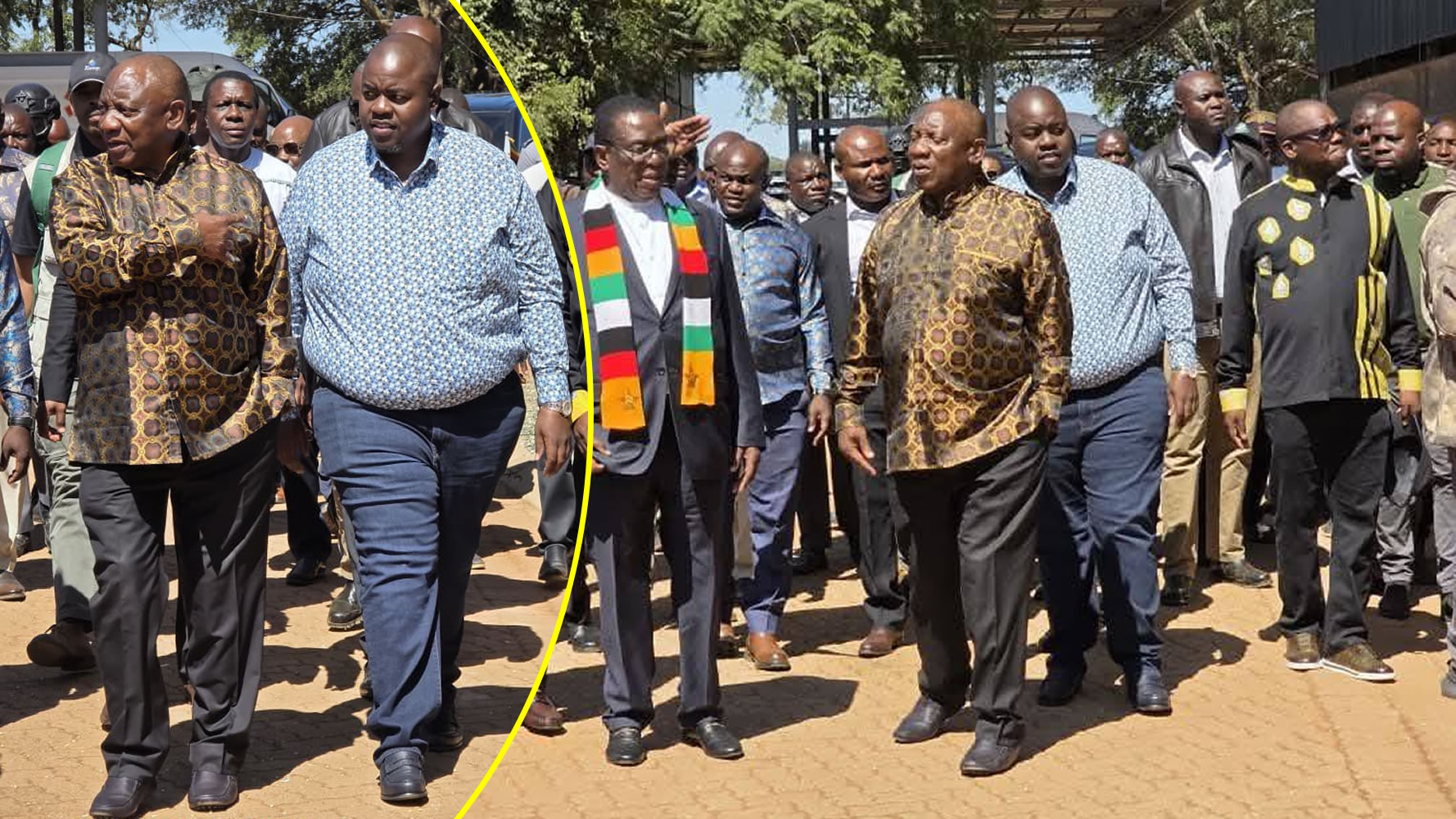
Zimbabwe on the Brink: A Web of Intrigue, Corruption, and Coup Fears
Zimbabwe, a nation perennially grappling with political and economic turbulence, finds itself once again at a critical juncture. A series of recent, interconnected events has ignited a firestorm of speculation, revealing a complex tapestry woven with threads of alleged corruption, intense power struggles, and the ever-present spectre of political instability. At the epicentre of this unfolding drama is an unannounced, clandestine visit by South African President Cyril Ramaphosa to his Zimbabwean counterpart, Emmerson Mnangagwa, at his private farm.
This high-stakes meeting, shrouded in secrecy, coincided with the controversial release of former cabinet minister Walter Mzembi from prison, a development that has only intensified public scrutiny. Adding further fuel to the already volatile situation, prominent political commentators and activists, including Rutendo Matinyarare and Knox Chivero, have issued dire warnings of an imminent coup, painting a grim picture of a nation teetering on the precipice of profound and potentially violent change. This investigative report delves into the intricate details of these events, seeking to unravel the underlying motives and potential ramifications for Zimbabwe and the broader Southern African region.
Ramaphosa’s Unscheduled Sojourn: A Crisis Intervention or Endorsement?
South African President Cyril Ramaphosa’s visit to President Emmerson Mnangagwa’s sprawling Precabe Farm in Kwekwe on 3 May 2026, was far from a conventional diplomatic engagement. Initially described by Ramaphosa’s office as a “working visit” aimed at discussing “issues of mutual and bilateral interest,” this official narrative quickly unravelled under intense media scrutiny. In stark contrast, Zimbabwe’s state broadcaster, ZBC News, characterised the encounter as a “private visit,” a glaring discrepancy that immediately raised eyebrows among political analysts and the public alike. The clandestine nature of the trip was further underscored by reports indicating that even senior officials within South Africa’s Department of International Relations and Cooperation (DIRCO) were reportedly kept in the dark regarding its planning and execution. This lack of transparency surrounding a high-level presidential meeting between two neighbouring nations with deeply intertwined histories and economies only served to heighten suspicions about the true agenda.
The guest list for the meeting itself was highly unconventional and further fuelled public disquiet. Notably absent were key senior Zimbabwean government officials, including Vice Presidents Constantino Chiwenga and Kembo Mohadi, as well as several cabinet ministers. Their exclusion from such a significant gathering, particularly given the purported “working visit” status, was conspicuous. Instead, the meeting included a select group of controversial Zimbabwean businessmen: Wicknell Chivayo, Kudakwashe Tagwirei, and Paul Tungwarara. The presence of these individuals, all of whom have been repeatedly linked to serious allegations of corruption and state capture, intensified public scrutiny and led to widespread accusations that the meeting was less about bilateral relations and more about private interests and political manoeuvring.
Veteran Zimbabwean journalist Hopewell Chin’ono, a seasoned observer of the nation’s tumultuous political landscape, offered a compelling interpretation of the visit. According to Chin’ono, Ramaphosa’s primary objective was to intervene directly in Zimbabwe’s internal political dynamics, specifically to address and quell persistent rumours of a military coup. He suggested that Ramaphosa sought to reassure Mnangagwa that South Africa would not countenance or support any unconstitutional change of government, particularly amidst growing concerns over potential military intervention allegedly linked to Vice President Constantino Chiwenga. This interpretation positions Ramaphosa’s visit as a critical, albeit covert, effort to stabilise a potentially explosive situation.
The events at Mnangagwa’s farm provided further insight into the underlying tensions. During a guided tour of the sprawling agricultural estate, where Ramaphosa was shown Ankole cattle and fish breeding pools, a particularly revealing exchange reportedly occurred. As the two leaders observed ostriches, Ramaphosa is said to have made a pointed and politically charged statement: “Nothing and nobody will remove my elder brother from power unconstitutionally.” He reportedly reinforced this sentiment by adding, “The owner of these ostriches will be president until 2030 if Parliament says so,” statements widely interpreted as a clear endorsement of Mnangagwa’s continued tenure and a stern warning to his detractors. These remarks, made in the presence of the accompanying delegation, were quickly disseminated and became a focal point of public debate.
However, the South African presidency, perhaps sensing the growing public backlash, later attempted to distance itself from the more controversial aspects of the visit. It issued a statement acknowledging reports involving a “person of interest” to law enforcement, without explicitly naming Wicknell Chivayo. This subtle, yet significant, retraction did little to quell the storm of criticism. Political activist Rutendo Benson Matinyarare vehemently asserted that Ramaphosa’s visit was, in fact, a “crisis management intervention” necessitated by Zimbabwe being “on the brink of a coup, if not a civil war”. Matinyarare further argued that the visit was a direct response to the profound instability generated by Mnangagwa’s proposed Constitutional Amendment Bill 3 (CAB3), which he unequivocally described as an “unconstitutional power grab” that had not only created a “huge storm inside ZANU PF” but had also escalated into a “regional security threat”. This perspective suggests that Ramaphosa’s visit was not merely a show of solidarity but a desperate attempt to avert a regional catastrophe.
𝗪𝗛𝗬 𝗗𝗜𝗗 𝗣𝗥𝗘𝗦𝗜𝗗𝗘𝗡𝗧 𝗥𝗔𝗠𝗔𝗣𝗛𝗢𝗦𝗔 𝗧𝗔𝗞𝗘 𝗨𝗡𝗦𝗖𝗛𝗘𝗗𝗨𝗟𝗘𝗗 𝗪𝗢𝗥𝗞𝗜𝗡𝗚 𝗩𝗜𝗦𝗜𝗧 𝗧𝗢 𝗭𝗜𝗠𝗕𝗔𝗕𝗪𝗘? pic.twitter.com/v6hI2nqkAL
— Rutendo Matinyarare (@matinyarare) May 7, 2026
The Chivayo-Tagwirei Nexus: A Web of Alleged Corruption
The presence of Wicknell Chivayo and Kudakwashe Tagwirei at such a high-level, yet ostensibly private, meeting has brought their controversial dealings back into sharp focus. Both businessmen have long been associated with allegations of corruption and state capture, their names frequently appearing in reports detailing illicit financial flows and questionable government contracts.
Wicknell Chivayo, in particular, has become a lightning rod for public anger. His ostentatious displays of wealth and close proximity to the highest echelons of power have drawn significant criticism. According to investigative journalist Knox Chivero, Chivayo is a “shameless criminal” and the “biggest and most ruthless thief Zimbabwe has ever witnessed”. Chivero’s explosive claims, made in a widely circulated YouTube video, allege that Chivayo is currently under investigation by South Africa’s Financial Intelligence Centre for corruption involving R1.1 billion. It is further claimed that a South African court has frozen Chivayo’s assets and bank accounts due to these activities.
The core of these allegations revolves around a massive scandal involving the procurement of election materials. Zimbabwe’s Treasury reportedly paid over R1.1 billion to Ren-Form CC, a South African printing firm, for these materials. Of this staggering amount, more than R800 million was allegedly channelled to accounts linked to Chivayo’s companies, raising serious anti-money laundering concerns. The South African elite police unit, the Hawks, is reportedly probing these suspicious financial flows, with Chivayo’s younger brother, Joachim, also said to be wanted in South Africa in connection with a gold smuggling case.
Kudakwashe Tagwirei, another prominent figure at the Kwekwe farm meeting, has also been implicated in extensive corruption. Chivero alleges that Tagwirei, alongside Mnangagwa, has been systematically looting the country, particularly through the “Command Agriculture” program. This program, initially designed by the military to ensure food security, is claimed to have been used as a conduit for the theft of $3.6 billion. Tagwirei’s firm, Sakunda Holdings, ran the Command Agriculture program from 2016 to 2019, during which time he allegedly used government Treasury Bills to enrich himself, effectively capturing the Ministry of Finance with the complicity of officials like Mthuli Ncube and George Guvamatanga. The United States Treasury Department imposed sanctions on Tagwirei in August 2020, citing his role in undermining Zimbabwe’s economic development through corruption.
Amidst this intricate backdrop of political intrigue and pervasive corruption allegations, the recent release of former Foreign Affairs Minister Walter Mzembi on bail, pending judgment in a significant $2 million corruption trial, has injected yet another layer of complexity into Zimbabwe’s already tumultuous political landscape. Mzembi, a figure who had been held in custody since June 2025 following his unexpected return from Zambia, is facing serious charges related to the alleged misappropriation of substantial funds that were originally earmarked for the 2010 FIFA World Cup.
The specifics of the charges against Mzembi are particularly illuminating. He stands accused of orchestrating the donation of outdoor television sets, which were acquired at a considerable cost of US$2 million for the designated World Cup fan parks, to a variety of churches. These beneficiaries included prominent religious organisations such as Zion Church of Christ, UFIC, and PHD Ministries. Crucially, these donations were allegedly made without the requisite approval from the national treasury or the cabinet, a clear breach of established protocols. However, Mzembi’s defence strategy hinges on a contentious claim: that these controversial donations were, in fact, explicitly authorised by the late former President Robert Mugabe and the then Prime Minister Morgan Tsvangirai. This authorisation, according to Mzembi’s legal team, was purportedly granted under a broader government policy aimed at promoting “religious tourism” within the country.
The timing of Mzembi’s release, granted under strict bail conditions that mandate his continued residence at his Harare address and prohibit travel beyond a 30km radius of the court, is particularly noteworthy. It occurred precisely as the political temperature in Zimbabwe was escalating, reaching a critical boiling point. While superficially appearing to be a routine development within the judicial system, the confluence of Mzembi’s release with the heightened political tensions has not escaped the attention of astute political observers. Many are now openly questioning whether this development is merely a fortuitous coincidence or, more ominously, an integral component of a larger, more intricate political manoeuvre designed to influence the ongoing power dynamics within the nation.
Constitutional Amendment Bill 3: Mnangagwa’s Power Play?
At the heart of the current political turmoil is the contentious Constitutional Amendment Bill 3 (CAB3), a legislative proposal that seeks to significantly alter Zimbabwe’s governance structure. The bill, if passed, would extend presidential and parliamentary terms from five to seven years, effectively prolonging President Mnangagwa’s tenure until 2030 or even beyond. This proposed amendment has been widely criticised as a blatant attempt by Mnangagwa to consolidate power and circumvent democratic processes.
The implications of CAB3 are profoundly far-reaching, posing an existential threat to the very foundations of Zimbabwe’s constitutional democracy. Critics from across the political spectrum vehemently argue that the bill is not merely a legislative adjustment but a calculated manoeuvre designed to entrench Mnangagwa’s power, safeguard his alleged ill-gotten wealth, and ensure the uninterrupted continuation of lucrative, albeit corrupt, contracts that are conveniently set to expire around 2030. These proposed constitutional amendments have not only ignited widespread public outcry and condemnation from civil society organisations but have also precipitated a significant and increasingly public rift within the ruling ZANU-PF party itself. This internal discord within the ruling party is particularly noteworthy, as it signals a deeper malaise than mere political disagreement, hinting at a fundamental struggle for the soul and future direction of the nation.
Vice President Constantino Chiwenga, a figure of immense influence and a pivotal architect of the 2017 military intervention that ultimately propelled Mnangagwa to power, has reportedly emerged as a vocal opponent of CAB3. His public criticism of the bill is widely interpreted as a direct and audacious challenge to Mnangagwa’s authority, serving as a clear indicator of the deep-seated divisions and power struggles festering within the party’s upper echelons. Chiwenga’s stance is particularly weighty given his enduring and formidable ties to the military, a factor that significantly amplifies concerns about the potential for further political instability and even a resurgence of military involvement in civilian affairs. The historical precedent of 2017, where military intervention reshaped the political landscape, looms large over the current discourse, making Chiwenga’s every pronouncement a subject of intense scrutiny.
Political activist Rutendo Matinyarare has been unequivocal in his condemnation, labelling CAB3 as an “unconstitutional power grab” that has not only generated a “huge storm inside ZANU PF” but has also dangerously escalated into a “regional security threat”. This grave sentiment is widely echoed by a chorus of political analysts and regional observers who express profound apprehension that Mnangagwa’s relentless determination to push through these amendments could have catastrophic consequences, not only destabilising Zimbabwe but also sending ripples of instability across the entire Southern African Development Community (SADC) region. The fear is that such a move could set a dangerous precedent, undermining democratic norms and potentially inviting further regional intervention or conflict, thereby jeopardising the fragile peace and economic stability of the wider region.
The Military’s Shadow: Whispers of a Coup and Chiwenga’s Warning
The political landscape in Zimbabwe is further complicated by persistent and increasingly loud whispers of an impending military coup. These rumours have gained considerable traction in the wake of Ramaphosa’s unscheduled visit and the deepening, palpable divisions within the ruling party. Knox Chivero, in his compelling and widely circulated YouTube exposé, explicitly warns of imminent military action, asserting with conviction that the very generals who meticulously orchestrated Mnangagwa’s ascent to power in 2017 now feel a profound sense of betrayal. This sense of betrayal, Chivero argues, stems from the perception that the initial objectives of the 2017 intervention – to bring about genuine economic reform and combat corruption – have been subverted.
Chivero’s narrative posits that the military’s initial vision for a genuine economic turnaround and national rejuvenation has been cynically hijacked by a corrupt “cartel” allegedly led by Mnangagwa and Tagwirei. This powerful cabal, Chivero claims, has systematically enriched itself at the severe expense of the nation and its long-suffering populace. He suggests that elements within the military are actively and meticulously investigating the Command Agriculture corruption scandal and are resolutely determined to hold Mnangagwa and Tagwirei accountable for their alleged transgressions. Chivero’s ominous warning that “the curtain is coming down” and that the corrupt leaders should “count the days” serves as a chilling underscore to the gravity and urgency of the situation, hinting at a potential reckoning.
Vice President Chiwenga’s public pronouncements have further fuelled these intense speculations and anxieties. His strong and unambiguous condemnation of “zvigananda” – a term colloquially referring to shadowy billionaires – who are allegedly siphoning national wealth, is widely interpreted as a direct and pointed attack on Mnangagwa’s closest business allies, particularly Kudakwashe Tagwirei and Wicknell Chivayo. Chiwenga’s deep-seated loyalty and influence within the military establishment render his opposition to Mnangagwa’s actions particularly potent and consequential, inevitably raising fears of a potential repeat of the 2017 scenario, where military intervention ultimately led to a dramatic change in leadership. The delicate balance of power within Zimbabwe’s political elite is evidently shifting, with the military’s role once again becoming a central, unsettling factor.
Hopewell Chin’ono’s report, suggesting that Ramaphosa’s visit was primarily intended to quash these burgeoning coup rumours and to unequivocally assure Mnangagwa of South Africa’s steadfast non-support for any unconstitutional changes, vividly highlights the profound regional concern over Zimbabwe’s precarious stability. However, the conflicting narratives, the continued political manoeuvring, and the palpable tension within the ruling elite collectively suggest that the situation remains exceptionally volatile, pregnant with the potential for unforeseen and dramatic developments. The delicate balance of power appears to be shifting, and the future trajectory of Zimbabwe hangs precariously in the balance, with regional and international actors watching closely.
Vice President Chiwenga’s public pronouncements have further fuelled these speculations. His strong condemnation of “zvigananda” (shadowy billionaires) who are allegedly siphoning national wealth is widely interpreted as a direct attack on Mnangagwa’s close business allies, particularly Tagwirei and Chivayo. Chiwenga’s deep loyalty within the military makes his opposition to Mnangagwa’s actions particularly potent, raising fears of a repeat of the 2017 scenario where military intervention led to a change in leadership.
Hopewell Chin’ono’s report that Ramaphosa’s visit was intended to quash coup rumours and assure Mnangagwa of South Africa’s non-support for unconstitutional changes highlights the regional concern over Zimbabwe’s stability. However, the conflicting narratives and the continued political manoeuvring suggest that the situation remains highly volatile, with the potential for unforeseen developments.
A Nation at a Crossroads
Zimbabwe, a nation with a rich but often turbulent history, currently stands at an exceptionally critical juncture. It is grappling with a complex and volatile confluence of deep-seated political instability, pervasive and rampant corruption, and an enduring economic hardship that continues to plague its populace. The intricately intertwined narratives of President Ramaphosa’s controversial and clandestine visit, the curiously timed release of former minister Walter Mzembi, the explosive and far-reaching allegations levelled by investigative journalist Knox Chivero, and the profoundly divisive Constitutional Amendment Bill 3 (CAB3) collectively paint a vivid picture of a nation in profound flux. The actions, pronouncements, and strategic manoeuvres of key figures within this drama – including President Mnangagwa, Vice President Chiwenga, and the controversial businessmen Chivayo and Tagwirei – are being scrutinised with unprecedented intensity, not only within Zimbabwe’s borders but also across the African continent and by the international community.
The immediate future of Zimbabwe appears fraught with uncertainty, and the coming weeks and months will undoubtedly prove to be pivotal in determining the nation’s trajectory. The outcome of the heated debate surrounding CAB3, which threatens to fundamentally alter the country’s democratic framework, will be a significant indicator. Concurrently, the progress and findings of the ongoing investigations into widespread corruption, particularly those implicating high-profile individuals, will be crucial. Furthermore, the delicate and ever-shifting balance of power within the ruling elite, especially between President Mnangagwa and Vice President Chiwenga, will play a decisive role in shaping the political landscape. These factors, individually and collectively, will determine whether Zimbabwe can somehow navigate these turbulent waters towards a semblance of greater stability and democratic governance, or if it is destined to descend further into political chaos, economic decline, and potentially, social unrest.
Indeed, one thing remains unequivocally clear: the eyes of the region, and indeed the world, are firmly fixed on Harare. Observers are keenly awaiting the next chapter in this unfolding drama, a narrative that holds profound implications not just for the people of Zimbabwe but for the broader stability and democratic aspirations of Southern Africa. The stakes are undeniably high, and the path forward remains shrouded in a fog of uncertainty, making every development a matter of urgent international concern.