


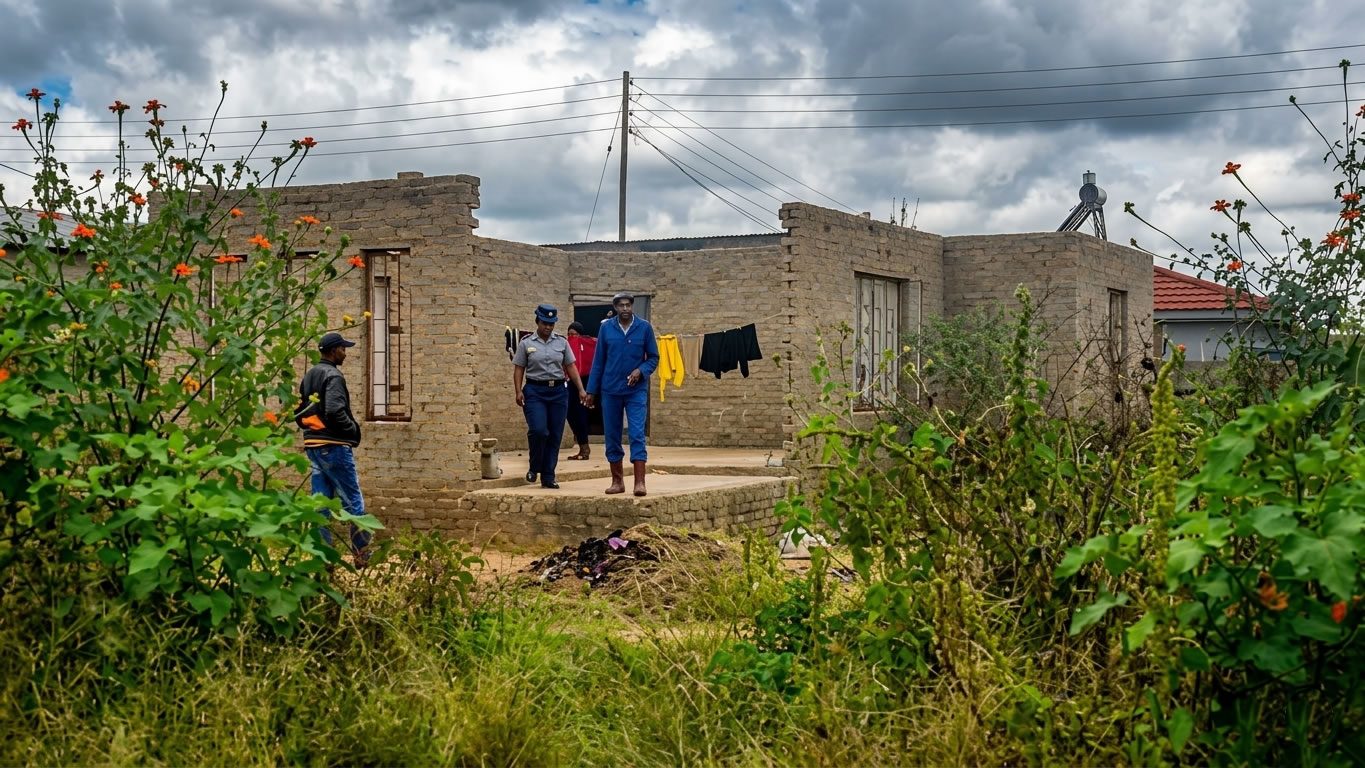
The Concrete Shell of Mathendele: Inside the Plumtree Teen Brothel that Exposed a Town’s Dark Side
PLUMTREE — In the dusty, half-finished suburbs of Mathendele Township, the skeletons of houses often tell stories of hope—of diaspora money sent home from South Africa to build a future. But at one particular stand, where the walls remain unplastered and the sky serves as a roof, the story was much darker. For weeks, this concrete shell was not a home, but a “no-holds-barred, all-styles-go” brothel, operated by a group of roughly 15 teenagers who had turned a construction site into a thriving, if wretched, hub of the sex trade.
The operation came to a crashing halt last week when Zimbabwe Republic Police (ZRP) officers descended on the property. The raid was the culmination of a simmering revolt by local women who had grown tired of seeing their husbands disappear into the roofless structure with girls young enough to be their daughters. While the police successfully shut down the business, the details emerging from the investigation paint a grim picture of desperation, exploitation, and a community struggling to protect its youth in a border town where the lines between survival and crime are often blurred.
The Raid in the Rubble
When the B-Metro news crew arrived at the scene shortly after the police intervention, the physical evidence of the trade was impossible to ignore. Amidst the piles of bricks and bags of hardened cement lay stinking stashes of used condoms and other unhygienically disposed debris. The house, which belongs to a Zimbabwean based in South Africa, lacked every basic amenity. There was no running water, no electricity, and no privacy.
“These girls lived at a house with no roof, running water or any other amenities,” one resident of Plumtree’s Ward 1 remarked, her voice a mix of disgust and bewilderment. “Where did they bathe before sleeping with our men?”
During the raid, police managed to apprehend seven of the teenagers. Two were identified as juveniles, while five were adults aged between 18 and 19. The rest of the group, estimated to be around eight others, managed to flee into the surrounding bush or the maze of the township as the blue-and-white police vehicles approached. Matabeleland South Province Police Spokesperson, Inspector Chiratidzo Dube, confirmed the arrests, noting that the girls were paying rent to a relative of the South African-based owner—a relative who seemingly saw no issue with the nature of the tenants’ business.
“Tireless Sex Machines” and Broken Homes
The brothel’s success was, ironically, its downfall. It had become “quite popular” with married men from across Plumtree, leading to a breakdown in local domestic peace. The residents’ descriptions of the teenagers were scathing, reflecting a community that felt both besieged and morally compromised.
“These kids must be using something to turn our men into imbeciles,” said one woman, who admitted that she and other wives in the area had teamed up to report the brothel to the authorities. “I shudder to think the kind of diseases they must be infected with. They were tireless sex machines who accommodated anyone with money.”
The disruption was not merely moral but auditory. Neighbours reported that the “obscene noises” ringing through the night made it nearly impossible to sleep. Furthermore, the presence of the girls acted as a magnet for other criminal elements. “These girls also attracted criminals to the area,” a neighbour noted, pointing out that disputes with boyfriends frequently erupted into violent shouting matches in the middle of the street.
Attempts by local elders to “correct” the girls’ behaviour were met with a wall of hostility and sharp tongues. The teenagers, far from being submissive, used their voices as weapons. “They were so foul-mouthed we ended up being afraid to speak to them,” one resident shared. “They would tell you a word or two that would send you straight to bed, where you would take hours to recover.”
The Rural Pipeline
The investigation has revealed that these girls did not originate from the township itself. Instead, they were part of a “rural pipeline,” drawn from the surrounding areas of Ndolwane, Matjinge, Tshitshi, Macingwana, and iZimnyama. These are regions where poverty is entrenched and the allure of a border town like Plumtree—seen as a gateway to the wealth of Botswana and South Africa—is powerful.
This incident is not an isolated case of urban vice but a symptom of a much larger socio-economic crisis gripping Matabeleland South. Recent research into the border towns of Beitbridge and Plumtree has highlighted the extreme vulnerability of children and young women. A 2017 study titled The Realities of Children in Prostitution in Zimbabwe identified these border zones as “high-risk areas” where child prostitution is a daily reality.
In Plumtree, the “absent parent” phenomenon plays a devastating role. With thousands of parents working illegally or legally in South Africa, many children are left in the care of elderly grandparents or, in some cases, are left entirely “child-headed.” Without parental supervision or financial support, many young girls see the sex trade as the only viable path to survival.
A Pattern of Urban Crackdowns
The Plumtree raid follows a string of similar police actions across Zimbabwe’s major cities, suggesting a nationwide surge in organized illegal brothels. In February 2026, police in Harare fined four women US$100 each for soliciting prostitution through social media under the guise of offering “massage services” at a local lodge. Similarly, in May 2025, five women in the capital were spared jail but handed suspended sentences for running a brothel disguised as a massage parlour.
However, the Mathendele case is distinct because of the age of the participants and the sheer squalor of their operating environment. Unlike the “massage parlours” of Harare, which often cater to a more affluent or tech-savvy clientele, the Plumtree operation was a raw, desperate enterprise conducted in the dirt.
The involvement of the Social Welfare Department in the Plumtree case is a recognition that these girls are as much victims as they are perpetrators. “Police are still investigating the issue and the Social Welfare Department has been appraised,” Inspector Dube stated. The challenge for the state now is not just to punish the five adults, but to rehabilitate the juveniles and address the root causes that drove them from the safety of their rural homes to a roofless shell in Mathendele.
The Aftermath: Education and Rights
In the wake of the shutdown, the ZRP has not simply walked away. They have launched an outreach programme in Mathendele and the wider Plumtree area, aimed at educating residents about their rights and how to tackle crime. During these sessions, the mood has been one of relief. Residents thanked the authorities for “removing the group,” but the underlying tensions remain.
The “men turned into imbeciles” are still there, and the poverty in Ndolwane and Matjinge has not vanished. While the obscene noises have stopped and the used condoms are being cleared away, the “no-holds-barred” brothel of Mathendele stands as a stark reminder of the work that remains to be done.
For the people of Plumtree, the victory is a hollow one if the next generation of girls from the rural outskirts finds another half-finished house and another relative willing to collect the rent. The police have closed the door on this particular house, but in the shadows of the border, many other doors remain ajar.
Fact Box: The Plumtree Crisis
- Location: Mathendele Township, Ward 1, Plumtree.
- Arrests: 7 females (2 juveniles, 5 adults aged 18-19).
- Origins: Ndolwane, Matjinge, Tshitshi, Macingwana, and iZimnyama.
- Key Issues: Lack of basic amenities, “absent parents” in the diaspora, and the vulnerability of rural girls in border towns.
A History of Border Vulnerability
The story of the Mathendele brothel is inextricably linked to the geography of Plumtree itself. As a primary gateway between Zimbabwe and Botswana, the town has long been a focal point for both legitimate trade and illicit movement. The border is not just a line on a map; it is an economic engine that, when it stalls, leaves those in its wake searching for desperate alternatives. For decades, researchers have noted that border towns like Plumtree and Beitbridge serve as “transit hubs” for irregular migration, where female migrants are particularly susceptible to exploitation.
Local activists point out that the “all-styles-go” nature of the Mathendele operation reflects a hardening of the sex trade. In previous years, prostitution in Plumtree was often confined to the shadows of long-distance truck stops or the backrooms of established bars. The move into unfinished residential stands represents a bold and dangerous shift. It brings the trade into the heart of the community, exposing children to the realities of the industry and creating a environment where criminal elements can operate with relative impunity behind half-built walls.
The “relative of the owner” who collected the rent in this case highlights another disturbing trend: the complicity of those who should be guardians. In a town where many properties are managed remotely by relatives of the diaspora, the lack of oversight has turned many stands into “no-man’s-lands.” This lack of accountability is what allowed 15 teenagers to set up a commercial enterprise in a residential area without immediate intervention. It was only when the domestic peace of the township was shattered that the silence was finally broken.
The Long Road to Recovery
As the five adults prepare to face the legal system and the two juveniles are processed through Social Welfare, the community of Plumtree is left to pick up the pieces. The police outreach programmes are a start, but they do not address the “hunger” that many believe is the true driver of the trade. “You can teach us about our rights,” one young man at a recent outreach session noted, “but you cannot teach a stomach not to be empty.”
The challenge for Zimbabwe’s authorities is to ensure that the shutdown of the Mathendele brothel is not just a temporary displacement. History has shown that when one brothel is closed, another often opens a few streets away, driven by the same unrelenting economic pressures. For the 15 girls who called that roofless house their place of business, the road to a different life is steep. Without meaningful intervention—education, vocational training, and psychological support—the cycle of exploitation in the shadow of the border is likely to continue.
The skeletons of Mathendele still stand, waiting for the roofs that may never come. For now, the silence in Ward 1 is a welcome change, but it is a fragile peace. The story of the teen brothel has been told, the arrests have been made, and the used condoms have been cleared. Yet, as the sun sets over the border, the factors that built the “concrete shell” remain as solid as the bricks themselves.