

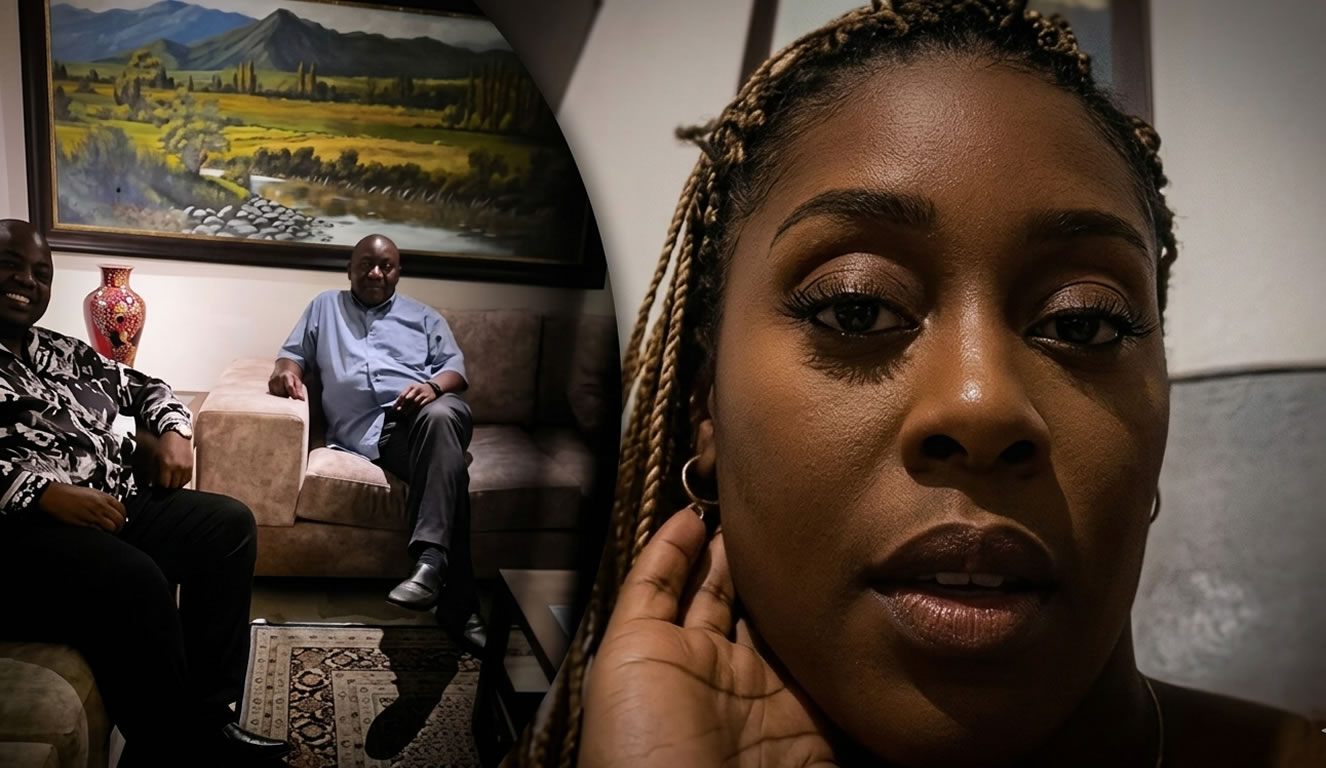
HARARE – On a cool Monday evening, the 18th of May 2024, Sonja Madzikanda found herself in a place she likely never imagined when she married one of Zimbabwe’s most flamboyant and controversial figures. Detained within the walls of the Highlands Police Station in Harare, the ex-wife of tender tycoon Wicknell Chivayo was not there for a routine matter. She was the centrepiece of a high-stakes legal drama that threatens to pull the curtain back on the clandestine relationships between African business elites and the heads of state who govern them.
The official charge levelled against Madzikanda is the theft of an electronic device. However, the true currency of this dispute is not the hardware itself, but the digital data it allegedly contains: a “compromising” video of South African President Cyril Ramaphosa. This arrest, initiated by Chivayo, has ignited a firestorm of speculation, suggesting that what began as a bitter domestic fallout has mutated into a potential exposé of regional power dynamics, blackmail, and political influence.
The Video That Shouldn’t Exist
The core of the controversy revolves around a piece of footage that directly challenges the official narrative of the South African presidency. On the 3rd of May 2024, President Ramaphosa visited Zimbabwe, where he was seen being welcomed by President Emmerson Mnangagwa. In the background, visible and smiling, was Wicknell Chivayo. At the time, Ramaphosa’s spokesperson, Vincent Magwenya, was quick to distance the President from the businessman, describing Chivayo as a “person of interest” to South African law enforcement and insisting that the two had never met before that day.
The alleged video, however, tells a different story. According to sources and a screen-grab that has since circulated on social media, the footage depicts Chivayo meeting Ramaphosa in an informal, private setting well before the official visit. In the image, a tieless Ramaphosa sits on a sofa, appearing relaxed and engaged in conversation with Chivayo. If this video is proven to be authentic, it suggests a clandestine relationship that contradicts the public stance of the Union Buildings in Pretoria.
Madzikanda, currently navigating a tumultuous divorce from the 45-year-old businessman, has been vocal about the origins of this footage. She claims that Chivayo himself was the one who shared the video as a display of his untouchable status. “I’m being arrested because he was sending around videos of him with heads of states threatening people,” Madzikanda stated in a video recorded from the police station. “So this is a message to all presidents who deal with Wicknell – he takes videos and he uses them to threaten people.”
But Muzukuru, is this not the corruption you are defending and promoting everyday and saying that it should take us to 2030 and beyond? Is this guy not the runner of your brother?
The degradation of the police has become a symbol of the corrupt second republic which reminds me… https://t.co/jNyWlapCkR
— Rutendo Matinyarare (@matinyarare) May 19, 2026
A Pattern of Proximity to Power
Wicknell Chivayo is no stranger to the limelight or the corridors of power. Known for his close ties to Zimbabwean President Emmerson Mnangagwa, Chivayo has built a brand around his access to the elite. His social media feeds are a gallery of “selfies” and private meetings with various African leaders, including the heads of Kenya, Tanzania, Mozambique, and Malawi. To his critics, these images are not merely souvenirs but tools of intimidation—visual proof that he operates within a sphere of protection that the average citizen, or even the law, cannot reach.
This latest incident, however, suggests that the protection may be fraying at the edges. Madzikanda’s legal team, led by South African lawyer Nolufefe Felicia Samalenge, has already taken the fight to Pretoria. They have filed a formal complaint with the chief prosecutor, alleging a disturbing level of collusion within the South African police service.
According to Samalenge, Madzikanda had previously filed a fraud complaint against Chivayo at the Sunnyside Police Station in Pretoria in February 2024. In a shocking turn of events, the confidential police statement was allegedly leaked directly to Chivayo. On the 11th of April, Chivayo reportedly contacted Madzikanda’s mother, Tabitha Madzikanda, forwarding a copy of the statement along with “unsavoury comments” and the very video of himself with Ramaphosa that is now at the heart of the arrest.
The lawyer’s complaint describes this as a “premature disclosure which carries the unpleasant odours of corrupt interaction with a suspect by an investigating officer.” It paints a picture of a man who does not just know people in high places but has the reach to manipulate the very systems designed to investigate him.


The $800 Million Shadow
To understand the intensity of the current battle, one must look at the financial stakes involved. Chivayo’s lifestyle—characterised by private jets, luxury vehicles, and million-dollar “donations”—has long been under scrutiny. In April 2024, just weeks before the current scandal erupted, the South African High Court delivered a significant blow to the businessman’s perceived invincibility.
Under Case No: 2024-006392, the court ordered the freezing of Chivayo’s bank accounts at FNB, Absa, and Standard Bank. Perhaps more significantly, it grounded his private jet, ordering the Airports Company of South Africa (ACSA) to block its movement. This intervention was tied to a high-impact investigation by the Financial Intelligence Centre (FIC) into the R800 million Ren-Form money laundering scandal.
The scandal involves the alleged siphoning of Zimbabwean taxpayer funds—intended for election materials—into South African accounts. While the Zimbabwe Anti-Corruption Commission (ZACC) had previously closed its probe into the matter citing a “lack of contractual evidence,” the South African judiciary was less convinced. The court acted on evidence that traced the movement of hundreds of millions of rand, money that critics argue should have been used to equip crumbling hospitals or repair the treacherous roads of Zimbabwe.
Madzikanda has been a central figure in this financial tug-of-war. As part of their divorce proceedings, she has sought to protect her interest in what she describes as joint matrimonial assets. Her success in the South African courts has inadvertently exposed the limitations of anti-corruption efforts within Zimbabwe, where Chivayo’s proximity to the “First Family” is often seen as a shield against accountability.
Personal Vendetta or Political Preservation?
As Sonja Madzikanda sits in detention, she maintains that the theft allegation is a calculated fabrication designed to silence her and strip her of her parental rights. She claims that Chivayo initially reported her for denying him access to their two minor children, and only when her legal team became involved did the “stolen device” narrative emerge.
“This is a man who is heavily guarded as you are all aware,” she remarked. “He has so many security guards around him and somehow I managed to get access to one of his devices and get a video of him with a president that’s very compromising. That is what I am now being arrested and detained for.”
The “compromising” nature of the video remains the subject of intense debate. Does it show mere social interaction, or does it hint at the “clandestine relationship” that the South African presidency is so desperate to deny? For Ramaphosa, the timing could not be worse. As he navigates the complex political landscape of South Africa, the suggestion that he has private, unpublicised dealings with a “person of interest” like Chivayo provides ample ammunition for his political opponents.
In Harare, the arrest of Madzikanda is seen by many as a classic display of “lawfare”—the use of legal systems to harass and intimidate. Chivayo has not yet commented publicly on the arrest, maintaining his usual silence on domestic matters while continuing to post images of his lavish lifestyle and political connections.
The Broader Implications
This story is more than a domestic dispute between an estranged couple. It is a window into the “donation diplomacy” that defines a certain class of African business. It is a tale of how personal relationships can be leveraged for political gain, and how sensitive information can be used as a weapon when those relationships sour.
The fact that a Zimbabwean citizen had to find justice in a Pretoria court to freeze the assets of a man accused of looting the Zimbabwean treasury is a stinging indictment of local institutions. It suggests that for the powerful, the law is often a negotiable commodity, while for those who dare to challenge them, it is a hammer.
As the legal proceedings continue, the pressure on the South African presidency to provide a more transparent explanation for the Chivayo-Ramaphosa interaction is mounting. Simultaneously, the Zimbabwean public is left to wonder how much more of their national wealth has been “donated” away while the institutions meant to protect them stand by with their hands in their pockets.
For Sonja Madzikanda, the immediate future is uncertain. But in her arrest, she may have achieved what years of investigative journalism and anti-corruption probes could not: she has forced the world to look at the hidden truths behind the flamboyant facade of Wicknell Chivayo. The “billionaire” playground is under siege, and the walls of protection, once thought to be impenetrable, are showing deep and irreversible cracks.
The story of the Ramaphosa video is not just about a single piece of footage; it is about the accountability of those who hold power and the lengths to which they will go to keep their secrets in the dark. As this investigative piece has shown, when the personal becomes political, the fallout is rarely contained within the home. It spreads, exposing the rot at the heart of regional governance and leaving the public to demand the transparency they have so long been denied.