


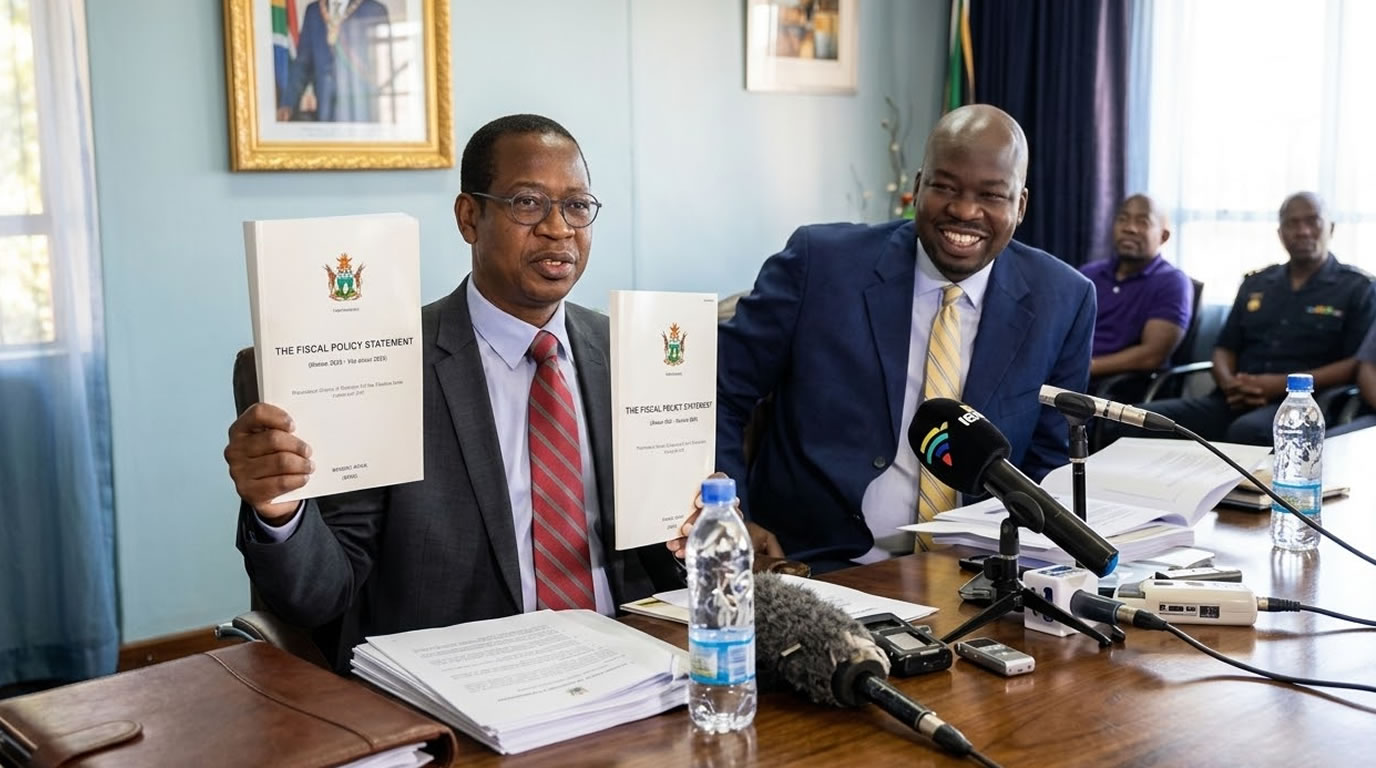
HARARE – In a revelation that has reshaped understanding of Zimbabwe’s political landscape, fresh details have emerged about how the late opposition icon, Morgan Tsvangirai, had already “hired” the current Finance Minister, Mthuli Ncube, long before the ruling party did. For years, citizens have viewed Ncube as a technocrat brought in by President Emmerson Mnangagwa to stabilise the economy. However, an investigative look into the opposition’s 2018 transition strategy reveals a different story. Dr Nkululeko Sibanda, a former spokesperson, has pulled back the curtain on a secret operation to recruit Oxford-based experts to run a future MDC Alliance government.
The plan was simple but bold. Tsvangirai knew that winning an election was only half the battle; the real challenge was fixing a broken economy. He tasked his inner circle with finding the brightest Zimbabwean minds in the diaspora. Sibanda admits he was the one who personally identified Mthuli Ncube in Oxford. At the time, Ncube was a respected academic, far removed from the daily bickering of Harare’s politics. The opposition believed that by placing a neutral, world-class economist at the helm of the Treasury, they could win international trust and unlock billions in credit lines.
This “shadow cabinet” was being assembled in total secrecy to avoid victimisation by state security agents. However, Tsvangirai’s untimely death in February 2018 threw the entire project into chaos. Without his leadership, the carefully curated list of technocrats was left in limbo. When Mnangagwa took over, he seemingly used the same playbook, reaching out to the same experts the opposition had courted. This raises a provocative question: Is Zimbabwe’s current economic policy actually a “stolen” opposition blueprint? By simplifying the hidden timelines of these recruitments, we see that the political divide in Zimbabwe is much thinner than it appears. The very man tasked with fixing the nation’s finances today was once the “secret weapon” of the man who spent his life fighting the system.
Mthuli Ncube’s Early Foray into Finance: The Barbican Bank Saga
Before his academic pursuits and his current role as Finance Minister, Mthuli Ncube had a significant, albeit controversial, stint in Zimbabwe’s banking sector. In 2003, he founded Barbican Bank under Barbican Holdings. However, its existence was short-lived. Just a year later, in 2004, the bank was placed under curatorship by the then Reserve Bank of Zimbabwe (RBZ) Governor, Gideon Gono.
This period was marked by a widespread clampdown on indigenous banks by the RBZ. The charge sheet against Barbican Bank, as with many others, listed serious infractions including weak corporate governance, insufficient capitalisation, and a high incidence of insider non-performing loans. The closure of Barbican Bank led to its assets being amalgamated into the Zimbabwe Allied Banking Group (ZABG). Following this tumultuous period, Ncube left Zimbabwe, relocating to the United States and later the United Kingdom, where he pursued an illustrious academic career at institutions like Oxford University and served as Vice President at the African Development Bank (AfDB). His return to Zimbabwe in 2018, as Finance Minister, marked a full circle, transforming him from a banker whose institution was shut down by the central bank to the very individual overseeing the nation’s financial health.
Tendai Biti’s Stewardship: A Beacon of Stability During the GNU
The narrative of Zimbabwe’s economic management cannot be complete without acknowledging the tenure of Tendai Biti as Finance Minister during the Government of National Unity (GNU) from 2009 to 2013. Biti, a lawyer by profession rather than an economist, is widely regarded as one of Zimbabwe’s most effective Finance Ministers.
His period at the Treasury was characterised by remarkable economic stabilisation following years of hyperinflation that had crippled the nation. Biti was instrumental in introducing the multi-currency system, effectively dollarising the economy, which brought an immediate halt to the runaway inflation. His famous mantra, “Eat what you kill,” underscored a commitment to fiscal discipline and prudent spending, a stark contrast to the financial profligacy that preceded and, arguably, followed his term. Under his stewardship, inflation plummeted from astronomical figures to single digits, and the economy experienced a period of relative growth and predictability. Biti’s approach prioritised transparency and economic recovery, earning him a reputation as a technocrat who put national interests above partisan politics, a quality that resonated deeply with many Zimbabweans and international observers alike.
The Mnangagwa-Ncube Alliance and Unfulfilled Political Ambitions
The relationship between President Emmerson Mnangagwa and Mthuli Ncube is a strong and often discussed aspect of contemporary Zimbabwean politics. Ncube’s appointment as Finance Minister in 2018 was seen as a strategic move by Mnangagwa to signal a new era of economic reform and re-engagement with the international community. Ncube, with his international academic and financial credentials, was presented as the ideal technocrat to steer Zimbabwe’s struggling economy. This alliance has been central to Mnangagwa’s administration, with Ncube often being the public face of economic policies, some of which have been met with both praise and criticism.
However, Ncube’s ambitions have not been limited to technocratic roles. He has actively sought to transition into a political figure, specifically aiming for a parliamentary seat under the ruling Zanu-PF party. His attempts to become a Zanu-PF Member of Parliament (MP) in Bulawayo, particularly in the Cowdray Park constituency, have been met with consistent electoral setbacks.
The Cowdray Park Conundrum: Free Wi-Fi and Electoral Defeat
Mthuli Ncube’s campaign for the Cowdray Park constituency in Bulawayo during the 2023 general elections became a notable case study in Zimbabwean politics. Despite his high-profile position as Finance Minister and a lavish campaign strategy, Ncube faced a significant defeat. His campaign was characterised by numerous developmental projects and incentives, including the installation of free Wi-Fi hotspots, road rehabilitation initiatives, drilling boreholes, and the establishment of “nutritional gardens”. These efforts were clearly aimed at endearing him to the local populace and demonstrating his commitment to improving their living standards.
However, these efforts did not translate into electoral success. In the August 2023 elections, Ncube, representing Zanu-PF, garnered 6,513 votes, while his opponent, Pashor Raphael Sibanda of the Citizens Coalition for Change (CCC), secured a decisive victory with 8,411 votes, accounting for 56.36% of the total. This outcome was particularly striking given the resources poured into Ncube’s campaign and the fact that the CCC itself faced internal challenges, including instances of double candidature in some constituencies, though this did not directly impact the Cowdray Park result against Ncube.
The defeat highlighted a disconnect between the perceived benefits of his developmental projects and the actual voting patterns of the residents. There were even reports, post-election, that the free Wi-Fi services he had installed were disconnected, although some sources indicated that they remained available at designated points. This incident further underscored the political challenges Ncube faced in gaining grassroots support in a region traditionally known as an opposition stronghold.
Adding another layer to the Cowdray Park saga, a by-election was held in December 2023 after Pashor Sibanda, along with other CCC MPs, was controversially recalled from Parliament by Sengenzo Tshabangu, who claimed to be the interim secretary-general of the CCC. While Ncube did not contest this by-election, the seat was ultimately won by Arthur Mujeyi of Zanu-PF, further illustrating the complex and often unpredictable nature of Zimbabwean electoral politics.
Conclusion: A Web of Interconnected Destinies
The journey of Mthuli Ncube, from a banking entrepreneur whose institution faced curatorship under Gideon Gono, to a respected academic, then a Finance Minister under Emmerson Mnangagwa, and finally a politician struggling to secure a parliamentary seat, is deeply intertwined with the broader political and economic narrative of Zimbabwe. The revelation of Morgan Tsvangirai’s secret plan to enlist Ncube for his own shadow cabinet adds a fascinating dimension, suggesting a convergence of ideas across the political divide that few would have anticipated.
This intricate web of relationships and events underscores the fluidity of political alliances and the enduring quest for economic stability in Zimbabwe. The contrasting fortunes of Ncube and Tendai Biti, both technocrats in their own right, offer a compelling study of leadership and economic management in a nation grappling with persistent challenges. As Zimbabwe continues its path, the legacies of these figures and the untold stories of their political manoeuvrings will undoubtedly continue to shape its future.