



CAB3 Hits Brickwall and The Matete Intervention: A Constitutional Roadblock for Mnangagwa’s Faction
Harare – A significant legal challenge has emerged against Zimbabwe’s controversial Constitution of Zimbabwe Amendment Bill No. 3 (CAB3), threatening to derail President Emmerson Mnangagwa’s political agenda, often referred to as ED2030. Youngerson Matete, a prominent civic activist, mechanical engineer by profession, who is also a sound political scientist, has taken the bold step of approaching the High Court, seeking to block key provisions of CAB3 unless they are subjected to a national referendum. This move has been widely lauded by critics of the bill and has introduced a new layer of complexity to the already contentious legislative process. To make matters worse, Zanu PF has never won a referendum, and chances that the party will win this one, are next to zero – especially considering that the party itself is sharply divided over CAB3.
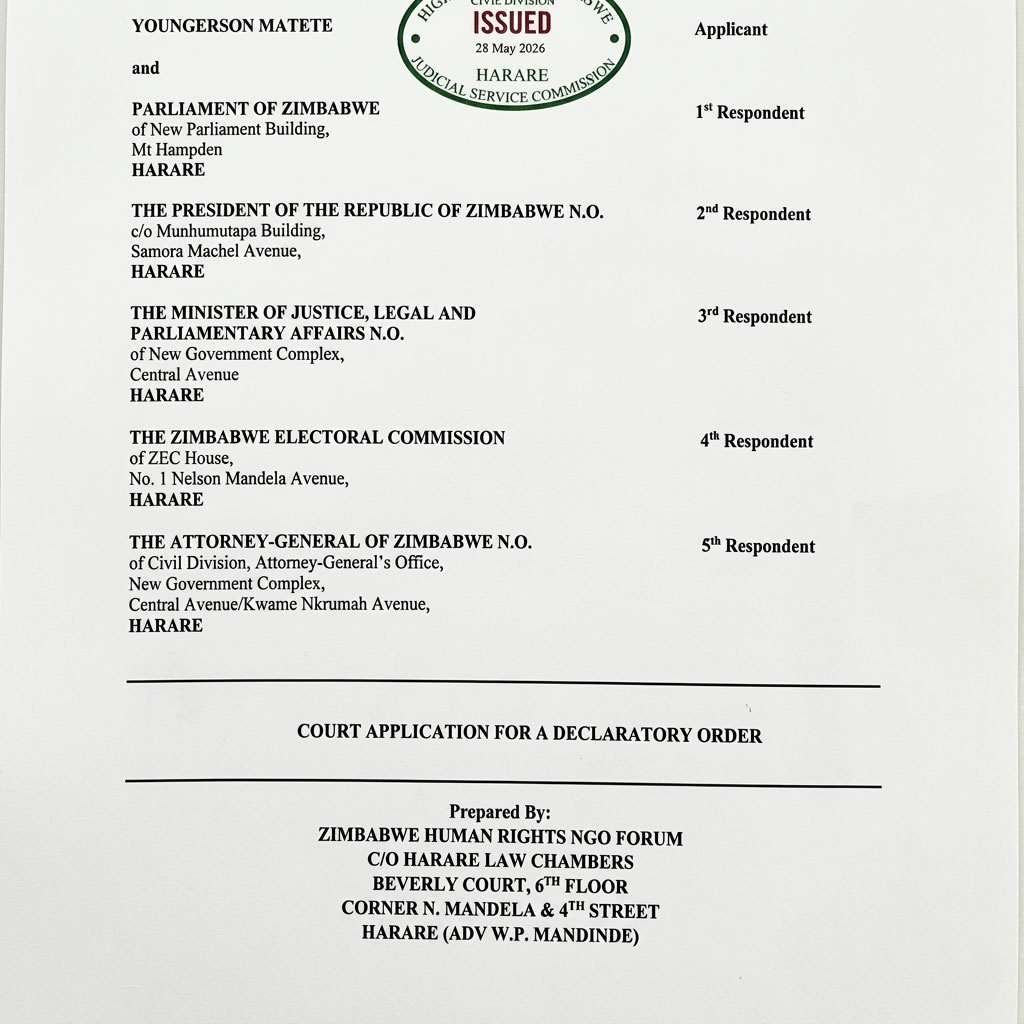
Matete’s application, filed against the Parliament of Zimbabwe, President Emmerson Mnangagwa, Justice Minister Ziyambi Ziyambi, the Zimbabwe Electoral Commission (ZEC), and the Attorney-General, seeks a declaratory order to halt the enactment and implementation of clauses 4, 9, and 10 of CAB3. His central argument is that these provisions fundamentally alter Zimbabwe’s democratic structure and, as such, require direct public approval through a referendum, as stipulated by Section 328 of the Constitution.
The Contentious Provisions of CAB3
CAB3, gazetted in February 2026, proposes a raft of changes to Zimbabwe’s constitutional and electoral framework. Among the most contentious are:
- Extension of Terms of Office: The bill seeks to extend the terms of office for the President, Members of Parliament, and local authorities from five years to seven years. This particular provision has drawn widespread criticism, with opponents arguing it is a thinly veiled attempt to prolong President Mnangagwa’s tenure without due democratic process.
- Abolition of Direct Presidential Elections: Perhaps the most radical proposal, CAB3 aims to replace direct presidential elections with a system where the President is elected by Members of Parliament. This change would effectively disenfranchise millions of Zimbabwean voters, stripping them of their fundamental right to choose their head of state directly.
- Transfer of Voter Registration Duties: The bill proposes transferring voter registration duties from the independent ZEC to the Registrar-General, a move that critics fear could compromise the integrity and impartiality of the electoral process.
- Creation of a Separate Zimbabwe Electoral Delimitation Commission: This new commission would be responsible for delimiting electoral boundaries, raising concerns about potential gerrymandering and manipulation of electoral districts.
- Increase in Appointed Senators: The bill suggests increasing the number of appointed senators, which could further concentrate power within the ruling party and diminish the representative nature of the Senate.
- Dissolution of the Gender Commission: CAB3 proposes dissolving the Gender Commission and merging its functions into the Zimbabwe Human Rights Commission, a move that some fear could dilute efforts to promote gender equality.
Matete’s Legal Strategy: A Broad and Potent Challenge
Youngerson Matete’s legal challenge is not merely a symbolic gesture; it is a meticulously crafted strategic intervention designed to exploit the narrowest, most legally potent avenues available. A Twitter user, operating under the pseudonym ‘ZVAMAINGA MUHONDO @Muswatadzi’ who describes himself as a “Politics | Strategy | Law | Freedom Fighter,” commended Matete for lodging what he called a “powerful and well crafted application for a declaratory order at the High Court.”
In his detailed analysis, ‘ZVAMAINGA MUHONDO’ highlighted several key aspects of Matete’s application:
1. The Framing: Widest Possible Doorway
Matete approaches the High Court under Sections 85, 171, and 175 of the Constitution. This is described as the “widest possible doorway” for legal recourse. Section 85 grants standing to any person alleging a violation of the Bill of Rights, Section 171 vests the High Court with jurisdiction over civil and criminal matters, and Section 175 empowers the High Court to make declaratory orders. This broad jurisdictional base is deliberate, aiming to deprive the respondents of any argument regarding Matete’s lack of standing or the court’s authority.
The respondents cited in the application include Parliament, the President, the Minister of Justice, the Zimbabwe Electoral Commission, and the Attorney General. This comprehensive approach ensures that “every state organ with a role in the passage, enactment, or implementation of #CAB3 is cited. No institutional actor is left outside the reach of the order sought. The net is cast wide.” This is not a narrow challenge against a single respondent but a broad assault on the entire machinery of the amendment.
2. The Question Presented: A Procedural, Not Political, Inquiry
Crucially, Matete does not ask the court to delve into the merits of CAB3 or the succession dispute within ZANU PF. Instead, he poses a “narrowest, most legally potent question available: do clauses 4, 9, & 10 of #CAB3 fall within the ambit of provisions protected under Section 328, and can they lawfully be amended without a national referendum?”
This focuses the court on the procedural question – the process by which the amendments are being pursued – rather than the political implications. This is a direct challenge to the “Cabal’s” (a term used by the Twitter user to refer to the faction pushing CAB3) insistence that the referendum debate is a political demand, not a legal requirement. Matete has placed this question squarely before the High Court, demanding a legal answer.
3. The Legal Foundation: Section 328 and Term-Limit Provisions
The application rests firmly on Section 328 of the Constitution. Section 328(1) defines a term-limit provision as “a provision of this Constitution which limits the length of time that a person may hold or occupy a public office.” Section 328(7) is a critical safeguard, stating that an amendment to a term-limit provision, the effect of which is to extend the length of time a person may hold office, does not apply to any person who held that office before the amendment. This is described as a “shield” that is self-executing and does not require a referendum to activate.
Matete’s case argues that clauses 4, 9, and 10 of CAB3 amend Sections 95(2), 143(1), and 158(1), which govern the length of the presidential term, the life of Parliament, and the electoral cycle. If these are indeed term-limit provisions under Section 328(1), then the “shield is engaged,” meaning the amendment cannot apply to the incumbent President or the current Parliament without a referendum.
The Constitutional Court, in the case of Marx Mupungu v Minister of Justice, previously listed Section 95(2) among the “myriad of provisions that unquestionably constitute specific term limit provisions.” While the respondents may argue this was obiter dictum (a remark made in passing), Matete will contend that the Court was interpreting Section 328 and that determining which provisions fall under its definition was a necessary step in its reasoning.
4. The Relief Sought: Comprehensive and Enforceable
Matete seeks four specific orders from the High Court:
- A declaratory order that clauses 4, 9, and 10 fall within the ambit of Section 328 and cannot be amended without a referendum.
- A declaration that any attempt to enact those clauses without a referendum would be unconstitutional and void.
- An interdict barring Parliament, the President, and the Minister of Justice from taking any further steps toward enactment unless and until a referendum is held.
- A direction to the Zimbabwe Electoral Commission to facilitate and conduct that referendum.
This is comprehensive relief that goes beyond merely declaring the law. It actively enjoins every state actor involved in the amendment process from proceeding further and compels the electoral commission to prepare for a referendum. This leaves no room for the respondents to argue that the declaration is purely academic or that the court’s order can be circumvented. The relief sought is precise, mandatory, and enforceable.
5. The Strategic Timing: Coordinated Intervention
Matete’s application was filed on 20 May 2026, coinciding with the very day the Constitutional Court heard oral arguments in the Madhuku matter. This timing is not coincidental but a clear demonstration of coordinated strategic litigation.
The Madhuku application challenges the President’s conduct in presiding over Cabinet approval of an amendment from which he would personally benefit. The Matete application, on the other hand, focuses on the necessity of a referendum. As ‘ZVAMAINGA MUHONDO’ explains, “The two applications attack the same edifice from different angles. The Madhuku application is the frontal assault on the validity of the process. The Matete application is the flanking manoeuvre against the legality of the outcome. If either succeeds, #CAB3 is halted. If both succeed, the amendment is dead on arrival.”
According to ZVAMAINGA MUHONDO, this coordinated approach forces the “Cabal’s” lawyers to fight on two fronts, before two different courts, with two different legal standards, and two different timelines. This strategic litigation extends the timeline, injects uncertainty into the parliamentary process, and provides crucial cover for Members of Parliament who may wish to oppose the amendment but fear the repercussions of doing so openly.
Youngerson Matete: A Profile in Activism
Youngerson Yahwe Matete is a Zimbabwean civic activist and political scientist with a history of advocating for democratic participation. He is the founder and executive director of Project Vote 263, a non-partisan organisation dedicated to mobilising young people to register to vote and participate in elections. In 2021, Project Vote 263 set an ambitious target of registering three million young voters ahead of the general elections, actively working with local leaders to help citizens obtain identity cards necessary for voter registration.
Matete holds a technical qualification in Mechanical Engineering from Harare Polytechnic, obtained in 2014. Despite his engineering background, he has described himself as a qualified Class 1 fitter who became a full-time vendor due to the collapse of Zimbabwe’s industrial sector, a poignant reflection of the country’s economic challenges. He is also an alumnus of the 2023 Mandela Washington Fellowship, a flagship programme of the Young African Leaders Initiative (YALI), a U.S. government initiative that brings young leaders from Sub-Saharan Africa to American universities for leadership training.
His involvement in civic activism extends beyond Project Vote 263; he has also founded the National Constitutional Movement, the School of Governance and Center for Democracy, and the Africa Network for Democracy. He has been recognised by the Giraffe Heroes Project, an organisation that honours individuals who take personal risks for the common good, and is also a member of the Global Peace Chain. Matete has co-authored opinion pieces in The Zimbabwe Independent and The Standard with Liam Kanhenga, focusing on opposition politics and democratic change in Zimbabwe.
The Political Landscape and Factional Divides
The instructions provided highlight a crucial aspect of the political landscape surrounding CAB3. It’s only a fraction of Zanu PF that is rallying behind the CAB3, as the majority of Zimbabweans are against it. Even in Zanu PF itself, senior officials like Vice President General (Retired) Chiwenga and those in his faction are strongly against CAB3. So those who are fighting against the enactment of CAB3, while they face resistance from Mnangagwa’s faction, however, they are indirectly supported by the Chiwenga faction which wants the bill quashed at all costs.
This internal division within the ruling ZANU PF party is a critical factor. While President Mnangagwa’s faction is pushing for the bill’s enactment, the strong opposition from Vice President Chiwenga’s faction provides an unexpected layer of invisible support for those challenging CAB3. This suggests that the resistance to the bill is not solely from opposition parties and civil society but also from within the corridors of power, albeit through indirect means.
Broader Implications and Public Sentiment
The proposed amendments in CAB3 have ignited widespread public anger and concern. Critics argue that the bill is a direct assault on democratic principles, aiming to consolidate power and undermine constitutional safeguards. The move to extend presidential terms and abolish direct presidential elections is seen by many as a step towards authoritarianism, effectively silencing the voice of the electorate.
The submissions made by the Zimbabwe Catholic Bishops Conference, the Zimbabwe Council of Churches, and the Law Society of Zimbabwe, all raising concerns over the need for a referendum, underscore the broad-based opposition to CAB3. These influential bodies represent a significant cross-section of Zimbabwean society, and their collective voice adds considerable weight to the arguments against the bill.
The ongoing debate has revealed deep divisions within the country, with government officials maintaining that a referendum is not necessary, while critics vehemently argue otherwise. The potential for a rushed amendment, passed amidst public anger and legal challenges, could intensify social unrest and further destabilise the nation. International observers and human rights organisations are closely monitoring the situation, concerned about the implications for democratic governance and human rights in Zimbabwe.
The Road Ahead: A Battle for Constitutional Supremacy
Youngerson Matete’s legal challenge, coupled with the Madhuku application, sets the stage for a protracted legal and political battle. The courts are now faced with the monumental task of interpreting the Constitution and determining whether the proposed amendments can proceed without a national referendum. The outcome of these cases will have far-reaching consequences for Zimbabwe’s democratic future.
As ‘ZVAMAINGA MUHONDO’ concludes, “The Matete application is not merely a legal challenge. It is a strategic intervention, timed with precision, framed with discipline & designed to exploit the narrowest, most legally potent avenue available. It will not, by itself, defeat #CAB3. But it is not intended to. It is intended to slow the advance, to extend the timeline, to provide cover for dissent, and to force the judiciary into a choice it would prefer to avoid.”
The CAB3 supporters now face a formidable challenge on multiple fronts. The September clock ticks, and the shield of constitutional safeguards holds. The courts are being asked whether the Constitution truly means what it says, and the answer will undoubtedly shape the trajectory of Zimbabwe’s political landscape for years to come.