


THE HIGHWAY TO HEMP: INSIDE ZIMBABWE’S MULTI-MILLION DOLLAR DRUG SMUGGLING CRISIS
HARARE – The rhythmic hum of heavy-duty engines on Zimbabwe’s highways usually signals the movement of essential goods, fuel, and regional trade. However, behind the steel doors of massive containers and the floorboards of long-distance buses, a far more lucrative and illicit trade is flourishing. In a series of high-stakes operations that have laid bare the sheer scale of the nation’s narcotics problem, law enforcement agents have recently intercepted record-breaking shipments of “mbanje” (cannabis) and other prohibited substances, pointing to a sophisticated smuggling network that spans the Southern African Development Community (SADC) region.
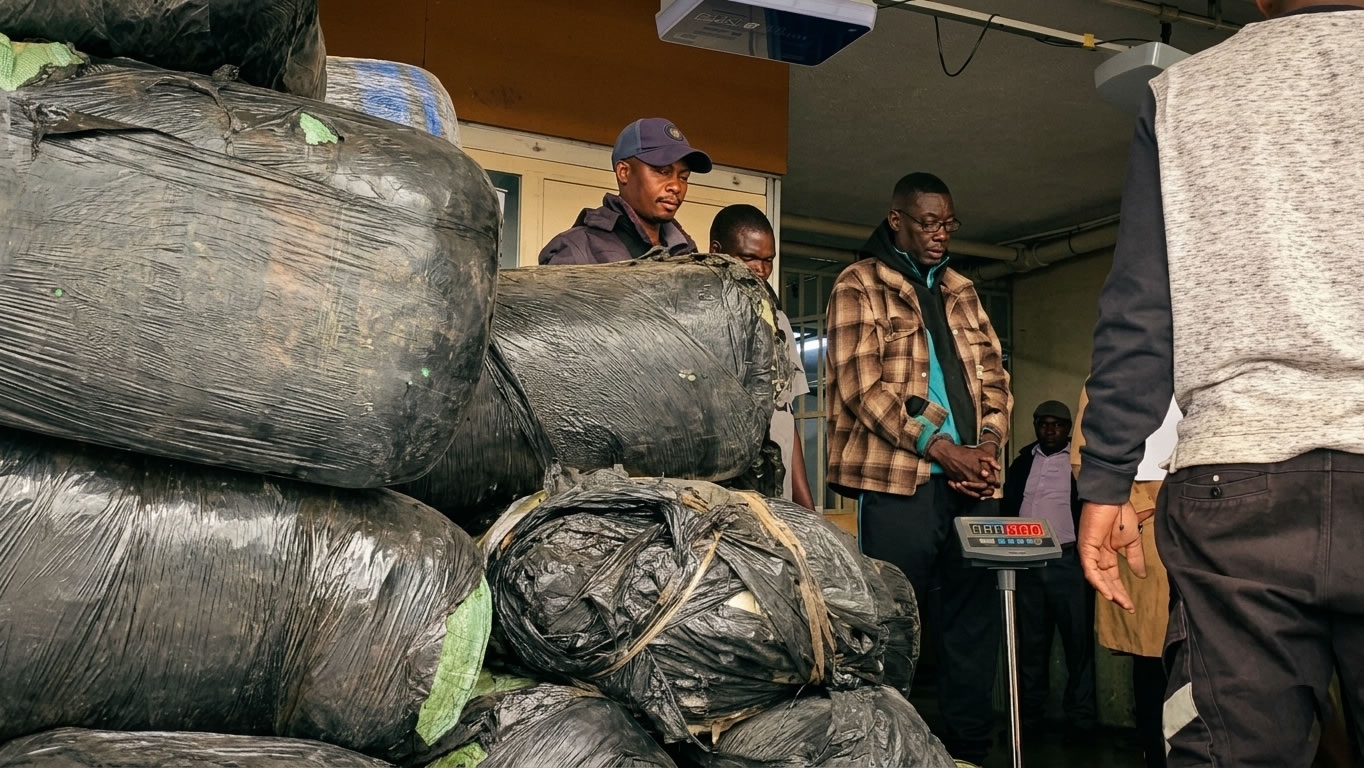
The latest and perhaps most significant blow to these syndicates occurred in the industrial heart of Southerton, Harare. Tapson Ndou, a 58-year-old truck driver, found himself at the centre of a massive police operation yesterday. Ndou was intercepted by the hard-working officers from the infamous Southerton police station while behind the wheel of a heavy-duty vehicle that was not carrying the industrial supplies one might expect in Southerton, but rather a staggering consignment of more than one tonne of mbanje.
Investigators believe the cargo, which has a street value running into millions of dollars, was loaded in a neighbouring country. The sheer volume of the seizure – 1,000 kilogrammes of compressed cannabis – suggests that this was not a small-scale operation but part of a well-oiled machinery designed to flood the streets of the capital with illicit drugs. Ndou’s arrest is seen as a pivotal moment in the ongoing “War on Drugs” declared by the Zimbabwean government, yet it is only one piece of a much larger, more complex puzzle.
The Bulawayo Connection: A Cross-Border Trail
While the Southerton bust dominated headlines in the capital, a parallel operation in Bulawayo further illustrated the regional nature of the trade. National Police spokesperson Commissioner Paul Nyathi confirmed the arrest of five men who were intercepted along the Bulawayo–Solusi Road. The suspects – Gordon Nkowu (58), Nkosiyabo Moyo (57), Shepherd Nkomo (43), Beven Sibanda (40), and Isaiah Moyo (31) – were travelling in a Toyota Hilux Single Cab, registration number DN08VG-GP.
The vehicle was towing a trailer, registered KW27Y2-GP, which appeared ordinary to the casual observer. However, upon inspection, police officers discovered 360 kg of mbanje, valued at approximately ZiG 10,800,000. This particular shipment revealed a circuitous smuggling route that highlights the porous nature of regional borders. According to police reports, the dagga was smuggled from South Africa via Botswana before entering Zimbabwe.
“Police continue to intensify the fight against drug and substance abuse across the country,” said Commissioner Nyathi. He added that police recently arrested suspects in Beitbridge, Mutare, and Harare for unlawful possession of illicit drugs and dangerous substances, resulting in the recovery of various drugs and substances.
The Vulnerable Gateways: Beitbridge and Beyond
The arrest of drivers like Tapson Ndou and the Bulawayo quintet is part of a recurring pattern. For investigative journalists tracking these trends, the border town of Beitbridge remains the primary “eye of the needle.” It is here that the majority of commercial traffic enters Zimbabwe from South Africa, and it is here that many smugglers meet their match.
Only weeks ago, in April 2026, security agents deployed at the Beitbridge Border Post intercepted another commercial truck driver, Edgar Maroto. Maroto was found in possession of 692 kg of mbanje, which he had allegedly loaded in Musina, Limpopo province. The drugs, valued at over US$69,000, were destined for Harare. Like many before him, Maroto had used the cover of legitimate commercial transport to hide 34 massive bales of the prohibited herb.
The trend extends beyond trucks to the public transport sector. Long-distance buses, often preferred for their ability to blend into the heavy flow of passenger traffic, have become mobile warehouses for drug mules. At the Dulivhadzimu Bus Terminus in Beitbridge, police recently apprehended a bus driver after recovering 40 kg of mbanje hidden within the vehicle’s luggage compartments. The street value of such a haul, while smaller than the tonne seized in Southerton, still represents a significant profit for the syndicates involved.
Beyond Mbanje: The Bronco Menace
While cannabis remains the most commonly seized substance due to its bulk, the smuggling of “Bronco” (BronCleer cough syrup) and other pharmaceutical drugs is equally rampant. In Masvingo, a 27-year-old truck driver was recently caught red-handed with 12,500 bottles of BronCleer. The cough syrup, which contains codeine and is highly addictive, is often smuggled from South Africa where it is more readily available.
The logistics of these operations are often impressive. In one instance at the Beitbridge Border Post, ZIMRA officers intercepted a truck carrying 4,300 bottles of BronCleer with a street value estimated at $866,000. These figures underscore the financial incentives that drive drivers to risk their freedom. For a driver earning a modest salary, the promise of a “delivery fee” that could equal several months’ wages is a powerful, albeit dangerous, temptation.
The Price of the Trade: Sentences and Sanctions
The Zimbabwean judiciary has begun to take a harder line on drug traffickers, reflecting the government’s stance that drug abuse is a national security threat. The sentences handed down in recent months serve as a grim warning to those considering entering the trade.
In a notable case at the Chitungwiza Magistrates’ Court, 56-year-old truck driver Desire Madiviko was sentenced to an effective five-year prison term. Madiviko had been caught using his vehicle to transport a significant quantity of dangerous drugs, and the magistrate noted that “as a person in a position of trust on the highways, the betrayal of that trust to facilitate the destruction of the youth through drugs warranted a custodial sentence.”
The severity of Zimbabwe’s drug laws was also felt by foreign nationals. In August 2025, two young British citizens, Tihaise Darlin Elisha (19) and a 21-year-old female companion, were each sentenced to nine years in prison after being caught with nearly 70 kg of cannabis in their suitcases upon arrival. Although three years of their sentences were suspended on the condition of good behaviour, the six-year effective term sent a clear message: Zimbabwe is no longer a “soft touch” for drug traffickers.
For larger hauls, such as the one tonne found with Tapson Ndou, the legal consequences are expected to be even more severe. Under the Dangerous Drugs Act, the possession and trafficking of such quantities can lead to decades behind bars, especially if the suspects are found to be part of an organised criminal group.
The Changing Face of Enforcement
Commissioner Paul Nyathi has been vocal about the need for a multi-agency approach to curb the flow of narcotics. The Zimbabwe Republic Police (ZRP) has intensified its “Clean Up Zimbabwe” operation, which involves not just roadblocks but also intelligence-led raids on “bases” where these drugs are distributed.
“The public is urged to remain vigilant and report drug dealers, suppliers and peddlers to the nearest Police Station,” Commissioner Nyathi emphasised during a recent briefing. The police have also called for greater regional cooperation, noting that the “South Africa-Botswana-Zimbabwe” route used by the Bulawayo suspects requires a coordinated response from all three nations.
However, the challenge remains daunting. The economic situation in the region means that there is a constant supply of willing “mules” – often desperate drivers or unemployed youths – who are prepared to take the risk for a payout. Furthermore, the sheer volume of traffic at borders like Beitbridge makes 100% inspection impossible without causing a total collapse of regional trade.
A Community in the Crosshairs
The impact of these drugs is visible in almost every high-density suburb in Zimbabwe. From the “ghettoes” of Mbare to the streets of Bulawayo, the rise in “crystal meth” (mutoriro) and mbanje use has been linked to a spike in violent crime, mental health issues, and the breakdown of the family unit.
Investigative efforts have revealed that the one tonne of mbanje seized from Tapson Ndou was likely destined for “distributors” who would have broken the haul down into thousands of small “sachets” for sale to school children and unemployed youths. This “retail” end of the trade is where the most damage is done, yet it is the “wholesale” end – the truck drivers and the smugglers – that provides the lifeblood for the entire industry.
As Tapson Ndou and the other suspects await their day in court, the battle on the highways continues. For every truck that is stopped in Southerton, there are fears that others may be slipping through the net, hidden in plain sight among the thousands of vehicles that traverse Zimbabwe’s roads every day. The war on drugs is far from over, but with every tonne seized, the authorities hope to slowly choke the supply lines that have brought so much misery to the nation’s doorsteps.
The police continue to appeal to the public, reminding them that the fight against drugs is not just a law enforcement issue, but a battle for the very soul of the nation. As the engines of the long-haul trucks continue to roar across the borders, the vigilance of the men and women in uniform remains the only barrier between a stable society and a nation under the thumb of drug lords.