


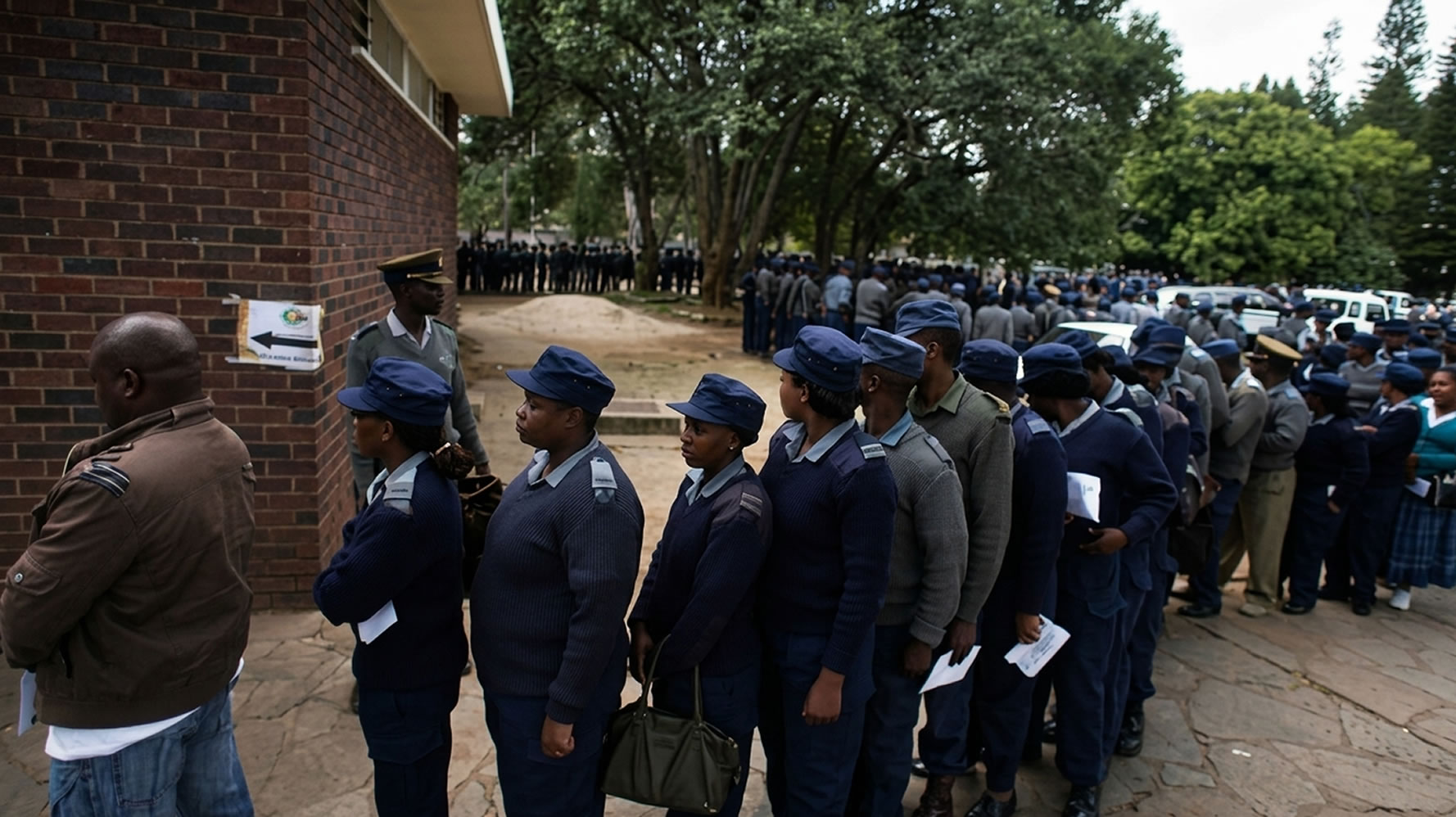
Zimbabwe Police Launch Recruitment Drive Amidst Calls for Public Vigilance and Rebranding Efforts
Harare – The Zimbabwe Republic Police (ZRP) has embarked on a significant recruitment drive for 2026, aiming to bolster its human resources as it continues a comprehensive transformation. This initiative seeks to adopt a new organisational structure and rebrand its image, with the ultimate goal of winning back public confidence. However, this crucial exercise is unfolding against a backdrop of persistent warnings regarding recruitment fraud and ongoing scrutiny of the force’s conduct.
Commissioner Paul Nyathi, the national police spokesperson, confirmed these developments, stating, “The Zimbabwe Republic Police is recruiting suitably qualified candidates who are Zimbabwean citizens, physically fit to join the organisation as general duty constables and train for a Diploma in Police Studies at Morris Police Academy, an affiliate of the University of Zimbabwe.” He further elaborated that applications are being sought for General Duty Constables, Construction Technicians and Artisans, and Tailor Technicians.
A Call to Service: Diverse Roles in the ZRP
The recruitment drive outlines specific criteria for various roles, reflecting a broader need for diverse skills within the police force. For General Duty Constables, applicants must be aged between 18 and 22 years, possess a minimum of five O-Levels, including Mathematics, English, and any other Science subjects, attained in not more than two sittings. Physical fitness is paramount, with male candidates required to have a minimum height of 1.68m and weigh no less than 57kg, while female candidates must be at least 1.60m tall and weigh a minimum of 55kg. All constable recruits must also be prepared to complete a 5km road run within 20 minutes for males and 25 minutes for females. General Duty Constables will undergo a one-year training programme at Mkushi Police Academy.
The ZRP is also seeking skilled professionals in Construction Artisans, encompassing roles such as Bricklayers, Carpenters, Tilers, Plumbers, Painters, Electricians, Welder/Boilermaker/Fabrication engineering technicians, and Refrigeration Mechanics. These applicants should be aged between 18 and 30 years and hold a minimum of five O-Level passes with a grade ‘C’ or better, including English Language and Mathematics, obtained in not more than three sittings. Crucially, they must possess a journeyman class one category, a national certificate, or a Diploma in a relevant field from a recognised institution. At least two years of practical industrial experience is considered an added advantage. Similar requirements apply to Technicians, including Civil Engineering Technicians, Quantity Surveyors, and Architectural Technicians, who must also be between 18 and 30 years old and hold relevant national certificates or diplomas.
For Tailor Technicians, the force is looking for individuals skilled in Industrial Clothing Technology, Industrial Clothing Machine Mechanics, Clothing Fashion Designing, and Clothing Design and Construction. Candidates in this category, aged 18-30, need a minimum of five O-Level passes with a grade ‘C’ or better, including English Language and Mathematics, obtained in not more than three sittings. A National Certificate, Diploma, or Degree in Textile Engineering or Textile Studies from a recognised institution is also required, with two years of practical industrial experience being an advantage. All artisan and technician recruits are expected to be apprenticeship-trained, physically and medically fit, and have a clean background with no previous convictions.
Applicants are instructed to submit handwritten application letters, including two contact numbers, a life history of 450 to 500 words, a copy of their identity document, and certified copies of educational/professional qualifications in person to the Officer in Charge of their nearest Police Station by Wednesday, 24 June 2026. Construction Technicians/Artisans and Tailor Technicians are additionally required to attach a detailed Curriculum Vitae (CV). The ZRP offers an attractive package, including good remuneration, free uniforms, free medical and dental care, housing and transport allowances, generous leave conditions, and opportunities for personal academic or professional development.
Rebuilding Trust: A Long Road Ahead
The current recruitment drive is part of a broader strategy by the ZRP to rebrand and restore public confidence, an effort that has been ongoing for several years. In late 2019, the ZRP embarked on a national rebranding exercise, which included refresher training courses for both junior and senior officers. These courses covered critical areas such as crime management, corruption, discipline, customer care, public order management, cyber-crime, and community policing.
Commissioner-General Godwin Matanga has consistently emphasised the importance of discipline and integrity among officers, stating that their actions must reflect the new brand the organisation envisions. He acknowledged that public criticism and feedback are vital for reforming and improving service delivery, asserting that the force derives its legitimacy from the people and must operate under public scrutiny. This rebranding initiative followed a period where public trust in the police, particularly under former Commissioner-General Augustine Chihuri, had significantly eroded due to perceptions of corruption, especially within the traffic section. The ZRP also committed to implementing recommendations from the commission of inquiry into the August 1, 2017, post-election violence, which called for enhanced skills, professionalism, and non-partisanship within the force.
Despite these stated commitments, the path to full public trust remains challenging. Reports from organisations like Human Rights Watch indicate that in 2025, the Zimbabwean government, including law enforcement, continued to intensify restrictions on civic space and freedom of expression, association, and peaceful assembly. This included the signing of the Private Voluntary Organizations Amendment Act in April 2025, which significantly curtails freedom of association and expression, allowing authorities to deregister and seize assets of non-governmental groups deemed ‘politically partisan’. Furthermore, instances of arbitrary arrests, detention, and alleged ill-treatment of human rights defenders, activists, and journalists continued to be reported, raising concerns about the misuse of the criminal justice system against critics. Such incidents, including the arrest and detention of journalist Blessed Mhlanga and an opposition council member for criticising the President, underscore the complexities in the ZRP’s journey to regain widespread public confidence.
The Dark Underbelly: Pervasive Recruitment Fraud
Crucially, the ZRP’s recruitment efforts are constantly undermined by rampant fraud. Commissioner Nyathi issued a stern warning to the public, cautioning them against fraudsters who exploit recruitment drives by promising employment within the Police Service in exchange for money. “Members of the public are warned against fake advertisements from social media platforms as well as individuals purporting to be members of the Zimbabwe Republic Police who may dupe them of their hard-earned cash under the pretext that they will be recruited into the police,” he stated.
This warning is not without merit. The period between 2025 and 2026 has seen a sharp increase in recruitment scams, with numerous fake advertisements circulating on social media platforms. These fraudulent schemes often target unsuspecting individuals, preying on their aspirations for employment. One particularly alarming incident involved a scam that lured 15 Zimbabwean citizens to their deaths in the Russia-Ukraine war, under the guise of lucrative job offers. Information Minister Zhemu Soda confirmed these tragic deaths, highlighting the severe consequences of such fraudulent recruitment schemes.
These scams often originate from imposter social media accounts and contain financial misinformation, designed to extract money from desperate job seekers. The ZRP has repeatedly dismissed fake recruitment messages circulating on platforms like Facebook and Instagram, urging the public to rely only on official communication channels. Superintendent A. Badza has been identified as the sole focal person for recruitment matters, with specific contact numbers provided for legitimate inquiries.
The Broader Context: Human Rights and Public Perception
The ZRP’s efforts to rebrand and improve its public image are inextricably linked to its conduct and adherence to human rights principles. While the force aims to foster community policing and uphold law and order, reports from human rights organisations paint a complex picture. The Human Rights Watch World Report 2026 for Zimbabwe highlights concerns about the government’s continued suppression of dissent and restrictions on fundamental freedoms.
The Private Voluntary Organizations Amendment Act, signed into law in April 2025, has been criticised for curtailing freedom of association and expression, granting authorities broad powers to monitor and deregister non-governmental organisations. This legislative environment, coupled with instances of arbitrary arrests and detentions of activists and journalists, raises questions about the ZRP’s operational independence and its commitment to a truly reformed image. For example, the arrest of journalist Blessed Mhlanga in February 2025 for interviewing a ZANU-PF member who criticised President Mnangagwa, and the subsequent 71-day pretrial detention, illustrate the challenges faced by those perceived as critical of the government. Similarly, the detention of an opposition council member for sharing a TikTok video critical of the President further underscores these concerns.
These incidents, where individuals are targeted for expressing dissenting views, can significantly undermine public trust, regardless of rebranding efforts. The perception of a police force that is used to stifle opposition or suppress free speech can overshadow initiatives aimed at improving service delivery and community engagement. The report also notes that despite evidence of torture and ill-treatment of activists, no one has been held accountable, further eroding confidence in the justice system.
Historical Challenges and Ongoing Reforms
The ZRP’s journey towards regaining public confidence is not new. The force has faced historical challenges, including accusations of corruption and partisan policing. The rebranding exercise initiated in 2019 was a direct response to these issues, aiming to move away from the negative perceptions associated with the tenure of former Commissioner-General Augustine Chihuri. The recommendations of the Motlanthe Commission, which investigated the 2017 post-election violence, also played a crucial role in shaping the reform agenda, emphasising the need for a professional and non-partisan police service.
However, the political landscape in Zimbabwe often presents obstacles to these reforms. Reports of politically motivated violence, such as those instigated by the MDC-Alliance in 2019, as detailed in the Herald article, highlight the volatile environment in which the ZRP operates. While the police maintained that these demonstrations often degenerated into violence, the broader context of political tensions and accusations of suppressing opposition activities contribute to the ongoing debate about the ZRP’s role and impartiality.
Furthermore, the ZRP has been actively involved in tackling various crimes, including armed robberies, murder, rape, and cybercrime. The establishment of an anti-corruption specialised unit in 2018 and operations against illegal artisanal miners and machete gangs demonstrate the force’s efforts to address prevalent criminal activities. However, the effectiveness of these operations in truly transforming public perception depends not only on arrests but also on transparent investigations and accountability for all, regardless of their social standing.
The Way Forward: Balancing Recruitment with Accountability
The ZRP’s 2026 recruitment drive is a critical step in addressing human resource gaps and bringing in new talent with diverse skills. The emphasis on academic qualifications, physical fitness, and a clean background for all recruits is commendable. The inclusion of specialised roles like construction artisans and tailor technicians reflects a modern approach to policing, acknowledging the need for a multi-faceted force capable of addressing a wide range of societal needs.
However, for this recruitment drive to truly contribute to the ZRP’s rebranding and the restoration of public confidence, it must be accompanied by unwavering commitment to accountability, transparency, and respect for human rights. The pervasive issue of recruitment fraud must be aggressively tackled, with swift prosecution of perpetrators and robust public awareness campaigns to protect vulnerable job seekers. The tragic deaths of Zimbabwean citizens lured into foreign conflicts serve as a stark reminder of the devastating consequences of such scams.
Moreover, the ZRP must demonstrate its impartiality and commitment to upholding the rule of law, even when dealing with politically sensitive cases. Addressing concerns raised by human rights organisations, investigating allegations of misconduct, and ensuring accountability for abuses are paramount. Only through a consistent and demonstrable commitment to these principles can the Zimbabwe Republic Police truly achieve its goal of rebranding and earning the enduring trust and confidence of the Zimbabwean populace.