


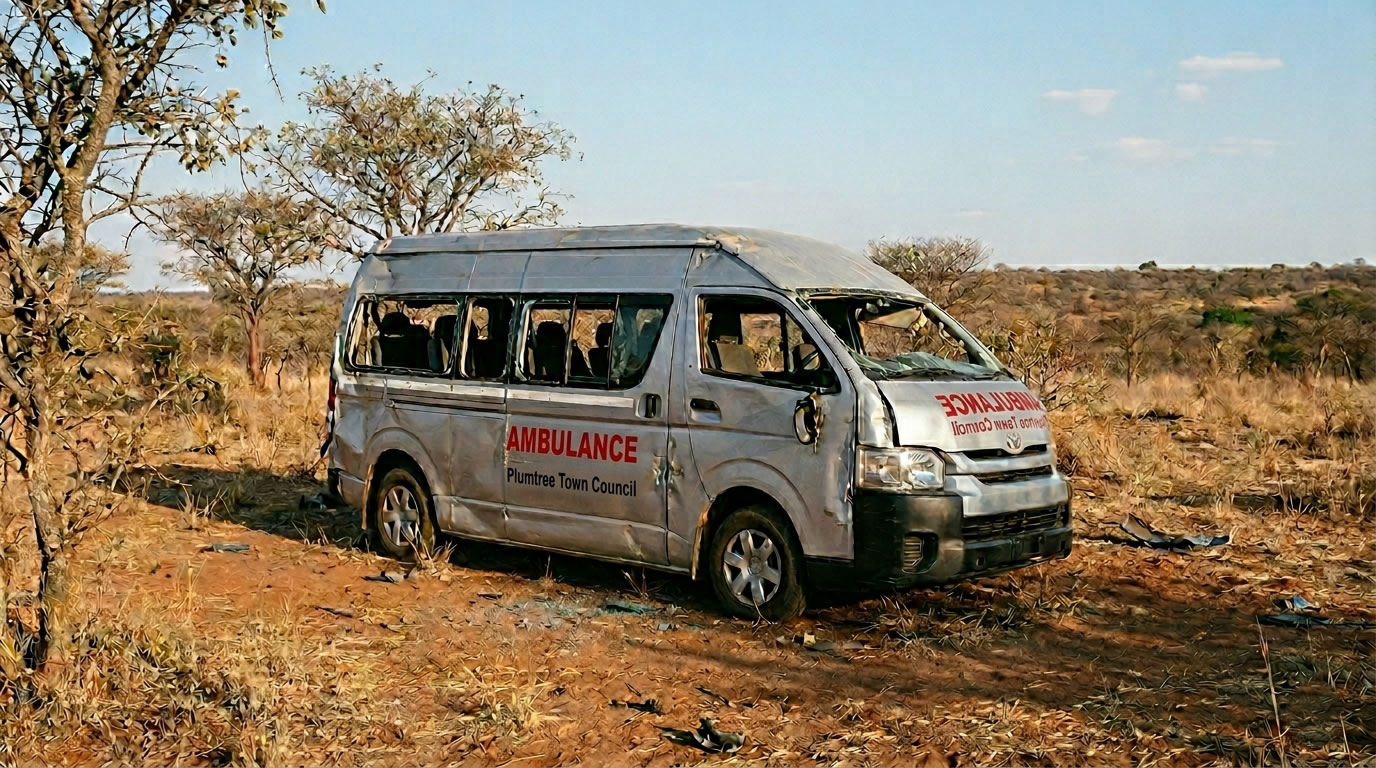
In the early hours of Monday, a silver Toyota Baby Quantum—Plumtree’s only functioning ambulance—was stolen from Dingumuzi Clinic and found hours later as a mangled wreck in a Marula field. The theft has forced the local council to suspend all emergency services, leaving thousands of residents without a lifeline. While the police hunt for the “midnight thieves” who fled the scene, the investigative angle looks at the “pattern of vulnerability” in our public health infrastructure. How does a town’s only emergency vehicle get driven away from a clinic without anyone noticing?
The hidden detail is the “security vacuum” at government clinics. For the average resident, the loss of this ambulance is a death sentence for those in urgent need. The simplified truth is that while the elite discuss “Vision 2030” in air-conditioned boardrooms, the basic tools of survival are being “stolen and rolled” by common criminals. The conspiracy theory suggests a “black market for parts,” where the sophisticated medical equipment inside the ambulance was the real target, and the crash was a result of a botched getaway. This story will follow the “tracks in the Marula dust” to show how the collapse of security and the desperation of the economy have combined to kill the only hope for the sick in Plumtree. It’s a documentary on a “town without a heartbeat.”
The vehicle was taken at approximately 3 a.m. from its regular overnight parking spot at Dingumuzi Clinic, where it is stationed to await emergency calls. It was discovered roughly two hours later, lying upside down, by villagers at Wilfred’s Hope Farm in Marula’s Ward 11, who reported hearing disturbing noises in the pre-dawn darkness. According to residents, the kombi appeared to have been travelling towards the Plumtree–Bulawayo Road when the driver lost control. The accident occurred just one kilometre before the junction with the main tarred R1 road, some 33 kilometres from Plumtree. No one was found at the scene, suggesting the perpetrators may have fled on foot.
The Criminal Investigation Department (CID) in Plumtree is investigating the matter, but no suspects have yet been arrested. In an official statement, Plumtree Town Council confirmed the theft and subsequent accident, announcing a complete suspension of its ambulance services.
“The general public is advised that the Council ambulance was stolen in the early hours of Monday, 8 June 2026. The vehicle has since been located. However, during the period when it was unlawfully taken, it was involved in a road traffic accident and sustained extensive damage,” the statement read. “As a result, ambulance services will be unavailable while we assess the required repairs to restore it or consider sourcing an alternative one.”
The Council added, “Council regrets any inconvenience this may cause. Members of the public requiring emergency medical transport services are encouraged to make alternative arrangements during this period.”
While the investigation will rightfully focus on identifying and prosecuting the individual responsible for this reckless theft, the incident cannot be dismissed merely as a criminal act. It represents a severe, self-inflicted wound on a community already navigating resource scarcity. The theft of an ambulance is not a victimless property crime. By targeting a vehicle specifically intended for life-saving interventions, the perpetrator has effectively disabled a critical arm of the local health system.
In a rural setting like Plumtree, where private ambulances are often unaffordable or geographically distant, this suspension directly translates to an increased risk of mortality from time-sensitive emergencies such as obstetric complications, road traffic accidents, or acute cardiac events. The Council’s admission that residents must now “make alternative arrangements” for emergency transport is stark.
This incident highlights a broader crisis in Zimbabwe’s healthcare infrastructure. The proliferation of counterfeit medical products and the theft of critical medical equipment have raised concerns over their impact on public health, safety, and the economy. Reports point to authorities selling hospital supplies in the black market, and the theft in the public health system is perpetrated by a wide range of actors.
The situation is so dire that in some communities, such as Jeka, a green-painted scotch cart proudly labelled “Community Ambulance” has become the only means of emergency transport. This “march back to the Middle Ages” underscores the desperation of rural populations who are left to fend for themselves in the absence of reliable public services.
The theft of the Plumtree ambulance is not an isolated incident but part of a larger pattern of vulnerability. The black market for medical equipment and vehicle parts is thriving, driven by economic desperation and a lack of security at government facilities. The sophisticated medical equipment inside the ambulance was likely the real target, and the crash was a result of a botched getaway.