


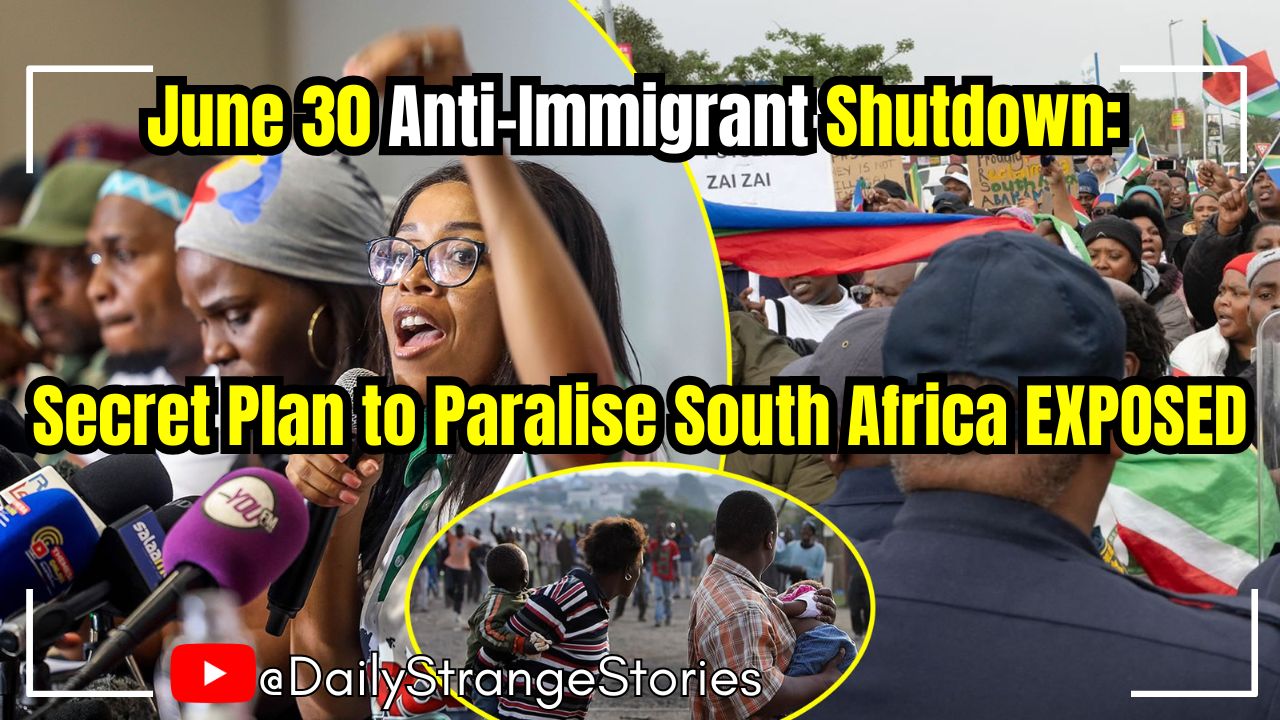
Johannesburg – Can a single date on a calendar bring an entire nation to a complete standstill? Hello everyone, my name is John Brown. The question of whether South Africa is prepared for the events of 30 June 2026 is being asked across the country. This date marks a deadline set by the March and March movement, led by Jacinta Ngobese-Zuma. Once a celebrated radio personality and MTN Radio award winner from Vuma FM in KwaZulu-Natal, Jacinta Ngobese-Zuma’s journey from entertainment to political activism is a narrative of hidden details now coming to light.
As South Africa braces for a potentially volatile national shutdown on 30 June, the political landscape has been further charged by explosive accusations from African National Congress (ANC) Secretary-General Fikile Mbalula. In a series of recent statements, Mbalula has directly blamed the ruling Zanu PF government in Zimbabwe and former South African President Jacob Zuma for contributing significantly to the nation’s current problems, particularly the escalating immigration crisis and the underlying social tensions.
The looming 30 June deadline, spearheaded by the controversial March and March movement, has intensified calls for undocumented foreign nationals to leave South Africa. This has created a palpable atmosphere of apprehension, with authorities deploying substantial resources to prevent a repeat of past unrest. Mbalula’s pronouncements have not only highlighted the deep divisions within South African politics but also cast a spotlight on the complex regional dynamics at play.
While Jacinta Ngobese-Zuma is the public face, the March and March movement also involves directors Sanele Khambule and Nozibusiso Khambule. These figures have significant links to former president Jacob Zuma, through the late Thokazile Jennifer Mbambo. Nozibusiso Khambule, also known as Nozi Zuma, is Mbambo’s daughter and the movement’s convenor, receiving donations into her personal ABSA account. Sanele Khambule, the treasurer, was even on the MK Party’s election list, solidifying the political ties behind this anti-immigrant movement.
Ironically, Jacinta Ngobese-Zuma’s potential as an influencer was noted by the United States government, inviting her to discuss women in media and participate in the US Department of State’s International Visitor Leadership Program on ‘Media Responsibility in an Age of Disinformation’. Yet, she now faces accusations of amplifying inflammatory claims about foreign nationals, including Nigerians and Zimbabweans.
Mbalula’s Blistering Attack: Zuma and Zanu PF in the Crosshairs
Fikile Mbalula did not mince his words when addressing the media. He unequivocally accused Jacob Zuma, now leader of the uMkhonto weSizwe (MK) Party, of acting irresponsibly by endorsing the slogan “Mabahambe” – a Zulu phrase meaning “They should go”. According to Mbalula, Zuma’s backing of this slogan is directly fuelling hostility towards other Africans ahead of the planned protests. “Jacob Zuma has endorsed March and March and effectively embraced its position,” Mbalula stated, further adding that Zuma’s secretary-general had mentioned him and the president by name in defence of illegal activities.
Mbalula’s criticism extended beyond Zuma to the Zimbabwean government. He explicitly laid the blame for a significant portion of South Africa’s immigration challenges at the feet of the Zanu PF government led by Emmerson Mnangagwa. He asserted that the economic collapse in Zimbabwe during the late President Robert Mugabe’s era had driven an unprecedented number of people across the Limpopo River into South Africa in search of survival. This is a notable shift in rhetoric, as the ANC and Zanu PF have historically maintained close ties, often referring to each other as “sister parties”.
The Zuma Connection: “Mabahambe” and the MK Party
The former President Jacob Zuma’s involvement in the current tensions is multifaceted. Having been expelled from the ANC in July 2024 for supporting the MK Party, Zuma has since become a vocal critic of the ANC-led Government of National Unity (GNU). Political analyst Dr Bernard Sebake, Dean of Students at the Central University of Technology in the Free State, suggested that Zuma is using the immigration issue to highlight perceived failures of the current government.
Sebake explained, “In terms of the ability to guard South Africa’s borders, we have illegal immigrants because of shortcomings in the system that has been put in place to manage the flow of migrants entering the country in different ways.” He added that Zuma, through the MK Party, is acting as an opposition figure, attempting to win voter support.
Mbalula, however, countered that Zuma bears some responsibility for the very issues he now criticises. He argued that many of the immigration challenges developed during Zuma’s own presidency, from May 2009 to February 2018. “How can someone who was a leader not so long ago appear on a public platform and call for actions that could fuel violence? Does he understand the consequences?” Mbalula questioned, accusing Zuma of supporting the March and March movement for political gain.
More pointedly, Mbalula drew parallels between the current mobilisation and the devastating civil unrest of July 2021. He stated, “Because what is unfolding on some of our streets is not at its heart about immigration at all. We have seen this architecture before. In July 2021, our country was dragged to the very edge of the abyss by a coordinated assault dressed up as a grievance.” He warned that the current situation carried the same “fingerprints,” suggesting that “unlawful immigration is being manipulated by new political formations, a convenient cover by political formations whose real purpose is to manufacture chaos. To collapse the institutions of the state and to engineer unfair conditions on the very eve of our local government elections”. The 2021 riots, which followed Zuma’s imprisonment, resulted in over 350 deaths, more than 5,500 arrests, and an estimated R50 billion in economic losses, primarily affecting KwaZulu-Natal and Gauteng. The upcoming local government elections are scheduled for 4 November 2026.
Zimbabwe’s Economic Collapse: A Regional Burden
The economic turmoil in neighbouring Zimbabwe has long been a significant factor in regional migration patterns. Mbalula highlighted this, stating, “When Zimbabwe’s economy collapsed, we saw unprecedented numbers of people crossing the Limpopo River, often risking their lives, to come to South Africa in search of survival.” He directly linked this migration to the economic crisis that followed Zimbabwe’s land redistribution programme and the subsequent withdrawal of international investment and support.
This influx has placed considerable strain on South Africa’s resources and social services, contributing to the anti-immigrant sentiment that the March and March movement now capitalises on. Mbalula pointed out that the ANC government had even introduced exemption permits for Zimbabweans due to the scale of the challenge, acknowledging the deep-seated nature of the issue. He explicitly named the Zanu PF government of Emmerson Mnangagwa as the “cause” of the immigration crisis, linking it to the economic collapse and the “withdrawal of international investment” after the land redistribution programme.
The March and March Movement: A Catalyst for Tension
The March and March movement, established in March 2024, is a civic organisation focused on illegal immigration. It is at the forefront of the planned 30 June shutdown, advocating for the departure of undocumented foreign nationals. The movement’s leader, Jacinta Ngobese-Zuma, has been a prominent voice in these calls. Despite sharing a surname, she is not related to former President Jacob Zuma, though she has been seen addressing MK Party supporters.
Ngobese-Zuma has denied claims that her movement is funded by political parties or foreign entities, stating that March and March is not funded by Israel or any foreign government. However, Mbalula has linked the movement’s activities to Zuma’s broader political strategy, suggesting it is an attempt to weaken the ANC, particularly in KwaZulu-Natal.
The movement has also drawn criticism for its use of cultural symbols. Mbalula condemned the misuse of Zulu heritage symbols, such as Amabutho (Zulu regiments), to incite violence. He stated, “Amabutho are a heritage institution that we hold in the deepest admiration and respect. They are the pride of our nation’s history. And they must never be abused or hijacked as a cover for nefarious and criminal acts.” He further clarified that these regiments were “raised to defend the nation and its people. Not to terrorise the vulnerable, to loot the trader or to burn the home of the poor”. He urged for peaceful solutions to immigration and economic challenges, rather than resorting to actions that undermine social cohesion.
The Human Cost and Government Response
The escalating tensions have already had tragic consequences. Recent reports indicate that five Mozambican immigrants have been killed in xenophobic attacks, highlighting the very real dangers faced by foreign nationals in South Africa. These incidents underscore the urgent need for a measured and lawful approach to the complex issue of immigration.
In response to the planned shutdown and the potential for unrest, the South African government has allocated a substantial R600 million for a national security operation. Acting Police Minister Professor Firoz Cachalia has issued stern warnings that criminality, intimidation, incitement to violence, and the destruction of property will not be tolerated. The operation involves the deployment of police resources to potential flashpoints, with assistance from the private security sector, including Fidelity, and the potential mobilisation of the South African National Defence Force if the situation escalates. KwaZulu-Natal Premier Thami Ntuli has also issued a stark warning, stating, “We can never go back to 2021!” and vowing arrests ahead of the 30 June deadline.
Jacinta Ngobese-Zuma herself handed herself over to police in Durban in January 2026 over violence charges, though she claimed not to have been formally charged by June. This incident, coupled with the rising death toll among immigrants, paints a grim picture of the current climate.
A Nation Divided: Political Survival and the Path Forward
Mbalula’s recent statements represent a significant moment in South African politics. By directly attributing blame to both Jacob Zuma and the Zanu PF government, the ANC is attempting to navigate a treacherous political landscape ahead of the 30 June shutdown. The party is under immense pressure to address the legitimate concerns of its citizens regarding immigration, while simultaneously preventing xenophobic violence and maintaining regional diplomatic ties.
Dr Sebake noted that the central issue is the competing political narratives over who bears responsibility for the country’s migration challenges. While Zuma seeks to capitalise on public frustration, Mbalula argues that the issue is not new and requires a determined, state-led response, not vigilante action.
The praise from Mbalula for King Misuzulu, who has called for peace and rebuked anti-immigrant violence, further underscores the ANC’s efforts to de-escalate tensions and promote social cohesion. As the 30 June deadline approaches, the nation watches anxiously, hoping that dialogue and lawful processes will prevail over division and violence.