


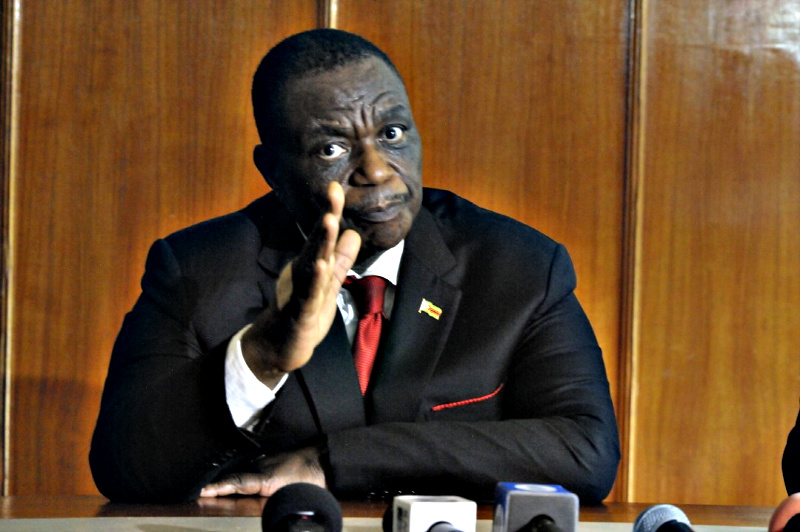
Harare – Vice President Constantino Chiwenga has once again captured national attention with a series of veiled pronouncements, sparking intense speculation about the intricate power dynamics within Zimbabwe’s ruling ZANU-PF party. His latest message, delivered through a biblical allegory, has been widely interpreted as a direct challenge to the controversial Constitutional Amendment Bill No. 3 (CAB 3) and a subtle call for greater public involvement in safeguarding the nation’s foundational legal document.
The Vice President’s recent address, captured in a video circulating on social media, saw him employing the biblical narrative of Lazarus to convey his message. Chiwenga recounted how Jesus, despite being informed of Lazarus’s illness, delayed his arrival, only to later involve Martha and Mary in the resurrection process. “When Lazarus fell sick, Jesus was told but he did not rush there. He continued with his lessons for four days before leaving for Lazarus’ home,” Chiwenga explained. “Martha and Mary asked why he had taken so long but he mourned Lazarus and asked people where they had buried him. Do you think Jesus did not know? He asked them because he wanted their participation. He asked them to open his tomb again because he wanted them to play a part in this miracle. They participated, and he only had to call out to Lazarus and he walked out of the tomb. Jesus went further to tell them to remove the clothes they had wrapped his body with”.
This allegorical tale, delivered to party supporters, was not merely a sermon but a potent political statement. It underscored Chiwenga’s belief that the populace should have been consulted, perhaps through a referendum, on significant constitutional changes. This stance directly contradicts the process by which CAB 3 has been advanced, a bill that has largely bypassed extensive public participation despite its far-reaching implications for the country’s governance structure.
The Contentious Constitutional Amendment Bill No. 3
Constitutional Amendment Bill No. 3 stands as a pivotal point of contention within Zimbabwean politics. The bill proposes sweeping changes that would fundamentally alter the nation’s political architecture. Among its most controversial provisions is the extension of the presidential term from five to seven years, effectively prolonging President Emmerson Mnangagwa’s tenure until 2030 without requiring fresh elections in 2028. Furthermore, CAB 3 seeks to abolish the direct election of the president by popular vote, instead reposing that authority to members of parliament sitting in a joint session of the Senate and National Assembly. This change would require a candidate to secure more than half the valid votes cast by MPs, a move critics argue could open the door to political manoeuvring and potential bribery within the legislative body.
Another significant aspect of CAB 3 is its erosion of provisions for automatic succession by the vice president in the event of the president’s incapacitation, resignation, or death. This particular amendment has been widely seen as a direct blow to Chiwenga’s political ambitions, effectively closing a clear path to the top office for him and Kembo Mohadi, the second of Mnangagwa’s two deputies. The bill’s proponents argue that longer terms would “eliminate election mode toxicity” and allow “sufficient time for project implementation”. However, opposition parties and legal experts contend that such extensions are unconstitutional and necessitate a national referendum to legitimise them.
Opposition activist Jacob Ngarivhume interpreted Chiwenga’s Lazarus analogy as a direct appeal to citizens to “save the country’s constitution, which he argues was ‘killed’ by Constitutional Amendment Number 3”. Ngarivhume elaborated on this, stating, “General Chiwenga is in another deep call to the nation through a sermon. He says our dear constitution, Lazarus, was sick through the CAB3 attack by the oligarchs in Zanu PF. He was told to help save the constitution, Lazarus, but did not do so on time. Lazarus died, and he asks them to remove the stone from the grave. The people must participate in raising the dead Lazarus, the constitution”. This interpretation highlights the deep-seated belief among some political observers that Chiwenga’s messages are not merely religious musings but carefully crafted political statements aimed at galvanising public sentiment against the proposed constitutional changes.
The King Hezekiah Sermon: A Precedent for Cryptic Warnings
Chiwenga’s use of biblical parables to convey political messages is not a new phenomenon. His latest Lazarus sermon follows a similar, equally potent address delivered earlier, which referenced the biblical story of King Hezekiah. This sermon, which angered some members of the Mnangagwa faction, served as a stark warning against the perils of unchecked power and the desire to cling to office.
In his King Hezekiah sermon, Chiwenga recounted the story of the Judean king who, upon being told by the prophet Isaiah that he would die, pleaded with God for more years. God granted Hezekiah an additional 15 years of life. However, this extension proved to be disastrous. In his pride, Hezekiah showed all his wealth and military secrets to visiting Babylonian envoys. The prophet Isaiah later warned him that Babylon would one day conquer Judah and steal all those treasures, a prophecy that came to pass, leading to Hezekiah spending the remainder of his extended life in captivity.
Chiwenga’s application of this parable was unambiguous. He stated, “Hezekiah reigned over Judah for a very long time, and became a very prominent king. He began to see himself as not fit for death and thought he was supposed to reign over Judah forever.” He continued, “God sent the prophet Isaiah to warn Hezekiah that his time was up, he had a few days to live and that he must put his affairs in order. But the king refused to accept it. Hezekiah would have none of it, hitting on the walls of the palace: ‘What kind of a God are you? There is no any other king who can reign like me.’”. The Vice President then delivered the chilling conclusion: “He never managed even three months (as king) of the extended period. He spent the extended 15 years down in jail. God did not take away the 15 years, he let him have them, but he was in jail”.
Factional Tensions and Political Fallout
The King Hezekiah sermon was widely interpreted as a direct jab at President Mnangagwa, who is perceived by many as seeking to extend his stay in power through CAB 3. The sermon intensified the ongoing power struggle and succession debate within ZANU-PF.
Temba Mliswa, a prominent politician and former ZANU-PF member, launched a scathing attack on Chiwenga following the King Hezekiah sermon, accusing the Vice President of undermining President Mnangagwa. Mliswa took to X (formerly Twitter) to express his dismay, stating, “This is as brazen an attack on the President as one can ever give and coming from his own Deputy its shocking. For one so close to the President to resort to this is diplomatically gross and strategically poor”.
Mliswa further criticised Chiwenga for “pandering to the whims of social media and the opposition by indulging in content creation,” suggesting that the Vice President was using biblical allegories to mask his direct opposition to CAB 3. “The subject matter, which he poorly dresses in Biblical frocks instead of explicitly stating his opposition to CAB3, as any serious politician would do, shows his level of frustration,” Mliswa wrote. He went on to challenge Chiwenga to resign if he genuinely opposed the direction of ZANU-PF, arguing that “Resigning, not metaphors, is the only redemptive path for him”. Mliswa also highlighted that CAB 3 was a “ZANU PF project” and that Chiwenga, as a cabinet member, had been part of the decision-making process.
These strong reactions from within the Mnangagwa faction underscore the deep divisions and mistrust that permeate the ruling party. Chiwenga, a former Zimbabwe Defence Forces commander and a key architect of the 2017 military coup that brought Mnangagwa to power, has long been considered a potential successor. However, CAB 3’s provisions, particularly those concerning presidential elections and succession, significantly dim his prospects, fuelling speculation that his cryptic messages are driven by succession politics rather than purely democratic principles.
Broader Implications and the Succession Battle
The ongoing political manoeuvring, characterised by Chiwenga’s allegorical warnings and the Mnangagwa faction’s defensive reactions, highlights the intense succession battle within ZANU-PF. The Africa Report noted that Chiwenga has “stopped short of openly opposing plans to extend President Emmangagwa’s rule to 2030,” but that “mounting mistrust inside ZANU-PF and intensifying succession tensions are fuelling fears of a deeper power struggle”.
Beyond the constitutional amendments, Chiwenga has also been vocal on issues such as corruption. In past statements, he has warned that corruption poses a significant threat to national security and state sovereignty, a stance that has been interpreted as another veiled criticism of elements within the ruling elite. These pronouncements, coupled with his recent biblical parables, paint a picture of a Vice President who, while not openly confronting the President, is actively using subtle means to express dissent and rally support.
The political landscape in Zimbabwe remains fraught with tension. Chiwenga’s continued use of cryptic messages, whether through biblical allegories or warnings against corruption, serves as a constant reminder of the unresolved power struggles within ZANU-PF. As CAB 3 progresses through the legislative process, the interpretations of these messages will continue to shape public discourse and influence the trajectory of Zimbabwean politics, with many watching closely to see how this intricate dance of power unfolds.