


The High Cost of Saying NO!: Epworth Man Left for Dead After Spurning National Hero’s Burial
HARARE – In the flickering shadows of the Manjemanje shops in Hopley Zone 6, the distinction between patriotic duty and personal survival was blurred with the jagged edge of a broken beer bottle. On the evening of 5 July 2026, Dillon Chisango, a 27-year-old resident of the sprawling Epworth settlement, made a choice that nearly cost him his life. His refusal to join the state-sponsored pilgrimage to the National Heroes Acre for the burial of Major General (Retired) Evaristo Dzihwema was met not with a debate, but with a brutal, systematic assault that has left him fighting for his breath in an intensive care unit.
The incident, which occurred at approximately 7:30 pm, has cast a harsh spotlight on the persistent climate of political intolerance that continues to simmer beneath the surface of Zimbabwean society. While the state media focused on the “dignified send-off” of a military stalwart, the reality on the ground in Harare’s peripheries told a different story—one of coercion, intimidation, and the violent enforcement of conformity.
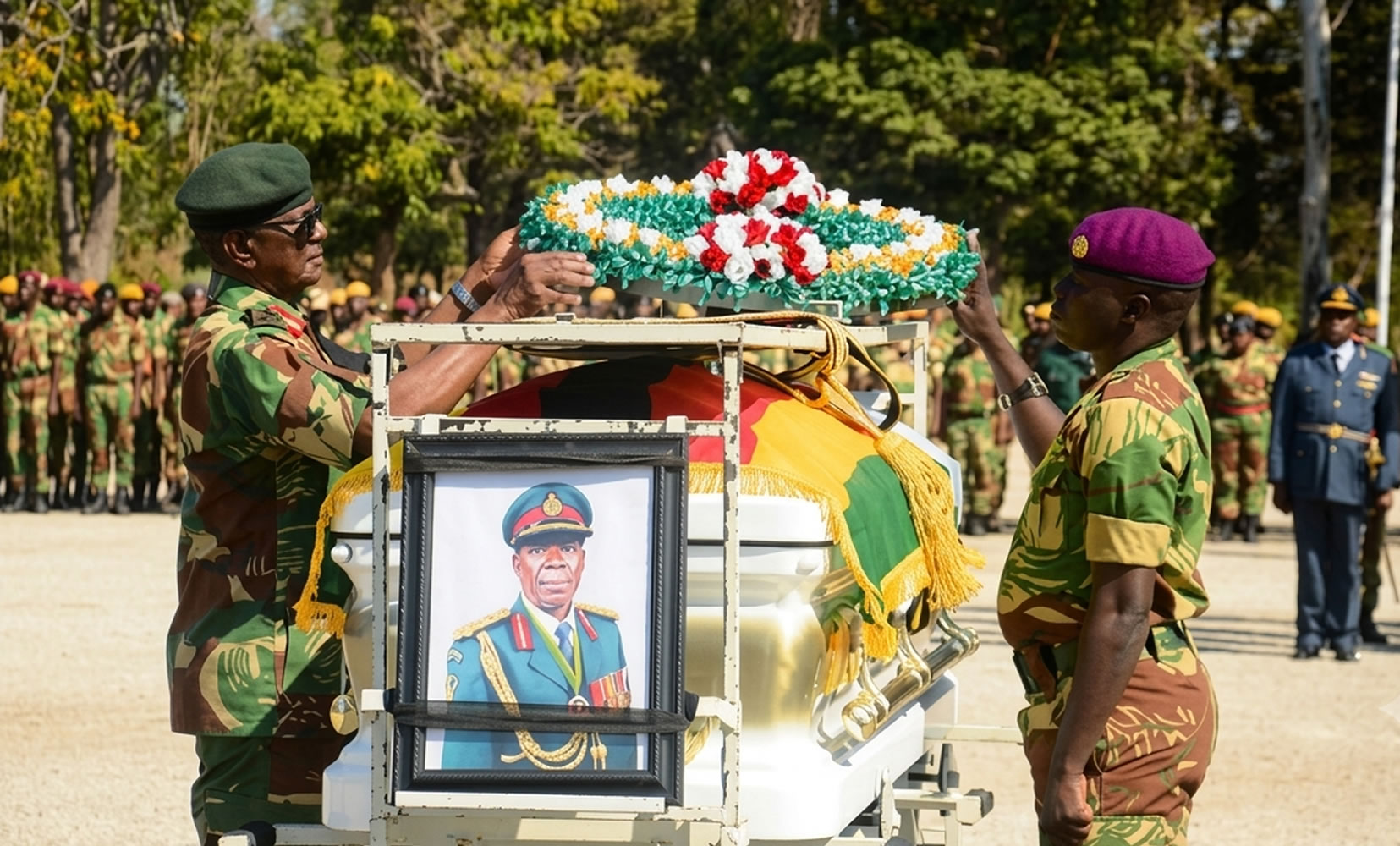
Major General Dzihwema, known by his liberation war name “Cde Kid MaWrong Wrong,” was a man of significant stature within the Zimbabwe Defence Forces. Having died in India on 25 June while receiving medical treatment, his repatriation and subsequent burial were treated as events of paramount national importance. President Emmerson Mnangagwa himself was scheduled to preside over the proceedings. To ensure a crowd befitting the occasion, the government mobilised a fleet of 64 buses to ferry mourners from across Harare and Manicaland.
“As Government, I can confirm that we are ready to give a dignified send-off to national hero, General (Retired) Evaristo Dzihwema,” stated Mr Mike Masaka, Director of Strategic Policy Planning, Monitoring and Evaluation in the Ministry of Home Affairs and Cultural Heritage, ahead of the burial. “We have provided 64 buses to ferry mourners to the National Heroes’ Acre. We have 50 buses for Harare Province, 10 buses for Manicaland and four buses for family members”.
However, in the high-density suburbs where economic survival is a daily battle, these “invitations” to mourn often carry an unspoken weight. For Dillon Chisango, the choice was simple: attend the burial or go to work. He chose the latter, a decision that allegedly enraged Bignews Zvarevashe, a local man who had taken it upon himself to mobilise residents for the event.
Witnesses at the Manjemanje shops recount a scene of sudden and terrifying violence. When Chisango indicated that he could not attend the burial as he was “supposed to report for work,” the atmosphere turned volatile. Zvarevashe allegedly struck Chisango in the mouth with a beer bottle before smashing the glass and using the jagged remains to stab him repeatedly. The attack was relentless. Chisango sustained deep lacerations to his chest, chin, back, head, and left palm. He was left bleeding on the dusty ground as onlookers scrambled to intervene.
“Zvarevashe hit Dilon Chisango once on the mouth with a beer bottle. He then broke the beer bottle, stabbed Chisango on the left side of the chest, once on the chin, once on the back of the head, and cut him once on the left palm,” according to the state’s allegations presented in court.
The brutality of the attack prompted a rare act of collective resistance. Members of the public who witnessed the assault did not simply flee; they moved in to overpower Zvarevashe, effecting a citizen’s arrest before handing him over to the authorities. Chisango was rushed to Parirenyatwa Group of Hospitals, where he was immediately admitted to the Intensive Care Unit (ICU). As of this week, he remains in a critical condition, his life hanging in the balance.
On Tuesday, Bignews Zvarevashe appeared before Harare Magistrate Jesse Kufa, facing a charge of attempted murder. Representing the state, Lawrence Gangarahwe outlined the harrowing details of the night, describing how a disagreement over a funeral attendance escalated into a near-fatal stabbing. Zvarevashe was remanded in custody and advised to apply for bail at the High Court.
This incident is not an isolated outburst of temper; it is a symptom of a much deeper malaise. For decades, the mobilisation of “mourners” for national events in Zimbabwe has been a hallmark of the ruling ZANU-PF party’s strategy to project an image of universal support and national unity. In suburbs like Epworth and Hopley — areas often populated by those displaced by “Operation Murambatsvina” in 2005 — the pressure to conform is immense.
Epworth, a settlement that has long struggled with poverty and a lack of formal infrastructure, has frequently been a flashpoint for political violence. The community’s history is scarred by incidents where political affiliation—or the lack thereof—determines one’s safety. In 2010, the area saw a wave of attacks where ZANU-PF youth militia reportedly assaulted supporters of the then-opposition MDC-T. The tactics have evolved, but the underlying threat remains: dissent, even in its most passive form, is dangerous.
Human rights organisations have long warned about the narrowing of civic space in Zimbabwe. A 2025 report from Human Rights Watch noted that “Zimbabwean authorities acted to undermine democratic processes, repressed civil society and restricted political pluralism.” The report highlighted that impunity for ruling party violence remains a significant barrier to justice. In 2026, as the country grapples with further constitutional amendments and a tightening grip on dissent, the attack on Chisango serves as a grim reminder of the stakes involved.
The irony of the situation is not lost on local residents. Major General Dzihwema’s own journey to the liberation struggle began after he was assaulted by Rhodesian Security Forces in 1978. That incident, according to official biographies, “strengthened the young Dzihwema’s resolve to take up arms and join thousands of other young Zimbabweans fighting for the country’s independence.” Decades later, a young man in the country Dzihwema helped liberate was stabbed for exercising the very freedom of choice that the liberation struggle was ostensibly fought to secure.
President Mnangagwa has frequently characterised ZANU-PF as a “mammoth revolutionary movement that welcomes all Zimbabweans.” Yet, the experiences of people like Dillon Chisango suggest that this “welcome” is conditional upon absolute compliance. The mobilisation efforts for the Heroes Acre burials are often spearheaded by local party “enforcers” who view non-attendance as a personal affront to the revolutionary legacy [11].
“The alleged assault has shocked residents in Waterfalls and Epworth,” noted a local report, though “shock” is perhaps a polite term for the quiet terror that such incidents instil. “Authorities urged members of the public to resolve disputes peacefully and avoid resorting to violence.” Such platitudes, however, offer little comfort to those living in zones where the law of the party often supersedes the law of the land.
As the legal process against Zvarevashe unfolds, the broader questions of accountability remain. “The matter is expected to return to court as investigations continue,” the prosecution stated. “Under Zimbabwean law, criminal charges are allegations until proven in court, and the accused is presumed innocent unless and until convicted.” While the judicial system follows its course, the community of Epworth watches with bated breath. Will this be a case where justice is served, or will it be another instance where political zealotry provides a shield against consequences?
For the family of Dillon Chisango, the technicalities of the law are secondary to the reality of the ICU waiting room. Their son, a man who simply wanted to go to his job and provide for his future, now lies broken because he chose work over a state funeral. His story is a testament to the devastating impact of political intolerance—a force that can turn a quiet evening at the shops into a bloody battleground.
The burial of Major General Dzihwema was indeed attended by thousands, as the state media proudly reported. The 64 buses were filled, the speeches were delivered, and the medals were polished. But in the ICU of Parirenyatwa Hospital, the true cost of that “dignified send-off” is being measured in heartbeats and bandages. The “climate of fear” is not an abstract concept in Hopley Zone 6; it is the air they breathe, and for Dillon Chisango, it nearly became the last thing he ever knew.
The state’s failure to protect its citizens from such brutal attacks—and the culture of impunity that allows “mobilisers” to feel they have the right to enforce patriotism through violence—demands more than just a court hearing. It demands a fundamental shift in a political culture that continues to view its own people as assets to be managed rather than individuals with the right to choose. Until then, the dusty streets of Epworth will remain a place where a simple “no” can be a death sentence.