


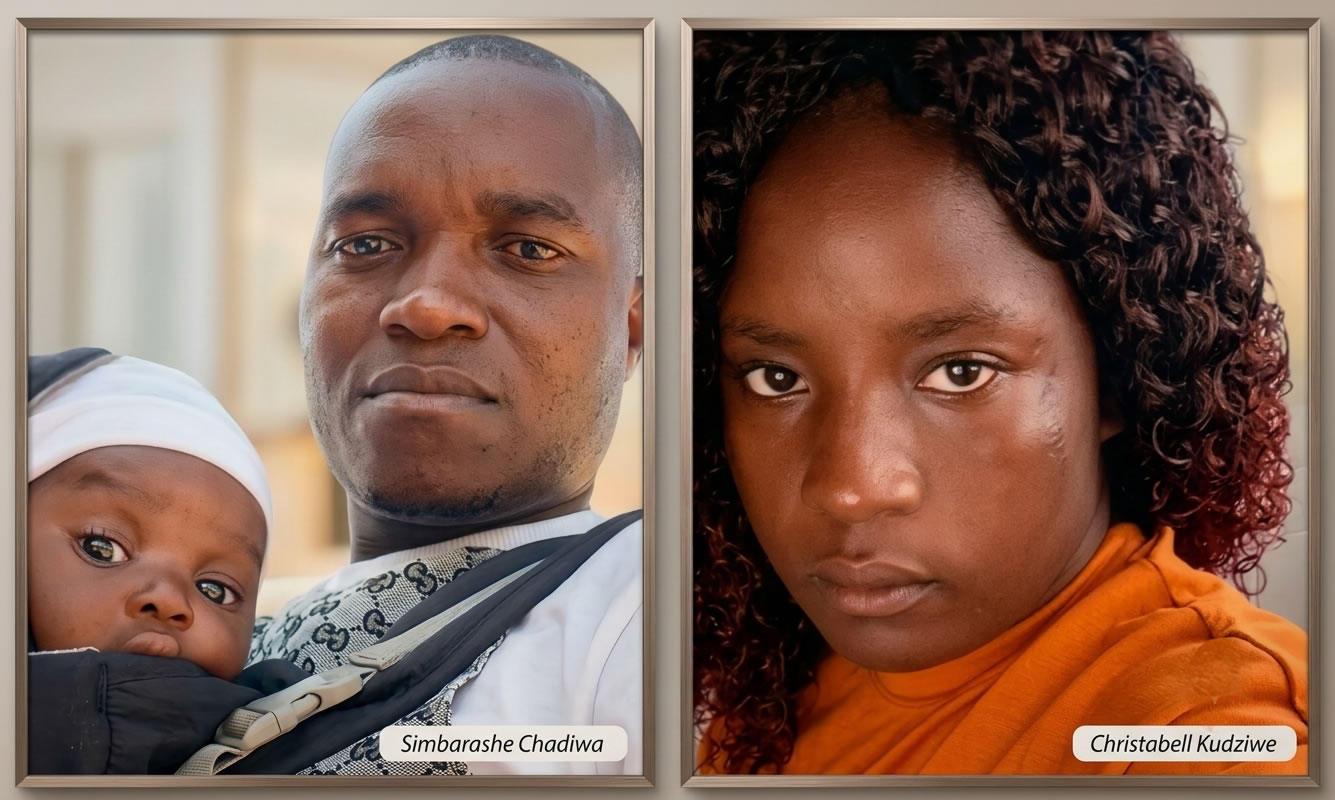
A Decade Undone: The Stolen Years and Newfound Hope of Simbarashe Chadiwa
GOKWE – In the quiet, sun-drenched expanses of Mairosi Village, under the watchful eye of Chief Gumbero, a man is quietly performing a miracle. He is rebuilding a life that was systematically dismantled by a decade of wrongful incarceration. Simbarashe Chadiwa, now 35, walks with the deliberate pace of someone who knows the true value of every step taken in freedom. For nine long years, those steps were confined to the harsh, grey reality of a prison cell, the result of a conviction for a crime that never happened.
His release on 19 April 2024 marked the end of a nightmare that began when he was condemned as a child rapist. Today, however, the narrative has shifted from one of despair to a poignant story of redemption, true love, and the quiet joy of fatherhood. Simbarashe has not only found the woman of his dreams but has been blessed with a new-born son, Ayani, a child whose very existence seems to defy the odds stacked against a man once branded with the most heinous of labels.
The Anatomy of a Miscarriage of Justice
The tragedy of Simbarashe’s lost decade began with a lie. The woman whose testimony originally sealed his fate was just a child when she was coerced into implicating him. Now an adult, she finally came forward to confess the truth: she had never been raped. The weight of the lie, she claimed, had become unbearable, especially following the death of her mother—the very person who had forced her to fabricate the accusation.
In Zimbabwean traditional belief, the concept of Ngozi or avenging spirits is deeply ingrained. The young woman spoke of misfortunes haunting her family, which she attributed to the grief and injustice inflicted upon Simbarashe. This spiritual burden eventually outweighed the fear of confession, leading her to seek redemption by setting the record straight.
“That man never raped me,” she stated with a clarity that came nine years too late. “I was under so much pressure that I ended up wrongly implicating him. That action has been haunting me daily such that I can no longer live with the fact that there is someone out there who is suffering for a crime that he never committed in the first place.”
Her mother had reportedly returned from Botswana and, noticing a limp in her daughter’s walk, pressured the child to confess to a sexual assault. Under duress, the young girl pointed to Simbarashe, their neighbour, as the culprit. It was a simple, devastating falsehood that the legal system accepted as gospel.
The Legal Labyrinth and the Cautionary Rule
Simbarashe’s case brings to the fore the complexities of the Zimbabwean legal system, particularly regarding sexual offences. For years, the “cautionary rule” in sexual assault cases required courts to treat the testimony of complainants with a degree of scepticism, often demanding corroboration . While legal reforms have sought to move away from this rule to better protect genuine victims, Simbarashe’s story illustrates the opposite danger: the vulnerability of the accused to false or coerced testimony, especially when it involves minors.
Legal experts have noted that reversing a conviction after such a significant period is a Herculean task. Phillip Hamunakwadi, a prominent legal expert, explained that even with a recantation, the Prosecutor-General’s Office must conduct a thorough review of all original evidence before a conviction can be formally overturned . For Simbarashe, this meant that even after the truth emerged, his freedom was not automatic. It required affidavits, police reports, and the slow, grinding gears of judicial bureaucracy to finally turn in his favour.
The Harsh Reality of Reintegration
When the prison gates finally swung open, Simbarashe found himself in a world that had moved on without him. The transition from the rigid structure of a correctional facility to the chaotic freedom of civilian life was jarring.
“Prison changes you,” Simbarashe reflected, his voice steady but carrying the weight of his experience. “Everything is controlled. You wake up at a certain time, eat at a certain time, and sleep at a certain time. Suddenly you come home and nobody is ringing a bell to tell you what to do.”
The psychological toll of long-term incarceration is well-documented. Exonerees often suffer from a form of post-traumatic stress, where the habits formed in survival mode within prison walls persist long after release. Simbarashe found even the simple act of sleeping difficult. He would wake up in the middle of the night, expecting the harsh shout of a guard or the clanging of bars.
Socialising presented another formidable barrier. Having been isolated from the community for nearly a third of his life, he had to relearn the nuances of human interaction. “People think that once the prison gates open, everything becomes normal. It does not happen like that,” he explained. “Your mind has to adjust. You have to learn to trust people again. You have to learn how to interact freely. You have to rebuild confidence because prison can make you feel disconnected from society.”
A New Chapter: Love in the Ruins
In the midst of this struggle, Simbarashe found an unexpected anchor: Christabell Kudziwe. In a society where the stigma of a rape conviction—even a wrongful one—can be a social death sentence, Christabell’s acceptance was nothing short of revolutionary. After a period of courtship, Simbarashe paid lobola at her family’s rural home in Manicaland, formalising their union according to tradition.
“After everything that happened, God blessed me with a woman who accepted me for who I am and never judged me by my past,” Simbarashe told reporters. “She believed my story when many people did not. That alone gave me the courage to believe that life could begin again.”
The birth of their son, Ayani, now two months old, has added a layer of profound joy to their lives. Yet, for Simbarashe, fatherhood is a bittersweet experience. It serves as a constant reminder of the years he lost with his first child, Ashiel, who is now 11 years old. Simbarashe missed the entirety of Ashiel’s early childhood—the first steps, the first words, the first day of school.
“Every time I look at my children, I remember the years I lost,” he said, his eyes reflecting a deep-seated sorrow. “I missed watching my first child grow up. I missed birthdays, her first day at school, and so many moments a father should never miss. Those memories hurt, but they also remind me that I still have a chance to be there for them now.”
The Role of Rehabilitation and the ZPCS
Surprisingly, Simbarashe does not hold a blanket resentment toward the institution that held him. He is quick to acknowledge the role of the Zimbabwe Prisons and Correctional Service (ZPCS) in preparing him for his eventual return to society. He credits the vocational and disciplinary programmes with giving him the tools to maintain his dignity during his darkest hours.
“There are officers who genuinely want inmates to leave prison as better people,” he noted. “They teach discipline and responsibility. They encourage people to work and prepare themselves for life outside. The rehabilitation programmes helped me understand that life would continue one day. They taught us not to lose hope.”
This perspective is supported by broader studies on the ZPCS, which has increasingly focused on vocational training—such as commercial agriculture and various trades—to reduce recidivism and aid in the reintegration of ex-offenders . For an innocent man like Simbarashe, these programmes were not about reform, but about survival and the preservation of his humanity.
The Economic Struggle for Dignity
Freedom, however, does not put food on the table. Since his release, Simbarashe has been working at a relative’s small-scale mine. The work is gruelling and physically demanding, but for him, it is a form of therapy. Each ounce of earth moved represents a step further away from the stagnation of his prison cell.
“When I started working at the mine, it was not just about money. It gave me dignity again,” he explained. “I wanted to earn an honest living. I wanted to prove to myself that despite everything that had happened, I could still stand on my own feet.”
Despite his industriousness, the young family faces significant financial hurdles. The cost of raising a new-born and supporting his elder daughter, while trying to build a home from scratch, is immense. Simbarashe has made a public appeal for assistance—not for charity, but for the opportunity to work and provide.
“I am not asking for luxury,” he pleaded. “I only want an opportunity to work again. I believe in working for what I have.”
The Broader Shadow: Wrongful Convictions in the Region
Simbarashe’s ordeal is not an isolated incident. Across Southern Africa, legal systems grapple with the fallout of wrongful convictions. In many cases, the lack of a formal compensation framework for exonerees leaves them in a state of perpetual vulnerability. Unlike parolees, who may have access to certain state-sponsored reintegration services, exonerees often leave prison with nothing—no money, no identification, and no formal support system .
The question of compensation for Simbarashe remains a complex legal issue. While his accuser was a minor at the time, the role of her mother in orchestrating the lie suggests a potential avenue for civil litigation, though the mother’s death complicates matters. Ultimately, the responsibility for such a monumental failure of justice often falls into a legal grey area, leaving the victim to bear the cost of the state’s error.
A Message of Forgiveness
Perhaps the most remarkable aspect of Simbarashe Chadiwa is his lack of bitterness. He has consciously chosen a path of forgiveness, guided by a deep and abiding faith. He believes that his survival and his eventual exoneration were part of a larger, divine plan.
“If there is one lesson my life has taught me, it is that we should never give up,” he said. “No matter how painful your situation is, there is always tomorrow. Sometimes life becomes so difficult that you ask God why it is happening to you. I asked those questions many times. But today I realise that God has a purpose for every person. We may not understand it immediately, but eventually His plan becomes clear.”
His message is one of resilience, directed not just at those who have been wrongly imprisoned, but at anyone facing the overwhelming setbacks of life. “Do not allow pain to destroy your future. Pick yourself up. Keep believing. Keep praying. God can restore what people think is impossible to restore.”
As the sun sets over the Gokwe horizon, Simbarashe Chadiwa stands as a testament to the endurance of the human spirit. He is a man who was buried alive by a lie for nine years, only to emerge, brush off the dust of injustice, and begin the slow, beautiful work of living again.