


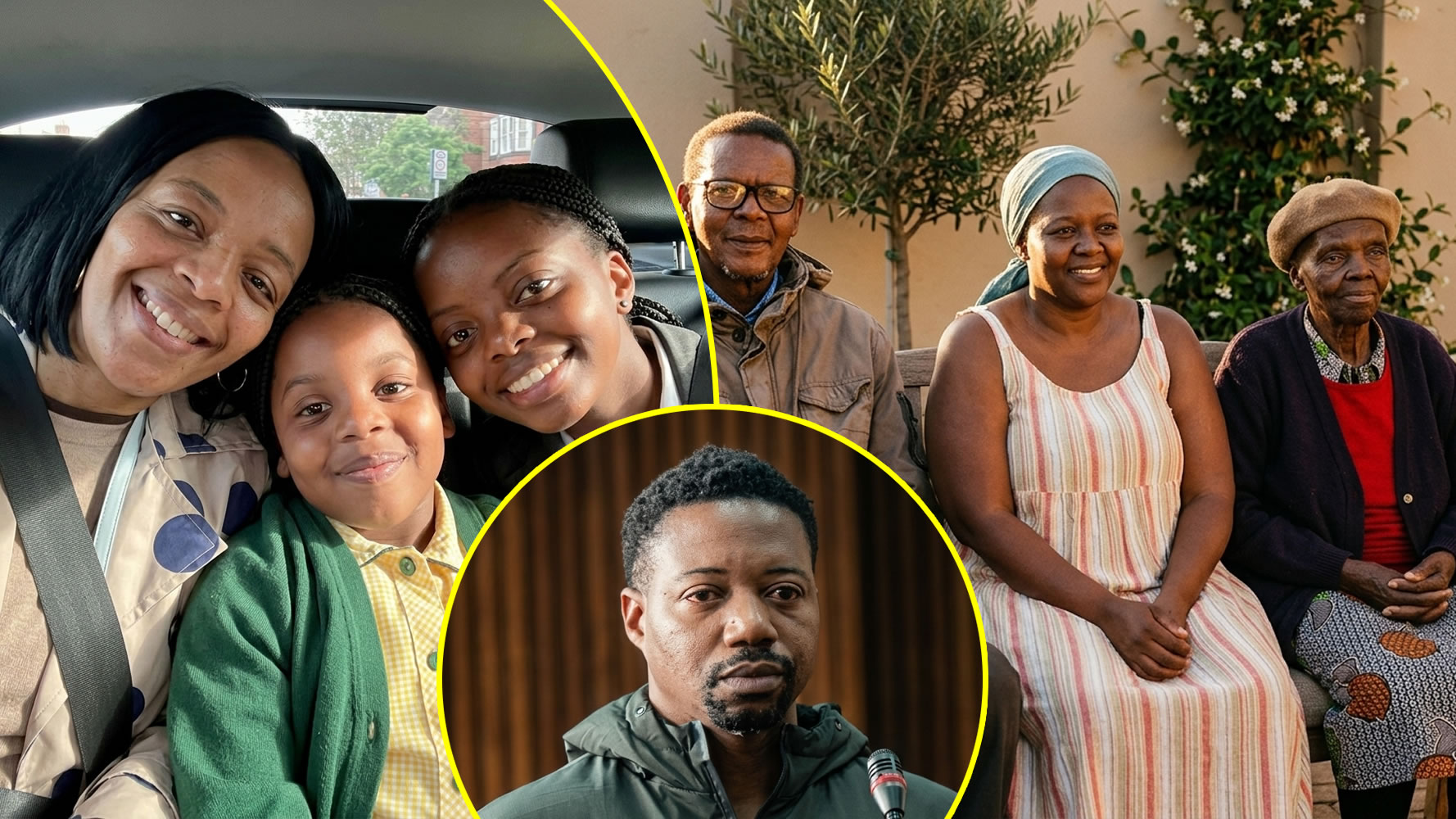
JOHANNESBURG – The anguish of a mother, Velile Khumalo, 76, has come to the forefront following the dramatic arrest of Ndodana Mkhanyisi Tshuma, 45, in Johannesburg, South Africa. Tshuma, the husband of Nothabo Zandile Tshuma, 42, and father to their two young daughters, Natalie, 15, and Nala, 5, is the prime suspect in their brutal murders at the family’s £1.3 million home in Great Denham, Bedfordshire, United Kingdom. His apprehension, which South African police suspect thwarted a suicide attempt, has brought a complex mix of relief and renewed sorrow to the grieving family, particularly to Zandile’s mother, who has now spoken out about her profound loss and the circumstances surrounding the tragedy.
Velile Khumalo, a retired teacher from Zimbabwe, had last seen her granddaughters when Nala was an infant. She had been eagerly anticipating their visit to Zimbabwe in December, a reunion that will now never happen. Speaking to B-Metro in an exclusive interview, her words painted a harrowing picture of a mother’s regret and sorrow. “If I had one more chance to talk to her, I would advise her to leave everything and come home,” she revealed. This poignant statement hints at underlying issues in Zandile’s marriage, a detail further corroborated by reports that the couple was going through a divorce at the time of the murders.
Mrs. Khumalo continued, sharing her struggle to reconcile with the devastating loss. “I can only accept what God has allowed to happen. My only wish now is that my daughter and grandchildren get buried here in Zimbabwe at Luveve Cemetery. Makhu (Zandile) had the two sweetest daughters ever, my grandchildren. They are all gone, just like that. My other daughter has boys. All the girls are now gone.” The sheer finality of her words, punctuated by her breaking down during the interview, underscores the unimaginable grief she and her family are enduring. Her other daughter, Sibonginkosi Gugulethu Mungoni, 48, and uncle Leon Leroy Khumalo, 61, have been providing support, stepping in to manage the overwhelming situation.
The bodies of Zandile, Natalie, and Nala were discovered on 6 July 2026, after concerned neighbours raised the alarm, noting the family’s unusual absence for several days. Post-mortem examinations confirmed the horrific nature of their deaths, revealing blunt force trauma as the cause. The timeline of events leading to Tshuma’s arrest is particularly chilling: he had fled the UK on 5 July 2026, just a day before the bodies were found, boarding a flight from London Heathrow to Johannesburg, via Dubai, using his British passport. This pre-emptive escape immediately triggered an international search operation, culminating in his capture.
Ndodana Mkhanyisi Tshuma, also known as Mark, was arrested on Friday, 10 July 2026, in Kensington, Johannesburg. The arrest was the result of a meticulously coordinated effort involving the South African Police Service (SAPS) Interpol National Central Bureau, Crime Intelligence, and the Organised Crime Investigation Unit. Crucially, at the time of his apprehension, Tshuma was found in possession of an illegal firearm. South African police spokesperson Athlenda Mathe stated, “According to our investigation, after landing in South Africa on July 5, he then went to one of the townships and he bought this particular unlicensed firearm. It is our suspicion that this… firearm was going to be used to end his life.” This revelation adds a stark dimension to the tragedy, suggesting a desperate attempt to evade justice through self-harm.
British prosecutors have since authorised three murder charges against Tshuma, and the complex process of his extradition to the UK is now underway. South Africa has received a provisional extradition request from Interpol Manchester through Interpol Pretoria, with a full request, including the UK case docket and supporting evidence, anticipated within 40 days. Before facing murder charges in the UK, Tshuma will first address the charge of illegal possession of a firearm in South Africa, an offence that carries a potential 15-year prison sentence for first-time offenders. This intricate legal dance highlights the challenges of cross-border justice, where national laws and international agreements must converge to ensure accountability.
The family’s profound grief has been exacerbated by insensitive online speculation surrounding the tragedy. Leon Leroy Khumalo, Zandile’s uncle, made a heartfelt plea for privacy, stating, “As a family, we would like to appeal to all those online people who are making up stories about the tragedy to let us grieve in peace. We also appeal to journalists to stop coming here canvassing for stories as we have nothing to say.” Sibonginkosi Gugulethu Mungoni, Zandile’s sister, echoed this sentiment, adding, “She was my mum’s handbag and we spoke often. We are utterly devastated. Words can never express the sorrow in the family right now. We just request that people let us grieve in peace. As a family, we are now keeping away from social media as we have been encountering very distressing and untrue statements made by faceless people.” The family has indicated that burial arrangements will be announced in due course, as they navigate their private sorrow amidst public scrutiny.
Beyond the personal tragedy, investigations have also shed light on Tshuma’s professional background. He owned and operated a property business, Nexus Trove Holdings, which was based at the family’s substantial £1.3 million home. Company filings indicated that the business held assets valued at over £1 million at the end of 2024. The reported marital difficulties, coupled with the financial context, often emerge as significant factors in cases of domestic homicide and family annihilation, pointing towards potential motives rooted in control, resentment, or financial disputes during periods of intense personal crisis.
The tragic case of the Tshuma family sadly echoes other devastating incidents of family annihilation in the UK. The Nicholas Prosper triple murder in Luton, Bedfordshire, in September 2024, serves as a grim parallel. In that case, Nicholas Prosper, then 19, brutally murdered his mother, Juliana, 48, and his siblings, Kyle, 16, and Giselle, 13, with a shotgun. Disturbingly, Prosper had also planned a school shooting, underscoring the extreme danger posed by individuals capable of such violence. He was subsequently sentenced to a minimum of 49 years in prison in March 2025. These cases collectively highlight a disturbing pattern of violence within families, frequently perpetrated by male figures, often during periods of marital breakdown or perceived loss of control.
Criminological research offers valuable insights into the psychological profiles of individuals who commit familicide, often termed “family annihilators.” Experts, including those from Birmingham City University, have identified four primary profiles: the self-righteous, who believe they are justified in their actions; the disappointed, who feel their family has failed them; the anomic, who experience a sudden loss of status or financial ruin; and the paranoid, who perceive external threats. These acts are frequently linked to intense personal crises, such as divorce proceedings, significant financial difficulties, or a profound sense of losing control over their lives. The Office for National Statistics reported 111 domestic homicides in the year ending March 2025 in the UK, with 85 people, predominantly women, killed by a current or ex-partner annually. These statistics paint a stark picture of the pervasive issue of domestic violence and its most extreme, fatal consequences.
The arrest of Tshuma in South Africa also brings into sharp focus the complexities of international extradition processes. The case of Ruth Lawrence and Neville Van Der Westhuizen, involving an extradition from South Africa to Ireland/UK for a double murder, serves as a pertinent example, illustrating the often lengthy and intricate legal procedures involved. Such cases demand meticulous coordination between law enforcement agencies and judicial systems across different nations, ensuring that justice, though sometimes protracted, is ultimately served. The unwavering commitment of the South African Police Service to assisting international partners in bringing fugitives to justice, as unequivocally demonstrated in Tshuma’s arrest, sends a clear and resolute message that the country will not serve as a sanctuary for those fleeing serious crimes.
As the legal proceedings unfold, the Tshuma family and the wider community continue to grapple with the profound grief and the multitude of unanswered questions surrounding this horrific event. The case stands as a poignant and tragic reminder of the devastating impact of domestic violence, the critical importance of vigilance, robust support systems for victims, and seamless international cooperation in the relentless pursuit of justice.