


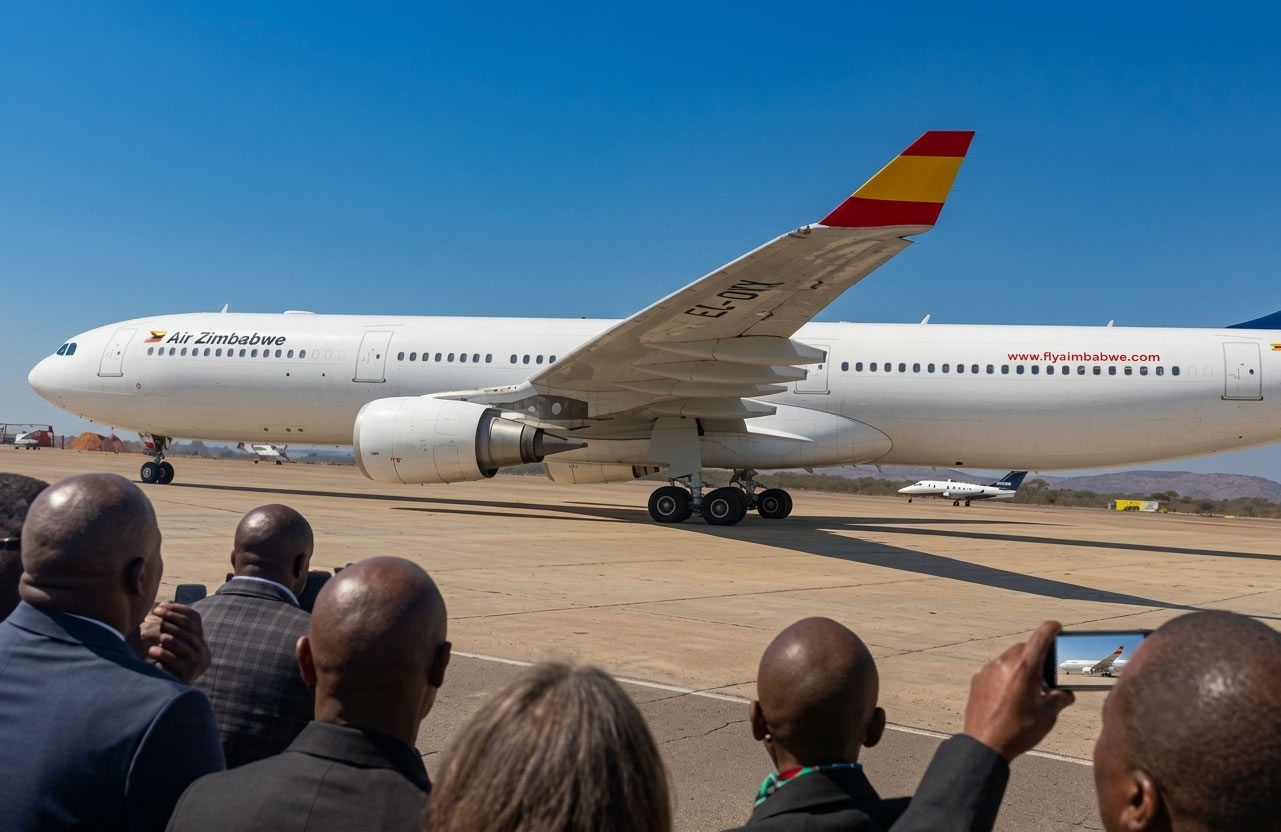
HARARE – The honeymoon period for Air Zimbabwe’s long-awaited return to the London skies has come to an abrupt and costly conclusion. For many travellers in the Zimbabwean diaspora, the dream of affordable, direct travel between Harare and London Gatwick was a brief summer romance that has now been met with the cold reality of increased fares and the familiar sting of operational delays. As the national carrier announces the end of its promotional pricing, the airline finds itself navigating a familiar landscape of technical hitches and public scrutiny, reminiscent of the very issues that grounded it over a decade ago.
Last week, the optimistic atmosphere surrounding the relaunch was punctured by a series of disruptions that left passengers stranded and questioning the reliability of the restored service. On a Friday night that should have seen Flight UM724 soaring towards the United Kingdom, the aircraft remained firmly on the tarmac at Robert Gabriel Mugabe International Airport. The reason? A pilot had reportedly fallen ill, an occurrence that, while human, highlighted the precarious nature of the airline’s current operations. The flight was cancelled and rescheduled to the following day, leaving hundreds of passengers to rearrange their lives at short notice.
In a statement released to the press, Air Zimbabwe sought to reassure the public that the turbulence was temporary. The airline advised its “valued passengers and stakeholders that normal flight scheduling has been restored”. The carrier confirmed that the service had eventually departed Harare on Saturday at around 9pm, arriving in London the following day at approximately 6am. The return service left London later that morning and arrived in Harare the same day. However, the damage to the airline’s reputation for punctuality, which it has been desperately trying to rebuild, was already evident.
“All Air Zimbabwe flights are operating as scheduled. Tonight’s (yesterday) departure to London will operate on schedule. Passengers travelling on Flight UM724 should proceed with their travel plans as planned and present themselves for check-in three hours before departure,” stated the company earlier this week, attempting to project an image of stability.
Yet, for many, the most significant change isn’t just the schedule, but the cost. The promotional season, which saw one-away tickets priced at a competitive US$495 and return fares at US$900, is officially over. The new pricing structure reflects a significant hike. One-way tickets to London now start from US$720 or £689, while return fares have climbed to start from US$1,412 or £1,056. For a community that has spent sixteen years waiting for a direct link to their homeland, the price increase is a bitter pill to swallow, especially when coupled with the recent service disruptions.
To understand the weight of these recent events, one must look back at the dark clouds that led to Air Zimbabwe’s sixteen-year absence from the London route. The suspension began in December 2011, following a humiliating incident at Gatwick Airport. A Boeing 767-200, the pride of the fleet, was impounded by a United States aviation firm, American General Supplies, over an unpaid debt of US$1.2 million for aircraft spares. It was a moment of national embarrassment that symbolised the airline’s spiralling financial crisis, with debts at the time estimated to be around US$40 million.
For years, the Harare-London route remained a ghost of its former self. The airline was further crippled in 2017 when it was added to the European Union’s Air Safety List. The ban was a result of the carrier’s failure to meet international safety standards, specifically those set by the IATA Operational Safety Audit (IOSA). Effectively barred from European and British skies, Air Zimbabwe was forced to watch from the sidelines as other regional carriers filled the void.
The relaunch in July 2026 was therefore hailed as a triumph of diplomacy and strategic manoeuvring. To bypass the EU ban, Air Zimbabwe entered into a wet lease agreement—known in the industry as an ACMI (Aircraft, Crew, Maintenance, and Insurance) deal—with the Spanish carrier Plus Ultra Líneas Aéreas. By using a Spanish-registered Airbus A330-300 and a European crew, the airline could legally operate in the UK, even as the national carrier itself remained under regulatory scrutiny. The aircraft, registered as EC-ONX, is a twenty-year-old workhorse configured with 302 seats, including 30 in business class and 272 in economy.
Despite the clever workarounds, the underlying issues of debt and operational capacity continue to haunt the airline. Air Zimbabwe’s current debt is estimated at a staggering US$380 million. The government has recently moved to assume this debt through the Mutapa Investment Fund, a sovereign wealth fund designed to revitalise struggling state enterprises. Acting CEO Edmund Makona has spoken optimistically about a US$775.5 million fleet renewal programme, but for the average passenger, these high-level financial manoeuvres mean little when their flight is cancelled due to a lack of standby crew.
The strategic importance of the Harare-London route cannot be overstated. It is a vital artery for tourism, trade, and investment. Early reports suggested that the airline had secured over 1,400 confirmed bookings and thirty tonnes of cargo within weeks of the relaunch. The direct flight offers a convenience that indirect routes through Johannesburg, Dubai, or Addis Ababa simply cannot match. It is this convenience that Air Zimbabwe is betting on, even as it raises its fares.
In its recent communications, the airline has doubled down on its commitment to the service.
“Air Zimbabwe remains steadfastly committed to building a safe, reliable, and efficient Harare-London service that meets the expectations of passengers and serves the country’s broader economic and strategic interests,” the company declared. It also expressed gratitude to its customers:
“Your understanding, patience, and continued loyalty have been deeply appreciated during this period.”
However, investigative look into the airline’s recent history reveals a pattern of “operational reasons” being used as a catch-all phrase for deeper systemic failures. The cancellation on August 1st was not an isolated incident; it followed a series of delays that have plagued the airline since its return to the skies. While the “sick pilot” explanation was given to the public, industry insiders suggest that a lack of depth in the crew roster and the complexities of managing a wet lease agreement are the true culprits.
The Plus Ultra deal, while a necessary bridge, is a costly one. A wet lease is significantly more expensive than operating one’s own aircraft with one’s own crew. Every hour the Airbus A330 sits on the tarmac due to a “sick pilot” or a technical fault, the airline is haemorrhaging money. This financial pressure is undoubtedly a driving factor behind the end of the promotional season. The airline needs to start recouping the massive costs of the lease, even if it means pricing out some of the very passengers who have been its most loyal supporters.
Furthermore, the reliance on a twenty-year-old aircraft brings its own set of challenges. While the Airbus A330-300 is a reliable platform, an aircraft of that age requires meticulous and frequent maintenance. Any unforeseen technical issue can ground the plane for days, as spares for older models are not always readily available in Harare. This creates a fragile ecosystem where one small problem can lead to a cascade of cancellations.
As Air Zimbabwe moves forward, the question remains whether it can truly shed the baggage of its past. The government’s decision to absorb the airline’s debt is a significant step, but it does not solve the immediate operational hurdles. The diaspora, while eager for a direct connection, is also weary of the “Air Zim” reputation for unreliability. The competition on the route, though indirect, is fierce, with carriers like Ethiopian Airlines and Emirates offering a level of consistency that Air Zimbabwe has yet to prove it can maintain.
For now, the national carrier is standing its ground. The fares have been adjusted, the schedules have been “restored,” and the rhetoric remains one of national pride and strategic necessity. But as the sun sets over Gatwick and the Airbus A330 prepares for its long haul back to Harare, the shadows of 2011 still loom large. The airline must prove that this relaunch is more than just a brief flight of fancy, and that it can provide the reliability that its passengers—and the nation—deserve.
In the words of the airline itself, they are “steadfastly committed.” Whether that commitment is enough to overcome the gravity of three hundred million dollars in debt and a history of operational turbulence remains to be seen. For the passengers paying the new, higher fares, the hope is that the only thing “rescheduled” in the future will be their own arrival at a destination they have waited sixteen years to reach directly.
Key Operational and Financial Overview
|
Category
|
Details & Metrics
|
|
Route & Frequency
|
Harare (RGM International) to London Gatwick (LGW), 3 times weekly
|
|
Aircraft & Lessor
|
Airbus A330-300 (Reg: EC-ONX, age ~20 years), wet lease (ACMI) via Plus Ultra Líneas Aéreas
|
|
Seating Configuration
|
302 total seats (30 Business Class, 272 Economy Class)
|
|
Previous Fares (Promotional)
|
US$495 one-way, US$900 return
|
|
New Fares (Adjusted)
|
From US$720 / £689 one-way, From US$1,412 / £1,056 return
|
|
Historical Context
|
Route suspended in 2011 (Boeing 767 impounded at Gatwick over US$1.2M debt); EU safety ban in 2017
|
|
National Debt Burden
|
Estimated at US$380 million, being absorbed via the Mutapa Investment Fund
|