


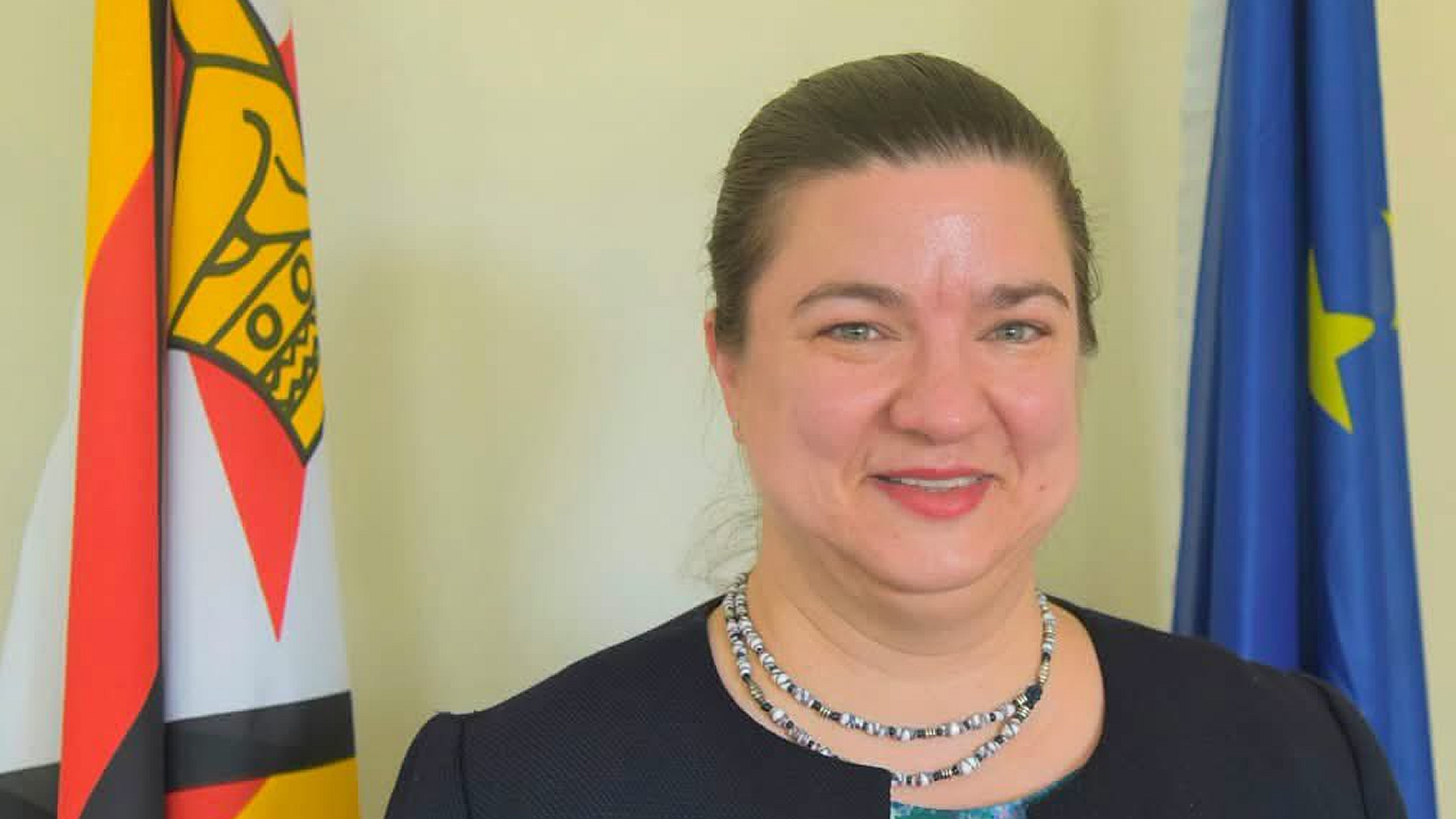
HARARE — European Union ambassador to Zimbabwe Katrin Hagemann was found dead at her Harare residence on Thursday, less than a year after taking up one of the most important diplomatic posts in the country.
Hagemann, 53, reportedly became unwell after breakfast before she was found unresponsive at home. Her driver discovered her when he arrived to take her to work, diplomatic sources said.
The EU delegation confirmed her death in a brief statement issued on Friday, saying: “It is with deep sadness that we confirm the sudden and unexpected passing of Her Excellency Ms Katrin Hagemann on September 3, 2026.
“We extend our heartfelt condolences to her family, loved ones, colleagues and all those who mourn this profound loss. Out of respect for the privacy of the family, there will be no further comments at this time.”
A Book of Condolences will be open to members of the public from Monday, September 7, to Thursday, September 10, between 10:00 and 16:00 each day at the EU Delegation to Zimbabwe.
Hagemann presented her credentials to President Emmerson Mnangagwa on December 11, 2025, formally beginning her tenure as the EU’s representative in Zimbabwe. Although her time in the country was brief, she quickly became a visible voice on corruption, economic reform, governance, human rights and the conditions needed to attract investment.
Her public interventions were direct but closely tied to the EU’s stated interest in helping Zimbabwe clear its debts, restore investor confidence and expand trade with Europe. She repeatedly argued that progress on paper would not be enough unless it was followed by practical action inside public institutions.
At a Transparency International Zimbabwe Integrity and Accountability Summit in Harare in July, Hagemann pointed to the country’s poor standing on corruption as a warning to policymakers and investors.
“Zimbabwe’s corruption perceptions index score of 21 out of 100 is a sobering reminder that more still needs to be done. Additionally, as acknowledged in the National Development Strategy 2, the effort to fight corruption must continue,” she said.
She connected the loss of public resources to the daily pressures faced by ordinary Zimbabweans, asking: “What could countries achieve if the resources lost to corruption were invested instead in schools, clinics, justice, clean water and opportunities for young people?”
She then put the issue in terms of Zimbabwe’s investment ambitions: “Let us ask another honest question. Can investment fully flourish where corruption remains a persistent risk?”
Hagemann’s answer was clear. “Investors are drawn by opportunity and by integrity. That is why the clearance of arrears matters so much,” she said. “It can open the door to greater confidence and to wider Global Gateway investment opportunities in Zimbabwe.”
Her remarks came as Zimbabwe continued to work through a debt burden of more than US$14 billion owed to international creditors. The arrears have restricted the country’s access to fresh international capital, making the EU-backed Structured Dialogue on Arrears Clearance and Debt Restructuring a central part of the relationship between Harare and its European partners.
Hagemann co-chaired the dialogue’s Governance Track with the Permanent Secretary in the Ministry of Justice, Legal and Parliamentary Affairs. The track covers reforms linked to transparency, accountability and the justice system, areas she presented as essential to rebuilding public trust and opening the way for economic recovery.
“Allow me to conclude by restating that integrity is the foundation for debt resolution, economic recovery and public trust. Integrity needs to be practiced until it becomes the culture of institutions, inspires confidence among citizens, attracts investors and contributes to economic growth,” she said.
She also urged the government to turn official commitments into visible results. “We recognise the progress made, we acknowledge the gaps that still exist and we remain convinced that there are real opportunities ahead. Let us move from policy to practice, turn reforms into results and make integrity the habit that shapes us all,” Hagemann said.
“Let us keep moving. Partners are here to support, but only Zimbabwe can carry this agenda to completion,” she added.
Her comments on corruption formed part of a wider message about the link between governance and investment. Zimbabwe has duty-free and quota-free access to the markets of all 27 EU member states, yet only around 200 Zimbabwean companies currently export to Europe. Hagemann said there was substantial room for growth, including an immediate symbolic ambition of reaching US$1 billion in trade.
The EU has also been supporting programmes in agriculture, private sector development, climate action, biodiversity, governance, youth and women’s empowerment. It is involved in the Global Gateway strategy and in the rehabilitation of the Kariba Dam, a major source of hydroelectric power for Zimbabwe. Hagemann regarded stability, predictability and strong governance as the foundation for expanding that work.
In February, she also raised concerns about Zimbabwe’s shrinking civic space and the pressure facing civil society organisations and opposition political figures. Her intervention came amid plans for constitutional amendments that would extend Mnangagwa’s tenure, a police ban on a public meeting called to debate the proposals and the reported abduction and beating of activist Baird Gore.
“It’s quite interesting to see how muted the response has been so far, including from civil society,” Hagemann said.
“Many have been unresponsive, and we understand why. In some cases, it has become very difficult for civil society to speak up as long as they are not registered.”
She said the Private Voluntary Organisations Act was already discouraging groups from speaking publicly while they waited for registration certificates. “As long as organisations have not received their (registration) certificate, people are being very cautious about speaking out. We are seeing that, and it worries us,” she said.
Hagemann was equally outspoken about restrictions on opposition activity. “We are concerned about the arrests we have seen and the suppression that occurs when opposition figures try to hold press conferences, sometimes finding they cannot because the venue is shut down or the building has been burnt down. These things are happening, and they are worrying,” she said.
Her professional career had taken her through Germany’s Federal Foreign Office, the EU Council Secretariat and the European External Action Service. She joined the Council Secretariat in 2006 and later moved to the External Action Service when it was established in 2011. From 2015 to 2019, she headed the Political Section of the EU Delegation to Botswana and the Southern African Development Community before becoming deputy head of the EU Delegation to Kenya in 2019.
She held a degree in astronomy and physics and brought a combination of diplomatic experience and technical training to her Zimbabwe assignment. In her first public engagement with the media as ambassador, she described the EU as a “steadfast and reliable partner” and said the bloc wanted a relationship built on “trust, mutual respect and shared interests”.
The EU delegation said there would be no further comment on the circumstances of Hagemann’s death out of respect for her family’s privacy. Her sudden death has left the diplomatic community and Zimbabwean officials mourning an envoy whose public role had increasingly centred on a simple but demanding message: international support could help Zimbabwe move forward, but only if integrity, accountable government and practical reform became part of the country’s everyday institutions.