


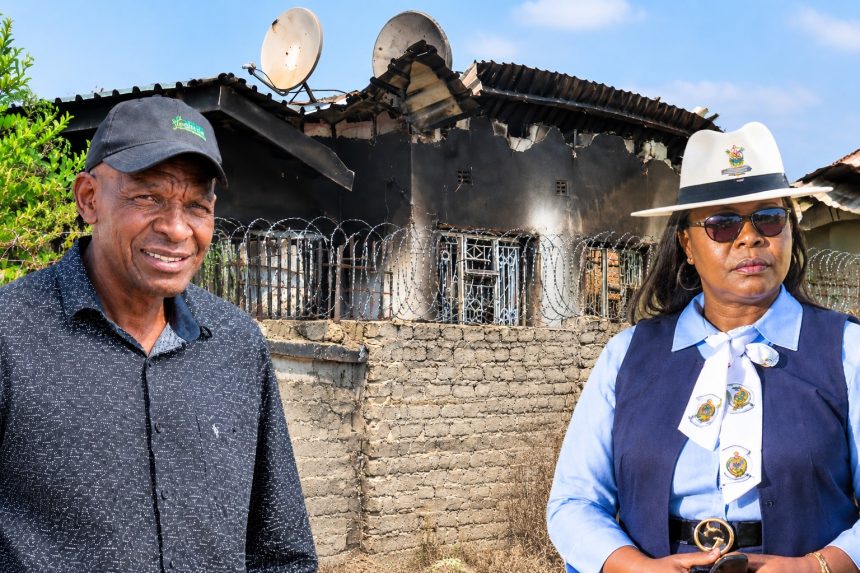
MASVINGO — A 65-year-old former laboratory assistant at Masvingo Provincial Hospital died in a house fire at Victoria Ranch, popularly known as Zexcom, hours before he was due to appear at the High Court in Masvingo for a divorce hearing involving his wife.
Zvinofara Shuro died in the early hours of Sunday, 4 October 2026, at his home. The fire came on the eve of a case in which he and his estranged wife, Memory Muchono Shuro, were expected to appear before the High Court on Monday.
Memory Shuro, 52, is a Chief Correctional Officer with the Zimbabwe Prisons and Correctional Services and is understood to be serving as the acting officer in charge at Masvingo Remand Prison. She had also recently been attached to the office of the Minister of State for Masvingo, according to information about her work at the time of the incident.
The circumstances surrounding the fire were not immediately clear. Police had sealed the property when journalists visited, with a forensic team expected to attend the scene. The involvement of forensic investigators indicates that the circumstances of the death were being examined rather than treated as a routine household fire.
Shuro’s son confirmed the death but declined to be named. No detailed account of how the fire started, whether anyone else was in the house, or whether any items were recovered from the scene was immediately available.
Police had not publicly released a cause of death or a formal account of the incident. Attempts to obtain comment from Masvingo provincial police spokesperson Inspector Kudakwashe Dewa were unsuccessful at the time of the initial report.
The fire occurred as the couple’s marriage was already before the High Court. The divorce matter had been scheduled for hearing on Monday, 5 October, before Justice Justin Uladi at the Masvingo High Court. The hearing could not proceed in the ordinary way after Shuro’s death.
People familiar with the case described the marriage as having been affected by serious conflict. The dispute had reached the stage of a High Court divorce hearing, but details of the claims made by either spouse were not immediately available. There was also no public statement from Memory Shuro about her husband’s death or the court case.
The timing of the death means that the fire, the pending divorce and the administration of Shuro’s estate are now likely to become connected issues for investigators and the courts. The first task for the authorities will be to establish the cause of the fire and the circumstances in which Shuro died. That process may involve a post-mortem examination, forensic examination of the building and the collection of statements from relatives, neighbours and other people who may have had information about the household.
The legal effect on the divorce case is more straightforward than the circumstances of the death. Zimbabwe’s Matrimonial Causes Act provides for a marriage to be dissolved by a decree of divorce granted by the appropriate court. It also gives the High Court power, when granting a divorce, to make orders dealing with the division or distribution of matrimonial assets and with maintenance for a spouse or children.
If Shuro died before a divorce decree was granted, the marriage would ordinarily end through death rather than through divorce. A divorce action is personal to the spouses and cannot normally continue as a contested divorce between a living spouse and a deceased person. The High Court would therefore be expected to be informed formally of the death, record the development and bring the pending divorce action to an end or remove it from the roll, subject to the court’s procedural directions.
That does not mean that every issue raised in the divorce papers disappears. Questions about ownership of property, debts, pension interests, maintenance, children or other financial claims may have consequences for the deceased estate. Those matters may need to be dealt with through estate-administration proceedings or through a separate application involving the executor and any other legally interested parties.
The position may also depend on whether the court had already issued any order before Shuro died. A lawyer handling the matter would need to examine the pleadings, any settlement agreement, previous interim orders and the precise stage reached in the proceedings. The court may still need to determine what happens to any existing order, but it would not ordinarily complete a divorce hearing for the purpose of ending a marriage that has already been terminated by the death of one spouse.
Shuro’s death has brought an abrupt end to a court case that was due to be heard within hours, while leaving investigators with a fatal house fire to explain and the family with an estate to administer. The outcome of the forensic examination and any police update will determine what is known about the final hours of the former hospital laboratory assistant.