


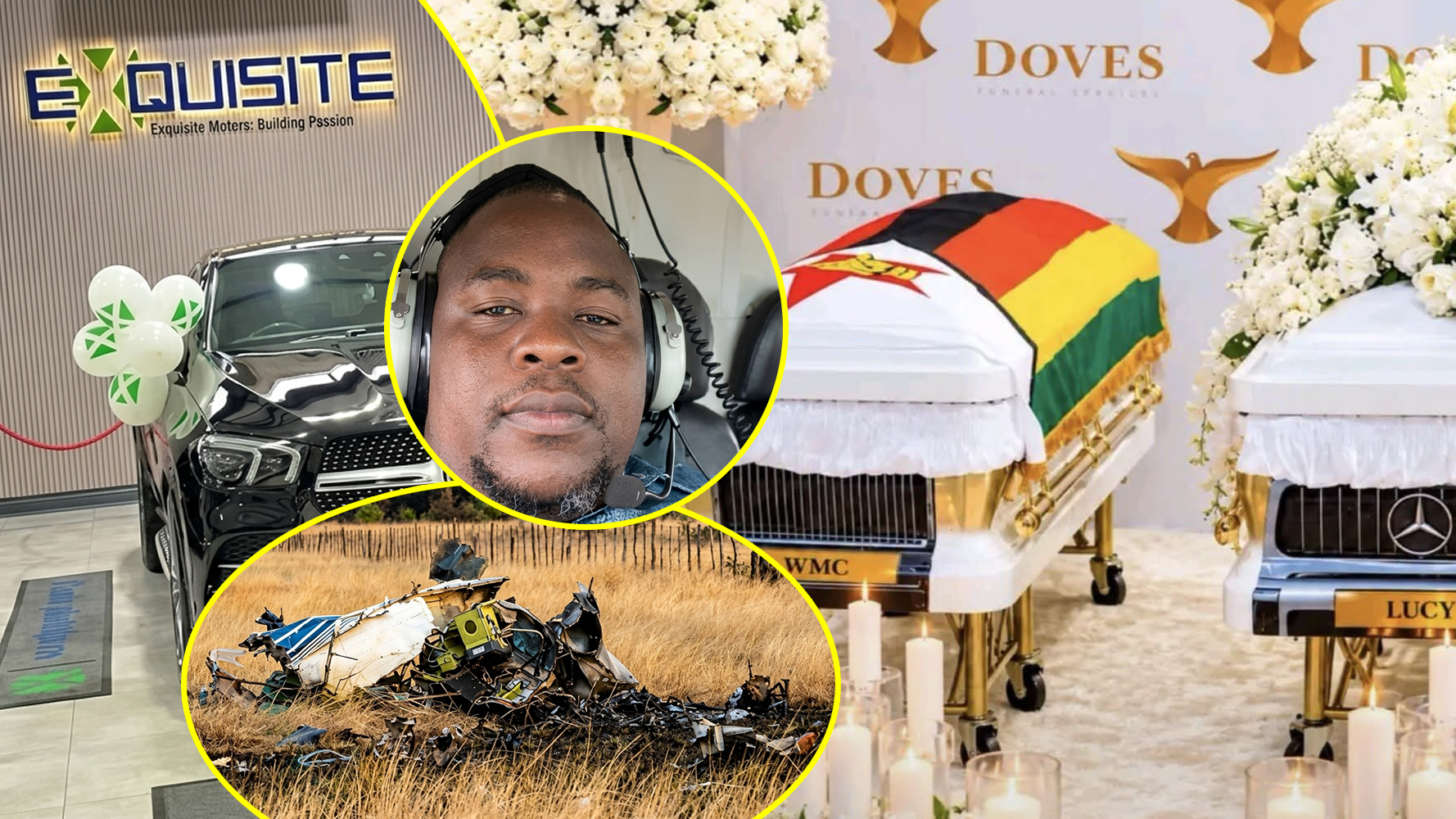
Workers have left two road construction sites in Marondera, while vehicle dealers are trying to establish whether millions of dollars in transactions were settled, after businessman Wicknell Chivayo died in a helicopter crash with his wife and four other people on September 30.
The disruption is being felt across businesses linked to Chivayo’s large public profile. In Marondera, crews and equipment have left projects that were due to be completed in December. In Harare, car suppliers are checking orders, invoices and transfers for vehicles already released to beneficiaries. Chivayo’s death has also put a renewed spotlight on the future of the long-delayed Gwanda solar project, for which his company had received a fresh 24-month implementation timetable only weeks earlier.
Chivayo, 43, and his wife Lucy Muteke were among six people killed when a helicopter came down in the Marondera rural area, about 70 kilometres east of Harare. Police said all six people on board died. The crash ended a business operation in which Chivayo personally announced vehicle gifts and large purchases, while companies and dealerships handled procurement, transport and delivery.
Work stops on two Marondera roads
The immediate change on the ground has been at two road construction sites in Marondera district. IMC workers who had been building the roads have left, and equipment has been removed from the sites. The pause has raised concern among residents and road users that the projects could be abandoned.
IMC was led by Chivayo and had been expected to complete both projects in December. One is the 25-kilometre Marondera–Murewa Road, a strategic link joining traffic between the Harare–Mutare and Harare–Nyamapanda highways. Before the road was under construction, transporters travelling between the routes had to go through Harare, taking a longer and more expensive journey.
The other project is the 10-kilometre Longlands Road, running from Marondera towards KwaMuteke, the area where Chivayo’s in-laws live. Both roads are in Marondera East constituency.
A source familiar with the work described the stoppage as temporary, saying: “For now construction works on both roads have taken a sabbatical. Reports are that works will resume end of this week.”
IMC representative Flashdance Madzudzo said the company had not walked away from the contracts. He said the immediate task was to secure fuel before crews could return to work.
“We have not abandoned the project. We are currently mobilising diesel so that we go back on the roads. We will resume work soon,” Madzudzo said.
But the December completion target is no longer achievable, according to Madzudzo. Asked whether the company could still meet it, he said: “Because of the setback (Chivayo’s death), it is impossible for us to meet the December deadline.”
The pause leaves workers away from active sites and delays roads intended to shorten journeys for communities and commercial transport. IMC’s statement points to a return once fuel is available, but the missed deadline means the work will extend beyond the schedule announced before Chivayo’s death.
Dealers check orders after final deliveries
The uncertainty in the car trade is tied to the scale and speed of Chivayo’s purchases. He regularly announced cars for musicians, church members, lawyers and other recipients, telling people to collect vehicles from dealerships. Dealers supplied the cars, sometimes combining stock to meet orders larger than any one showroom could fill.
On September 25, Chivayo announced that 15 church members from Domboshava, Chiweshe and Mrewa would each receive a new 2026 Toyota Fortuner 2.4 GD-6 and US$5,000 in cash. In a social media post, he wrote: “Your 15 BRAND-NEW 2026 TOYOTA FORTUNERS 2.4 GD6 have arrived,” and added: “Each one of you will also receive US$5,000 cash as a token of appreciation for your commitment and service to our Church.”
The cars were collected on September 30, the day Chivayo and the other passengers died. A dealer said the 15 vehicles were being distributed to members of the Johane Masowe church from Mashonaland Central when some recipients heard the news. The handover had taken place, but suppliers were left unsure whether every part of the transaction had been settled.
Toyota GD-6 Fortuners were among the most sought-after vehicles, with each valued at about US$70,000. The orders also included Toyota Aquas, Land Cruisers and Mercedes-Benz models. Some cars were selected for low mileage, including vehicles with fewer than 20,000 kilometres on the clock.
Dealers had treated Chivayo as a dependable customer because payments were usually made within about two months. The repeated bulk orders helped showrooms move stock, but also linked businesses together: one dealer might buy cars from another to assemble a fleet, then wait for payment through the wider transaction.
Now suppliers are trying to match each vehicle with its order, invoice and payment. Reported outstanding balances across several showrooms run into millions of US dollars, although dealers have not publicly set out a complete account showing the amount owed to each business. The uncertainty concerns not only the vehicles collected on the day of the crash, but earlier orders and transactions where suppliers still need to establish whether balances have cleared.
Chivayo’s gifting campaign had been estimated at more than 300 luxury vehicles and about US$47 million in cars and cash. Those figures describe the scale of the public giveaways, not a confirmed debt total. For dealers, each delivery still has to be checked against its own payment record. For people who received cars, the vehicles had arrived; for the businesses that supplied them, the commercial trail may involve several dealers and payments made at different times.
Gwanda contract enters a new phase
The Gwanda Solar Project is a separate and much larger business commitment. Intratrek Zimbabwe, the company Chivayo led, was awarded the contract for a 100-megawatt solar plant in Matabeleland South in 2014. The original engineering, procurement and construction cost was set at US$172 million and later reduced to US$132 million as solar construction costs fell.
The project stalled after years of delay and a dispute between Zimbabwe Power Company and Intratrek. ZPC terminated the contract in 2018, but court rulings in 2023 upheld the agreement and required it to remain in force. The project was then put on a new footing through a restated contract signed on March 27, 2025, between Intratrek and ZPC, acting for the Government.
In September 2026, ZPC issued a Notice to Proceed directing the contractor to complete the plant within 24 months. Intratrek’s technical engineering partner is CHiNT Electric Co. Ltd. The company’s executive chairman, Wilson Manatse, said the notice marked the start of mobilisation.
“We are pleased to confirm that pursuant to the Notice, we are now proceeding with the immediate mobilisation of our project teams to site, together with the earth moving and associated construction equipment,” Manatse said.
The notice set out the delivery timetable: “The project duration shall be 24 months, in line with the agreed Programme of Works, as set out in the EPC Contract and its accompanying schedules.” ZPC also required regular progress reports. Site work was due to begin once an Advance Mobilisation Payment was released, while Intratrek said it had submitted the required payment guarantee through its technical partner.
Those arrangements provide the project’s stated route forward: ZPC’s notice, the existing EPC contract, Intratrek’s delivery role and CHiNT’s technical partnership. The 24-month clock was set before Chivayo’s death, and the project’s completion now depends on the companies and authorities responsible for carrying out those obligations. The solar plant has not been completed, and its planned contribution to Zimbabwe’s electricity supply remains tied to the implementation schedule.
The road sites, dealership accounts and Gwanda contract are different parts of Chivayo’s business life, but each now faces work that must continue without him. On the Marondera roads, IMC says it is mobilising diesel and expects to return, while conceding that the December target has been lost. In Harare, dealers are reconciling deliveries against payments. At Gwanda, the contractor has a formal notice and a 24-month deadline to deliver a project that has remained unfinished for years.