


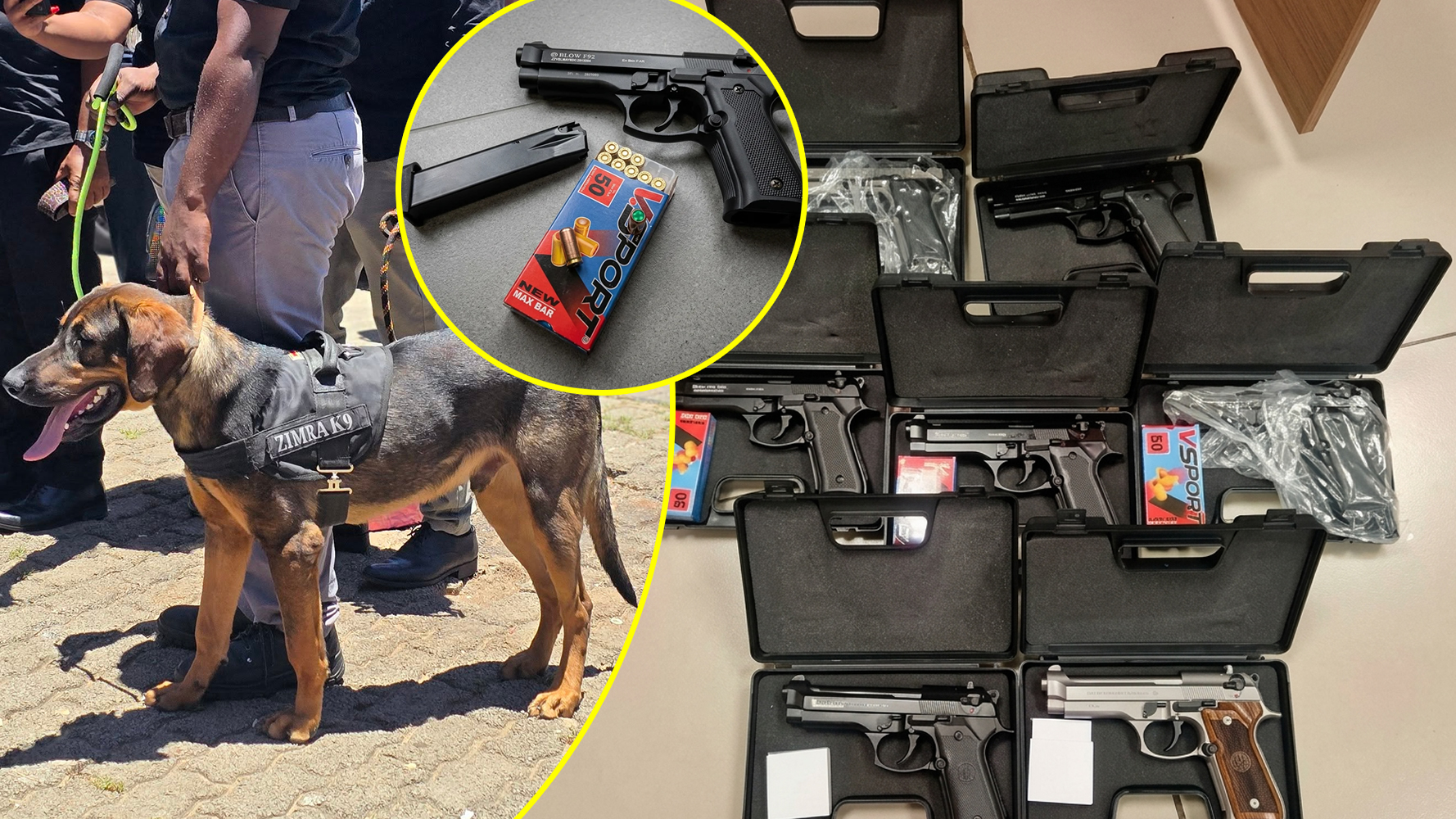
A Zimbabwe Revenue Authority detector dog helped uncover seven pistols and 170 rounds of 9mm blank ammunition concealed beneath passenger seats on a bus travelling from South Africa to Bulawayo, in a seizure at Beitbridge Border Post.
The discovery was made at about 03:00 on November 6, 2026, during a routine canine inspection at the northbound bus terminal. The dog, Poncho, alerted ZIMRA officers to parcels hidden beneath the first row of seats, directly behind the driver.
Officers searched the area and found 2 packages wrapped in black plastic and brown adhesive tape. Inside were 7 black pistols and the ammunition. ZIMRA valued the seized items at R21,400, or about US$1,250. The goods were recorded under Notice of Seizure 047464L, dated November 6.
The driver acknowledged receiving the parcels in South Africa for delivery in Bulawayo, but said he did not know what they contained. He was taken into police custody.
“The interception demonstrates the important role of our K9 dogs in combating smuggling of dangerous goods and other forms of illicit cross-border movement,” ZIMRA said.
The seizure highlights the role of canine teams in inspections where officers are checking vehicles used to carry passengers and luggage across the border. Poncho’s alert led officers to a specific area of the bus; they then carried out a physical search and found the packages.
ZIMRA urged travellers and people moving goods across the border to use designated entry points and declare what they are carrying. “Members of the public are urged to desist from smuggling and to use designated and authorised ports of entry when importing or exporting goods,” the authority said.
The firearms interception came just days after a separate seizure at Beitbridge. On November 2, ZIMRA officers inspecting a vehicle found controlled medicines after hearing a rattling sound from a 20-litre plastic drum selected for scanning. A closer examination uncovered bottles of Broncleer. A search of the vehicle and trailer found 2,600 units of Broncleer, 1,650 units of Benylin and 425 units of Astra Pain. The medicines had an estimated street value of US$23,375. The vehicle and goods were seized, and the driver was arrested.
Other major seizures have involved buses travelling through Beitbridge. In a separate operation on October 31, 2025, officers searching a bus bound for Malawi found marijuana and restricted medicines concealed among 45 comforters. The cargo included 43 bales of marijuana weighing about 719kg, as well as 69 smaller packages weighing about 71kg. Officers also found 234 units of Astra Pain, 561 units of Broncleer and 720 units of Benylin. ZIMRA valued the marijuana at about US$78,000 and the medicines at US$16,200. Two of the bus’s 6 crew members were arrested.
ZIMRA’s approach to border enforcement extends beyond searches at the terminal. It has added aerial surveillance to its work at Beitbridge and other crossing points. In a 2025 update to Parliament, the authority said drones deployed at Beitbridge, Plumtree and Forbes had strengthened surveillance and produced significant interceptions.
The drones are intended to help officers monitor areas that are difficult to reach by road, including unofficial crossing points. ZIMRA officials have also described using the technology to identify unusual loads that may not be easily detected through ordinary checks. The authority’s ICT director has said the drones have night-vision capability and can operate in difficult weather, allowing surveillance to continue beyond daylight hours.
The aerial system is one part of a broader enforcement effort. ZIMRA has also referred to physical and random searches of transit vehicles, intelligence-led inspections, scanning equipment and canine units as measures used to detect concealed or restricted goods. The methods serve different purposes: scanners can prompt a closer examination of cargo, while officers and dogs can focus searches on suspicious vehicles, packages or areas identified during inspections.
Together, these tools give officers more ways to inspect goods moving through formal border posts and to monitor routes beyond the main terminals. The recent cases show how concealed items can be found in very different places: beneath passenger seats, inside containers and among bus cargo.
ZIMRA has warned that goods brought into or taken out of Zimbabwe must comply with customs requirements. It says undeclared goods may be seized and can result in prosecution under Section 182 of the Customs and Excise Act. Its stated focus is on protecting national revenue and preventing illicit trade across the country’s borders.
“ZIMRA remains steadfast in protecting national revenue, securing the country’s borders against illicit trade, and ensuring that goods entering Zimbabwe comply with applicable customs laws and regulations,” the authority said.