


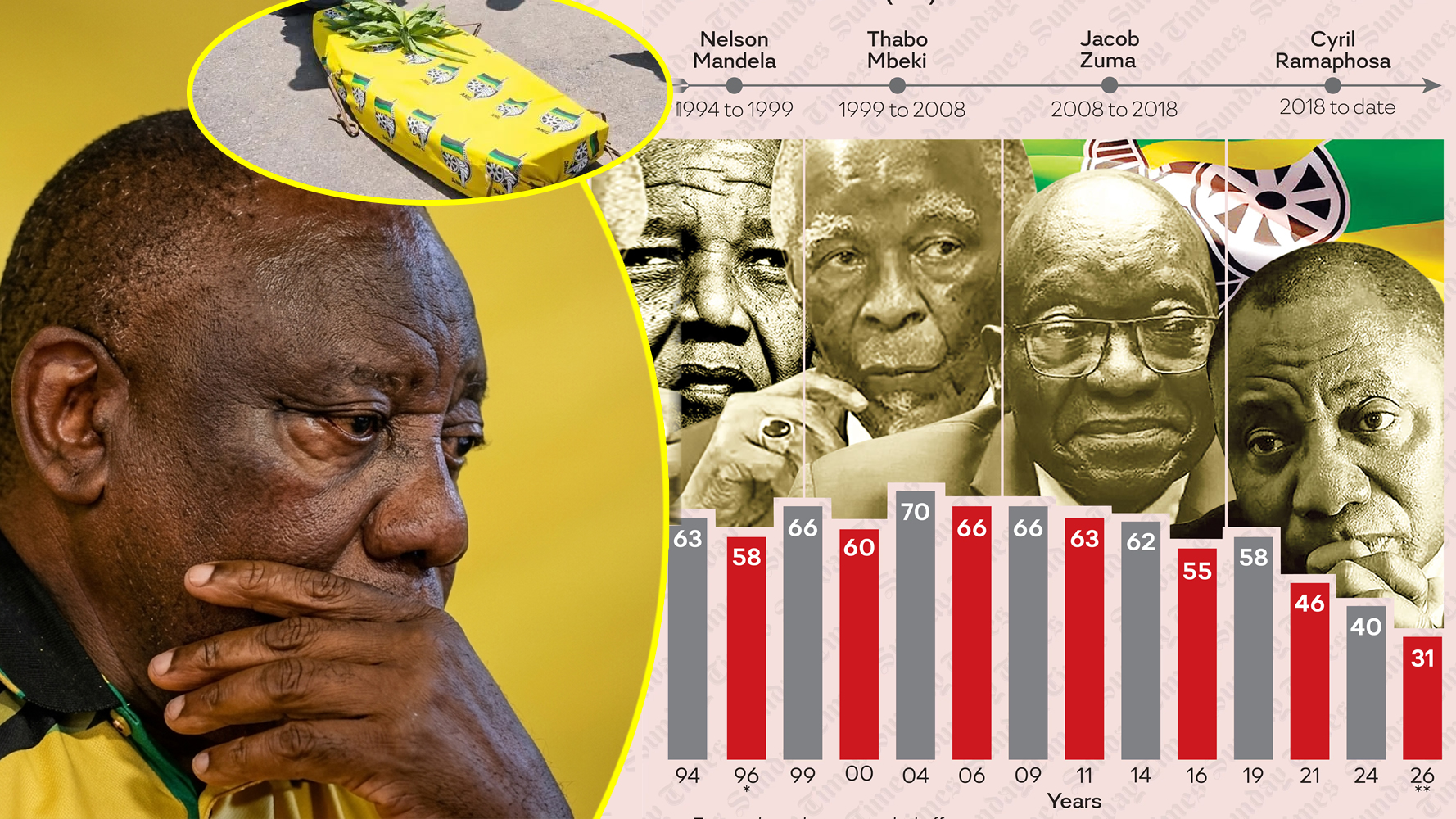
President Cyril Ramaphosa reportedly told senior African National Congress (ANC) leaders that he was willing to step down as party president after the party’s steep losses in the 2026 local government elections. But 3 members of the party’s top leadership have publicly rejected the account, creating an immediate split over what was said as the ANC faces a difficult reckoning with voters.
At least 5 members of the ANC’s National Executive Committee (NEC) described a meeting in which Ramaphosa raised the possibility of resigning. One said the president felt the party could not suffer 2 successive election defeats under his leadership without consequences.
“What I’m hearing is that the president felt that under him and the officials, the party had lost two elections and there needed to be consequences,” one NEC member said.
A second NEC member said Ramaphosa had indicated that he could leave alone if the rest of the ANC’s top 7 officials would not resign with him.
“I’m told that he told them that if they are not supportive of his suggestion for all the top seven members to resign, he can resign alone,” the member said.
The account was challenged on Sunday by ANC chairperson Gwede Mantashe, secretary-general Fikile Mbalula and deputy secretary-general Nomvula Mokonyane. Mantashe said: “There was no discussion like that.”
Mbalula dismissed the suggestion, saying: “That’s rubbish, resign for what? Ayikho leyonto (that is not true).”
Mokonyane said: “These calls are devoid of any objective evidence, and they once again seek to further divide the ANC. Comrade president led in thought and in person in these elections. The ANC requires space to have a scientific and objective assessment that must guide us on the way forward. Removing or recalling the president is not an answer. We have been there before.”
The differing accounts emerged as the ANC’s leadership confronted the scale of a result that has left the party without control of the country’s major metropolitan councils. With 99% of votes counted, the ANC had about 31% nationally, compared with roughly 25% for its main rival, the Democratic Alliance (DA). The uMkhonto weSizwe (MK) Party, led by former president Jacob Zuma, had about 10%.
The ANC’s support stood at 45.6% in the 2021 local elections. It received 40.2% in the 2024 national and provincial elections, losing its national majority for the first time since the end of apartheid. The latest local result marks another fall in support and has weakened the party’s position in municipal coalition negotiations.
Final results were expected to be announced on Sunday evening. The provisional count showed the DA leading in Johannesburg, where it had about 35% of the vote against the ANC’s 20%. The DA also emerged as the largest party in Gauteng’s other major metros, Tshwane and Ekurhuleni, while no party secured an outright majority in those cities.
The ANC also lost control of Nelson Mandela Bay in the Eastern Cape, where the DA took the lead, and eThekwini in KwaZulu-Natal, where the MK Party was ahead. The ANC remained the largest party in several municipalities, but fell below 50% in all provinces except Limpopo, according to the emerging results.
Coalition talks take centre stage
The results have placed the ANC in a position it has not faced in Gauteng’s major cities: it is no longer the automatic kingmaker in Johannesburg, Tshwane and Ekurhuleni. The DA and ActionSA could, in principle, combine their council seats to form administrations without the ANC, although negotiations are complicated by a personal and political dispute between DA federal chair Helen Zille and ActionSA leader Herman Mashaba.
ActionSA has insisted that its mayoral candidate, Nasiphi Moya, remain mayor of Tshwane. The party has also made clear that it does not want Zille installed as Johannesburg mayor. The DA, as the largest party in Johannesburg and Tshwane, has maintained that the leading party should provide the mayor and is keeping Zille as its candidate.
That disagreement has left open the possibility of different arrangements in each city. DA leader Geordin Hill-Lewis has also promoted a local-government model based on the national government of national unity, with the ANC and DA as the main partners. Such a deal would require the former rivals to work together in city administrations after competing against each other in the election.
ActionSA representatives have opened discussions with both the ANC and the DA. The Freedom Front Plus has also been drawn into the talks. The ANC has said it will not rush to secure mayoral posts and is prepared to sit in opposition where it cannot reach an agreement on its terms.
Mbalula said the party would put public services at the centre of any negotiations. “We are open to arrangements that will put people first and that stem squarely on our constitution, with clear and honest priority spelt out in advance and with no secret carve-outs for the benefit of one party or another. There must be no disruption to services that government is bound to provide, including water, electricity, and care for the poorest,” he said.
He added that the ANC was not prepared to bargain for office simply to remain in power. “The ANC will not be in a hurry to get into coalitions. That is not the only option. There is also an option to sit in opposition.”
The DA’s federal executive said it would negotiate with parties committed to clean and accountable government, fighting corruption, service delivery, the rule of law and non-racialism. Those principles are expected to shape negotiations as parties work towards forming municipal administrations.
The latest result differs sharply from the ANC’s position after the 2024 national election. Although the party had fallen to 40.2%, it remained the largest party in Parliament, with 159 of 400 seats. It retained the presidency, secured 22 of 34 Cabinet posts and took the Speaker’s position in the government of national unity. In the Gauteng metros, the party now has far less leverage and must decide whether to negotiate from opposition or join coalitions led by its rivals.
The ANC’s election chief, Mdumiseni Ntuli, had called for an open discussion about the leadership’s responsibility for the party’s decline. He said the NEC needed to ask what it had done or failed to do as the party lost support in successive elections. His remarks prompted calls within the party for a thorough review, but he did not publicly call on Ramaphosa to resign.
Mbalula described the result as “catastrophic” and said the ANC had been warned by its own polling that its support could fall to about 34%. He said the party knew it faced a serious challenge, while also expressing surprise that it had retained more support than its worst expectations.
“We recognise their concerns. We will not question their judgement or explain away their decisions. We will confront the reasons why people who once saw the ANC as their political home have become disillusioned with our movement,” Mbalula said.
He added: “We cannot ask people to trust us just merely because of our history. It gives us a responsibility to serve, not an entitlement to govern. The ANC must earn the confidence of the people through what it does today and what it delivers tomorrow.”
A previous resignation crisis
The reports of a fresh resignation discussion recall an earlier episode in 2022, when Ramaphosa considered stepping down as ANC president after a parliamentary panel found that he had a case to answer over the Phala Phala farm scandal. He summoned allies to his official residence in Cape Town and told them he intended to resign. Senior party figures urged him to reconsider, and he stayed in office. Mbalula later confirmed that episode at an ANC event.
This time, the ANC’s public leadership has rejected the claim that Ramaphosa offered to leave, while anonymous NEC members have described a discussion in which he did. The party’s national leadership is due to assess the election outcome and set its approach to coalition negotiations in the days ahead.
The party has said it will not lower its standards simply to remain in government. Mbalula said the ANC would accept opposition where it could not agree to an arrangement that put residents first, while insisting that losing power in municipal councils did not remove its responsibility to support local government and basic services across the country.
Coalition discussions are expected to determine who governs the largest cities and how municipal budgets and services are managed. For the ANC, those talks will take place alongside an internal review of a second consecutive election setback and continuing disagreement over whether its president should bear responsibility for the result.