


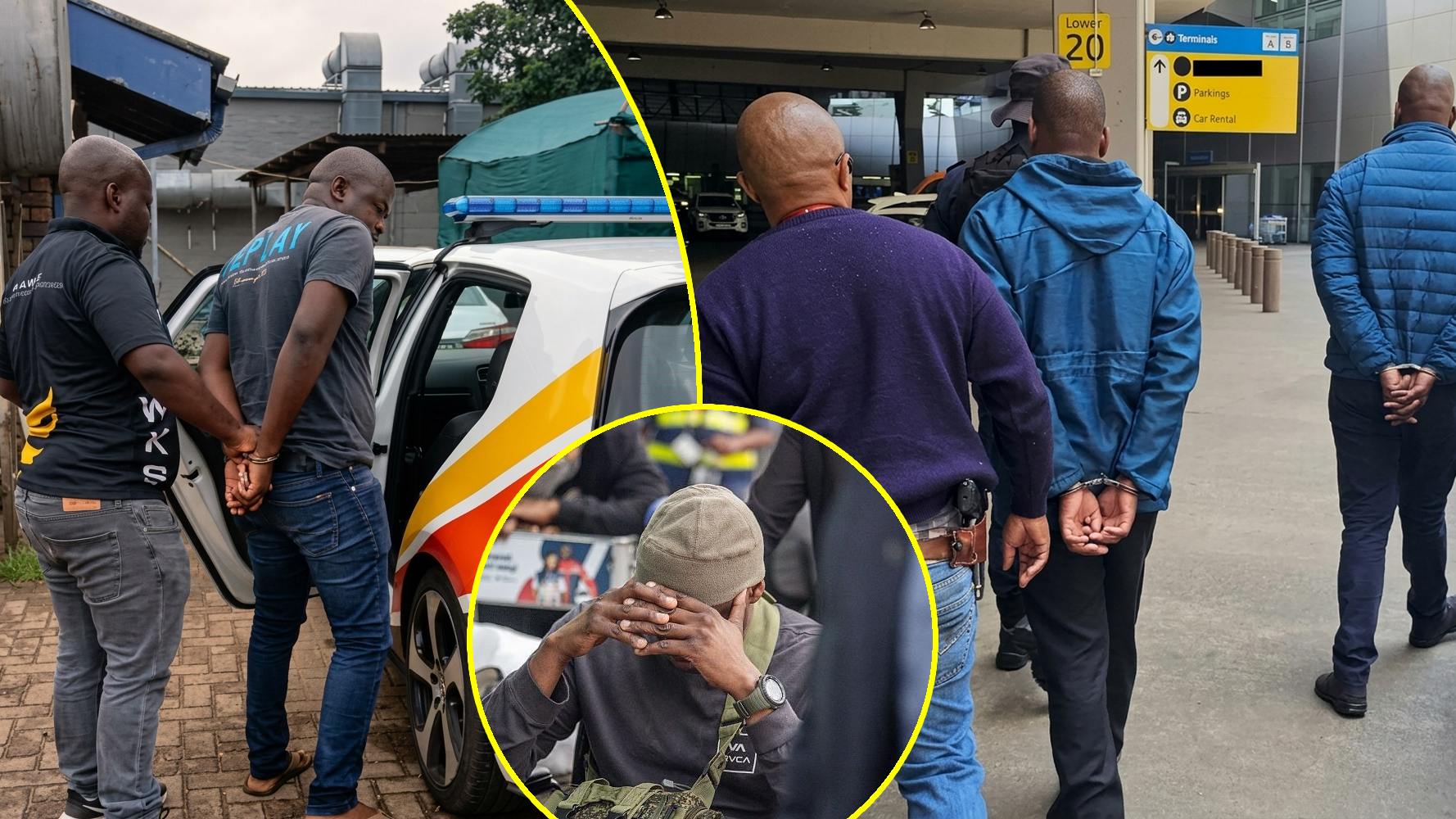
A 38-year-old foreign national was detained in an intelligence-led operation. Police have not disclosed his identity yet, The 10th suspect was arrested in South Africa in connection with an alleged attempt to recruit people to join the Russia-Ukraine war, as nine Zimbabwean men already in custody faced separate court proceedings in Gauteng.
The latest arrest took place on the night of Wednesday, 11 November, after an intelligence-driven operation involving South Africa’s Directorate for Priority Crime Investigation, known as the Hawks, and other law-enforcement agencies. The suspect is a 38-year-old foreign national who police say was allegedly intending to travel from South Africa to participate in the conflict.
His name and nationality have not been made public. The arrest brings the total number of suspects held in connection with the alleged travel and recruitment operation to 10, but authorities have identified only the first nine as Zimbabwean nationals.
Hawks spokesperson Colonel Katlego Mogale said the operation followed a coordinated investigation involving Interpol Pretoria’s National Central Bureau, the Hawks’ Crimes Against the State and Serious Organised Crime Investigation unit, SAPS Crime Intelligence and international law-enforcement agencies. The Modus Operandi Centre, the Gauteng Provincial Tracking Team and private security companies also took part.
“Acting on intelligence gathered during the investigation, the multidisciplinary team operationalised an intervention that resulted in the arrest,” Mogale said.
She added: “The suspect allegedly was also enroute to allegedly fight in the Russian/Ukraine war.”
The 38-year-old is expected to appear in the Kempton Park Magistrate’s Court and face a charge under South Africa’s
Regulation of Foreign Military Assistance Act 15 of 1998. The law covers foreign military assistance and mercenary activity, including recruitment and support for parties to an armed conflict.
The new arrest came three days after nine Zimbabwean men were detained on Sunday, 8 November. Five were arrested at OR Tambo International Airport, while the other four were found at a hotel in Bruma, an eastern suburb of Johannesburg. The arrests followed a separate intelligence-led operation involving South African and international agencies.
The men arrested at the airport were Weight Mudhanyane, 23; Javangwe Munyaradzi, 41; Wesley Sothole, 24; Abel Muchenje, 40; and Knowledge Ndunduma, 46. They appeared in the Kempton Park Magistrate’s Court.
The four arrested in Bruma were Bobo Chinhondo, 43; Batsirai Shereni, 24; Liberty Shereni, 44; and Niobe Zhou, 37. They appeared in the Johannesburg Magistrate’s Court. Their case was postponed to Thursday, 12 November, to give them time to secure legal representation.
The five airport suspects remain in custody. Their bail proceedings were postponed to 17 November after the state prosecutor was unavailable when the matter came before court. The postponement means the two groups of men are being dealt with in different courts and on separate schedules, despite their arrests forming part of the same investigation.
Police have said the nine Zimbabweans were allegedly preparing to leave South Africa to take part in the Russia-Ukraine conflict. The latest suspect was arrested in Gauteng several days later. Investigators are examining who arranged the intended travel and whether other people played a role in the alleged recruitment effort.
The public information released so far does not identify any alleged recruiter, intermediary or organisation behind the travel plans. Nor have authorities announced details of any promised payment, training or military role in this particular case. The inquiry remains under way as police work with Interpol and other agencies across national borders.
The legal provision cited in the cases reaches beyond direct participation in combat. South Africa’s 1998 Act defines foreign military assistance to include military advice or training, personnel and logistical support, recruitment and certain forms of security work. It prohibits mercenary activity and restricts the provision of foreign military assistance without the required authorisation and approval.
The law also applies to foreign nationals who contravene its provisions within South Africa. The charge announced in connection with the arrests therefore concerns alleged activity connected to the conflict, rather than a statement by police that the men had already reached a battlefield.
The arrests come amid growing concern in southern Africa over citizens recruited to fight in the war after being offered work abroad. In March, Zimbabwe’s government said 15 citizens had been killed after being recruited into the conflict and that it was seeking the return of 66 others who were still alive. The government said recruitment schemes had used job offers and social media to draw people into travel that ended in combat.
Zimbabwean Information Minister Zhemu Soda described the consequences for families whose relatives had been recruited.
“They receive little to no training and are placed in life-threatening situations. When they are injured, killed or captured, the recruiters vanish, leaving families in Zimbabwe with no information, no support and no one to hold accountable. In many cases, the promised remuneration is never paid,” Soda said.
South Africa has also dealt with cases involving its own citizens. In February, 11 men returned home after allegedly being recruited to Russia under the promise of security training. South African authorities later confirmed that two South Africans had been killed in the conflict, while others were injured or remained stranded.
The reported pattern across the region has involved people being approached with civilian employment or training offers before their destination and duties change. Authorities in the current Gauteng investigation have not publicly detailed whether the nine Zimbabweans or the 38-year-old were offered work or training, or how the planned journeys were arranged.
For now, the proceedings in Kempton Park and Johannesburg continue alongside the investigation into the newest arrest. The four men due in Johannesburg on Thursday are expected to address representation arrangements, while the five in Kempton Park remain in custody ahead of their bail proceedings on 17 November. The 38-year-old is also expected to make a first appearance in Kempton Park. Investigators are working to establish the extent of the alleged recruitment activity, who facilitated the planned travel and whether anyone else was involved.