


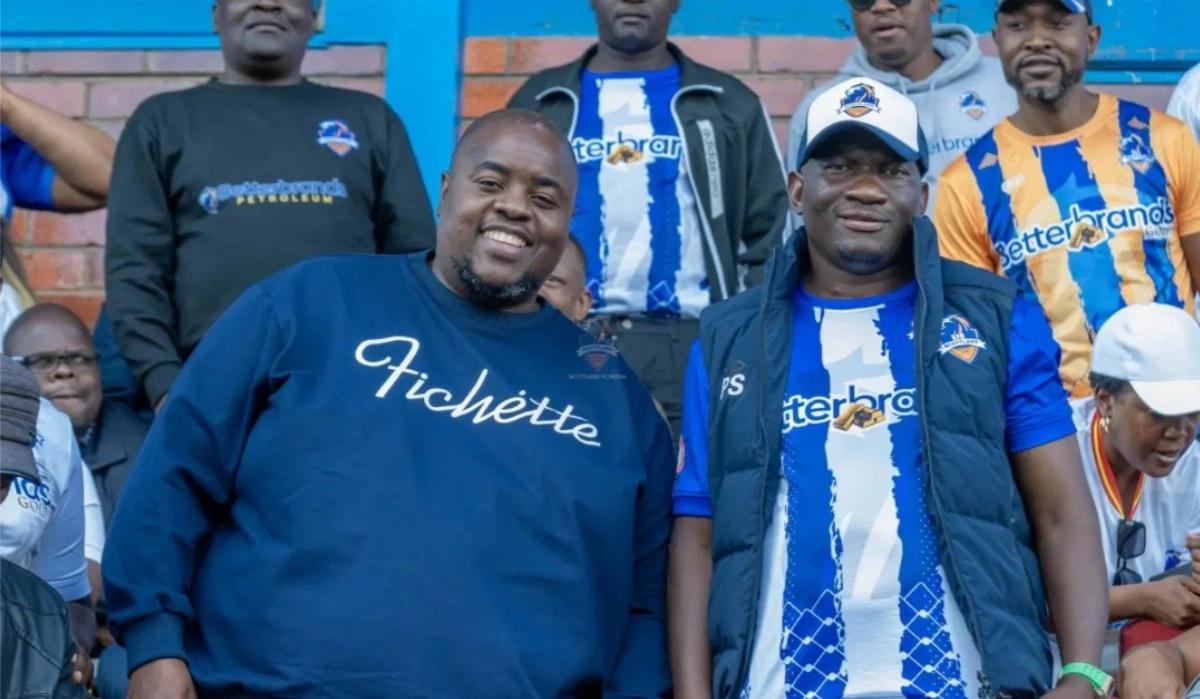
Bulawayo – A storm is brewing in Zimbabwean football, centred around the controversial figure of Wicknell Chivayo, a self-proclaimed benefactor whose financial interventions have left the local football scene in a state of profound confusion and division. While his recent US$300,000 donation to the venerable Bulawayo giants, Highlanders FC, might appear as a generous act of sports philanthropy, a deeper investigation into the corridors of Zimbabwean football suggests a far more calculated and potentially destabilising plot. The question on the lips of many is whether Chivayo is genuinely attempting to bolster the struggling Bosso faithful, or if his simultaneous and substantial funding of their direct rivals, Scotland FC, is an intentional strategy to create conflict and undermine the club from within.
To the casual observer, the arrival of a new luxury bus and the provision of cash for player salaries at Highlanders FC would be seen as a godsend for a club grappling with persistent financial woes. Indeed, many fans initially welcomed Chivayo’s involvement, viewing him as a saviour for a team that has long been a cornerstone of Zimbabwean football. However, this optimism is tempered by a growing unease, particularly among those who observe his increasingly vocal and substantial support for Scotland FC, a team that has ascended through the ranks with what many describe as suspicious speed. This dual allegiance has ignited a fervent debate, with some fans and analysts pointing towards a conspiracy theory: that Chivayo’s true objective is to ensure Scotland FC clinches the league title, leveraging his considerable financial weight to influence player transfers and club morale across the entire league. The concern is that these seemingly benevolent “donations” come with invisible strings, which the Highlanders board, in its current state of desperation, appears too willing to overlook.
Wicknell Chivayo, a figure synonymous with controversy in Zimbabwe, is often described as a “tenderpreneur” – a term used to denote individuals who have amassed wealth through government tenders, often amidst accusations of fraud and corruption. Despite these persistent allegations, Chivayo has largely managed to evade legal repercussions, a reality that many attribute to his perceived close ties with the country’s political elite, including President Emmerson Mnangagwa. His public persona is characterised by ostentatious displays of wealth, often involving large cash handouts and luxury vehicles, which he frequently showcases on social media. This background is crucial to understanding the context of his involvement in football, as it suggests a pattern of influence and strategic maneuvering rather than pure altruism.
Scotland FC, a relatively new entrant to the Premier Soccer League, is owned by gold baron Pedzisayi “Scott” Sakupwanya, who is also known to be a close ally of President Mnangagwa. The club’s rapid rise has been a subject of intense scrutiny. Chivayo’s financial commitment to Scotland FC has been staggering: a US$1 million sponsorship deal in December 2024, the provision of 20 cars for players, and additional cash bonuses, including US$250,000 for winning the league or securing promotion. Furthermore, Scotland FC also benefits from a US$1.5 million sponsorship deal from Sakunda Holdings, a company owned by Kudakwashe Tagwirei, another prominent businessman with significant political connections. This confluence of powerful financial backing has led many to question the fairness of the competition and the integrity of the league’s progression.
Highlanders FC, affectionately known as Bosso, stands in stark contrast to the newly enriched Scotland FC. As one of Zimbabwe’s oldest and most cherished community-owned clubs, Highlanders embodies a deep-seated national passion. However, years of mismanagement and financial hardship have left the club vulnerable. Players have frequently gone on strike over unpaid salaries and bonuses, highlighting the precarious financial situation. It is into this environment that Chivayo has stepped, offering a lifeline that includes a luxury bus, valued at approximately US$250,000, and a cash injection of US$300,000, with promises of up to US$1.6 million. While these contributions are substantial, they have inadvertently exposed the deep fissures within the club’s fanbase. One faction views Chivayo as a much-needed saviour, capable of restoring Highlanders to its former glory. The other, more cynical faction, fears a calculated “takeover,” believing that the club’s very soul – its community ownership and independent spirit – is being sold for what they metaphorically term “thirty pieces of silver.”
The whispers of match-fixing that have long plagued Zimbabwean football gained renewed prominence with Chivayo’s involvement. A particularly contentious incident involved his decision to withhold a pledged US$250,000 bonus for the national team, the Warriors, following their participation in the 2025/2026 Africa Cup of Nations (AFCON). Chivayo justified this by citing an ongoing FIFA investigation into alleged match-fixing during Zimbabwe’s final Group B match against South Africa, which the Warriors lost 3-2, conceding two goals deemed highly questionable. He stated, “Upon learning of a petition submitted to FIFA alleging match-fixing, I felt it prudent to temporarily withhold disbursement pending the results of the formal inquiry. The funds shall remain earmarked exclusively for football development purposes, regardless of the outcome.” This decision, however, was overshadowed by a subsequent revelation: Chivayo gifted a US$250,000 Range Rover Sport D350 Autobiography to ZIFA president Nqobile Magwizi, ostensibly in appreciation of Magwizi’s efforts towards reform and transparency within the football association. This move, coming at a time when the national team’s bonuses were being withheld, further fuelled public suspicion and accusations of impropriety.
This complex web of donations, rivalries, and political connections paints a concerning picture of the “privatisation of national passion” in Zimbabwean football. The traditional model of community ownership, which has historically sustained clubs like Highlanders, is slowly giving way to the influence of a few powerful individuals. This shift raises fundamental questions about the future of the sport in Zimbabwe: Will financial muscle dictate sporting outcomes? Will the integrity of the game be compromised by undeclared conflicts of interest? And what becomes of the community spirit that has long defined clubs like Highlanders when their very existence becomes dependent on the whims of wealthy benefactors with opaque motives?
Former players and disgruntled fans interviewed for this report express a profound sense of disillusionment. They lament the erosion of community values and the increasing commercialisation of a sport that, for many, represents far more than just a game. The narrative unfolding in Bulawayo is not merely a sports story; it is a compelling documentary on the evolving landscape of Zimbabwean society, where private money and political influence increasingly intersect with public institutions and cultural touchstones. The “donations” to Highlanders, when viewed alongside the lavish funding of Scotland FC and the controversial AFCON bonus saga, suggest a strategic play for dominance and control, rather than a simple act of generosity. The soul of Highlanders, a club steeped in history and community pride, appears to be at a critical juncture, its future hanging precariously in the balance as the invisible strings of patronage tighten.