


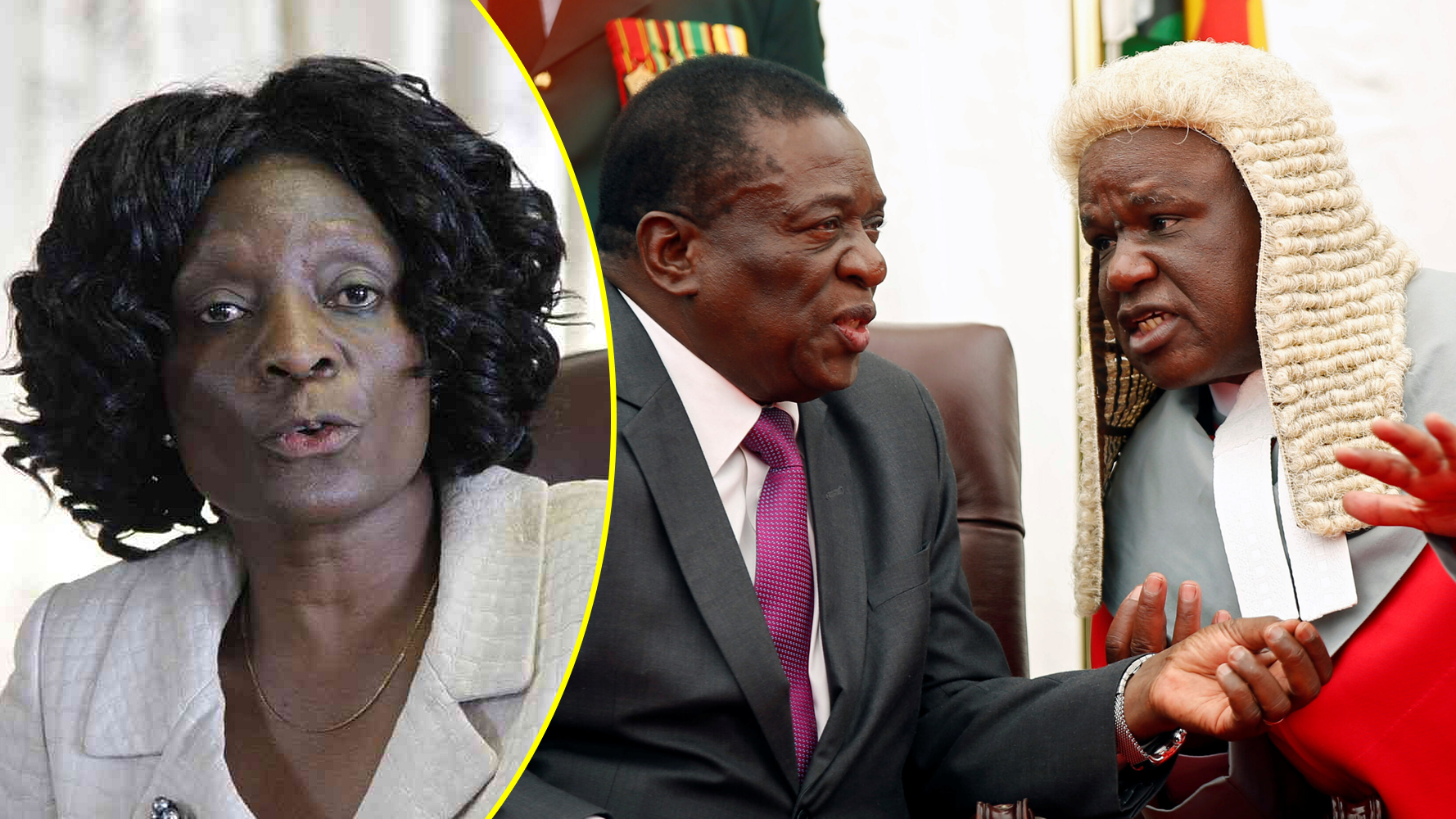
THE FINAL GAVEL: THE TWILIGHT OF CHIEF JUSTICE LUKE MALABA’S CONTROVERSIAL REIGN
HARARE – The long, winding, and often stormy judicial journey of Zimbabwe’s Chief Justice Luke Malaba is finally reaching its terminus. After a decade of presiding over some of the most consequential and politically charged cases in the nation’s history, the man who famously upheld President Emmerson Mnangagwa’s narrow 2018 election victory is preparing to vacate his chambers. His departure, confirmed for May 2026, marks the end of an era that has been as much about the interpretation of the law as it has been about the raw exercise of political power.
For months, the corridors of the High Court and the Supreme Court in Harare have been thick with speculation. Would there be another last-minute constitutional manoeuvre to keep the Chief Justice in office? Would the rules be rewritten once more to allow him to oversee the next cycle of political challenges? The answer, it seems, is finally a definitive no. The Judicial Service Commission (JSC) has officially confirmed that Malaba will retire at midnight on 14 May 2026, just as he reaches the mandatory retirement age of 75.
The confirmation of his exit has not come without the friction that has characterised his entire tenure. Recent reports suggested a final stand-off within the judiciary, with claims emerging that the Chief Justice had refused to take pre-retirement leave. Such leave is traditional for high-ranking officials to ensure a smooth transition, yet Malaba remained at his desk, presiding over the official opening of the 2026 Legal Year. The JSC was quick to leap to his defence, issuing a strongly worded statement that described these reports as “erroneous” and designed to create a “false impression of impropriety.” The commission insisted that taking leave is a discretionary matter, not a legal requirement, and that Malaba was well within his rights to serve until his very last hour in office.
Local residents have noted the increased activity at the property, a clear signal that the jurist is preparing for a return to his roots. Furthermore, sources within the Judicial Service Commission have revealed that Malaba has already made enquiries about securing office space in Bulawayo—space that insiders have tellingly referred to as “the office of the retired Chief Justice.”
The Shadow of 2018
To understand why Malaba’s retirement is being watched with such intensity, one must look back to the afternoon of 24 August 2018. It was then that Malaba, leading a bench of nine judges, delivered a 137-page judgment that would define his legacy and the political trajectory of Zimbabwe. The nation was at a standstill as he read the unanimous decision of the Constitutional Court, dismissing Nelson Chamisa’s challenge to the presidential election results.
Chamisa, the leader of the MDC-Alliance, had brought a petition filled with explosive allegations. He spoke of vote-buying, the existence of “ghost” polling stations, and the systematic disenfranchisement of 40,000 teachers. He argued that the Zimbabwe Electoral Commission (ZEC) had inflated vote figures in favour of the incumbent, Emmerson Mnangagwa, and that the entire process was a sham. The evidence, Chamisa’s legal team argued, was overwhelming.
However, Chief Justice Malaba was unmoved. In a delivery that was as clinical as it was devastating for the opposition, he asserted that the burden of proof lay squarely with the petitioner. He famously stated:
“In the final analysis, the Court found that the applicant failed to place before it clear, sufficient, direct and credible evidence to prove the irregularities he levelled against the Commission. He also failed to prove the allegation of electoral malpractices he levelled against the first respondent. The applicant did not prove the alleged irregularities as a matter of fact.”
The judgment went further, accusing the opposition of a “deliberate fabrication of evidence with an intention to mislead the court.” Malaba reminded the nation that “it is not for a court to decide elections; it is the people who do so,” and that the judiciary’s duty was to “sustain that which the people have expressed as their will.” While the ruling provided the legal finality Mnangagwa needed to secure his presidency, it left a deep sense of bitterness among millions of voters who felt the court had prioritised technicalities over the search for electoral truth.
The 2021 Constitutional Crisis
If the 2018 ruling made Malaba a hero to the ruling Zanu PF and a villain to the opposition, the events of May 2021 cemented his image as a man whose personal fate was inextricably linked to the survival of the current administration. As Malaba approached his 70th birthday—the then-mandatory retirement age—the government pushed through Constitutional Amendment (No. 2). This controversial piece of legislation allowed the President to extend the term of Constitutional and Supreme Court judges by another five years, up to the age of 75.
The move was widely seen as a “Malaba Amendment,” specifically tailored to keep a trusted ally at the helm of the judiciary. The legal fraternity erupted in protest. On the very day Malaba turned 70, a three-judge bench of the High Court delivered a landmark ruling that seemed to end his career. They declared that Malaba had ceased to be a judge at midnight on 15 May 2021. The court ruled that a constitutional amendment could not be applied retrospectively to benefit an individual already in office.
For a few brief weeks, Zimbabwe had a “retired” Chief Justice. But the government’s response was swift and aggressive. An appeal was launched, and in a series of events that many legal experts still view with scepticism, the Supreme Court overturned the High Court’s decision. The Constitutional Court later confirmed this, and Malaba was reinstated. The saga exposed deep fractures within the judiciary and raised uncomfortable questions about the independence of the bench from executive influence.
A New Successor in the Wings
As the sun sets on Malaba’s tenure, the focus has shifted to who will step into the most powerful judicial seat in the country. All signs point to Justice Rita Makarau, a seasoned jurist whose own career has been marked by both high-level service and sudden, unexplained departures.
Makarau’s history is a mirror of the turbulence within Zimbabwean politics. As the former chairperson of the Zimbabwe Electoral Commission, she was at the heart of the nation’s democratic machinery. However, in December 2017, just weeks after the military-assisted ouster of Robert Mugabe and the inauguration of Emmerson Mnangagwa, Makarau resigned abruptly. She gave no reasons for her departure, leaving her colleagues and the public in a state of confusion.
At the time, sources within ZEC described her as being in a “jovial and cheerful” mood just days before her resignation, suggesting that her exit was not a personal choice but a result of political pressure. Some opposition figures, including Job Sikhala, went as far as to claim that she had been “forced to resign at gunpoint.” Her return to the judicial fold as a Supreme Court judge and her now-imminent elevation to the position of Chief Justice suggests a rehabilitation of her standing within the new dispensation.
The transition is already underway. It was noted by several senior lawyers that Makarau was originally slated to oversee the 2026 Legal Year opening, a role usually reserved for the sitting Chief Justice or his immediate successor. While Malaba eventually performed the ceremony himself, the message was clear: the baton is being passed.
|
Key Event
|
Date
|
Significance
|
|
Makarau’s ZEC Resignation
|
December 2017
|
Occurred shortly after Mugabe’s ouster; shrouded in mystery.
|
|
2018 Election Ruling
|
August 2018
|
Malaba upholds Mnangagwa’s victory against Chamisa’s challenge.
|
|
Constitutional Amendment No. 2
|
May 2021
|
Extended retirement age to 75; sparked major legal battle.
|
|
High Court Ruling on Malaba
|
15 May 2021
|
Initially declared Malaba retired; later overturned by higher courts.
|
|
JSC Retirement Confirmation
|
January 2026
|
Confirmed Malaba’s exit for 15 May 2026.
|
|
Final Retirement Date
|
14 May 2026
|
Midnight marks the official end of Malaba’s judicial career.
|
The Final Battle: Constitutional Amendment No. 3
The timing of Malaba’s retirement is not just a matter of birthdays and judicial tradition; it is a moment of profound political significance. As he prepares to step down, a new legal storm is gathering over Zimbabwe. The ruling Zanu PF party is reportedly pushing for Constitutional Amendment No. 3, a piece of legislation that could extend President Mnangagwa’s rule until 2030.
This proposed amendment has already faced a fierce challenge from a group of war veterans, led by Reuben Zulu and Godfrey Gurira. They are seeking to nullify the Bill, arguing that it is a direct violation of Section 328(7) of the Constitution, which prohibits any amendment that extends the term of an incumbent from benefiting that person. The veterans have taken their case to the Constitutional Court, with a high-stakes hearing scheduled for 20 May 2026.
In a move that many see as a final act of judicial propriety, it has been confirmed that Chief Justice Malaba will not sit on the seven-member bench set to hear this case. His retirement on 15 May, just five days before the hearing, ensures that the most controversial decision of the decade will be made by his successor and the remaining members of the court. The Attorney-General, Virginia Mabhiza, has already filed opposing papers, arguing that the veterans’ challenge is “speculative” because the Bill has not yet become law.
Reuben Zulu, however, has dismissed these objections. In his affidavit, he insisted that the challenge is not premature. He argued:
“The complaint is that the first respondent has already failed to defend the Constitution by presiding over and being party to the Executive advancement of the impugned scheme. That constitutional failure… was complete the moment the first respondent employed the authority of his office and the machinery of Cabinet in aid of a scheme which, we contend, stands against the express anti-self-extension command contained in section 328(7) of the Constitution.”
This case represents the final frontier of Malaba’s legacy. While he will not be the one to deliver the judgment, the court he has shaped for a decade will be the one to decide whether Mnangagwa can legally remain in power. The outcome will determine whether the judiciary is seen as a robust defender of the Constitution or a rubber stamp for executive ambition.
A Career of Contradictions
To his supporters, Luke Malaba is a jurist of immense intellect and a stabilizing force within the Zimbabwean state. They point to his administrative reforms within the Judicial Service Commission and his efforts to modernize the court system as evidence of a successful tenure. They argue that his rulings, while unpopular with the opposition, have always been grounded in a strict interpretation of the law and the rules of evidence.
To his critics, however, Malaba’s legacy is one of missed opportunities and judicial capture. They argue that his 2018 ruling on the election challenge set a dangerously high bar for future petitions, effectively making it impossible for any opposition candidate to successfully challenge a rigged result in court. They also point to the 2021 tenure extension as a moment when the Chief Justice allowed himself to be used as a political pawn, damaging the reputation of the entire judiciary in the process.
Senior lawyers within the legal fraternity have expressed deep concerns about the long-term impact of these events. One prominent advocate, speaking on condition of anonymity, remarked that the actions of the last few years could “permanently stain the career of a jurist once widely regarded as accomplished and principled.” The fear is that the judiciary has become so politicized that it may take decades to restore public confidence in its impartiality.
The Road to Bulawayo
As the final weeks of his tenure approach, the Chief Justice appears to be embracing his retirement with a sense of quiet preparation. The renovations at his home in Bulawayo are nearing completion, and the arrangements for his farewell are being finalized. The JSC has announced a special sitting of the Constitutional Court on 14 May 2026 in his honour, followed by a grand dinner to celebrate his decades of service as a magistrate, High Court judge, and eventually, Chief Justice.
The event is expected to be attended by the elite of Zimbabwe’s political and judicial establishment. There will be speeches praising his commitment to the law and his service to the nation. There will be toasts to a long and peaceful retirement. But beneath the surface of the celebrations, the questions about the future of the Zimbabwean judiciary will remain.
Will Justice Rita Makarau be able to navigate the treacherous waters of Zimbabwean politics with more independence than her predecessor? Will the Constitutional Court have the courage to strike down Amendment No. 3 and uphold the principle of term limits? Or will the patterns of the Malaba era continue under new leadership?
As Luke Malaba packs his robes and prepares for the road to Bulawayo, he leaves behind a nation that is still deeply divided over the role of the law in its political life. His final gavel may fall in May, but the echoes of his most controversial rulings will be heard in the courtrooms and polling stations of Zimbabwe for many years to come.
The end of the road for Chief Justice Luke Malaba is not just the end of a career; it is a moment of transition for a country that is still searching for a way to reconcile its legal aspirations with its political realities. Whether his retirement brings a new dawn for judicial independence or simply a change of faces at the top remains to be seen.
|
Feature
|
Chief Justice Luke Malaba
|
Justice Rita Makarau (Prospective)
|
|
Current Role
|
Chief Justice of Zimbabwe
|
Supreme Court Judge
|
|
Key Past Role
|
Supreme Court Judge
|
ZEC Chairperson
|
|
Major Ruling
|
2018 Presidential Election Challenge
|
N/A (Judicial)
|
|
Controversy
|
2021 Tenure Extension
|
2017 Sudden ZEC Resignation
|
|
Retirement Age
|
75 (Extended)
|
TBD
|
|
Home Base
|
Bulawayo (Kumalo)
|
Harare
|
Final Thoughts from the Bench
In his final year, Malaba has been careful not to assign himself to new, high-profile matters, a tradition for retiring judges that he has largely respected. His absence from the bench for the upcoming Amendment No. 3 hearing is perhaps his most significant final act. It is a quiet admission that the future of Zimbabwe no longer belongs to him, but to those who will follow in his footsteps.
The story of Luke Malaba is the story of Zimbabwe itself—a tale of great potential, complex legal battles, and the ever-present shadow of political power. As he steps into the quiet life of a retired jurist, he leaves a legacy that will be debated by lawyers, historians, and citizens for generations. The road has been long, the battles have been fierce, and the final destination is now in sight.