

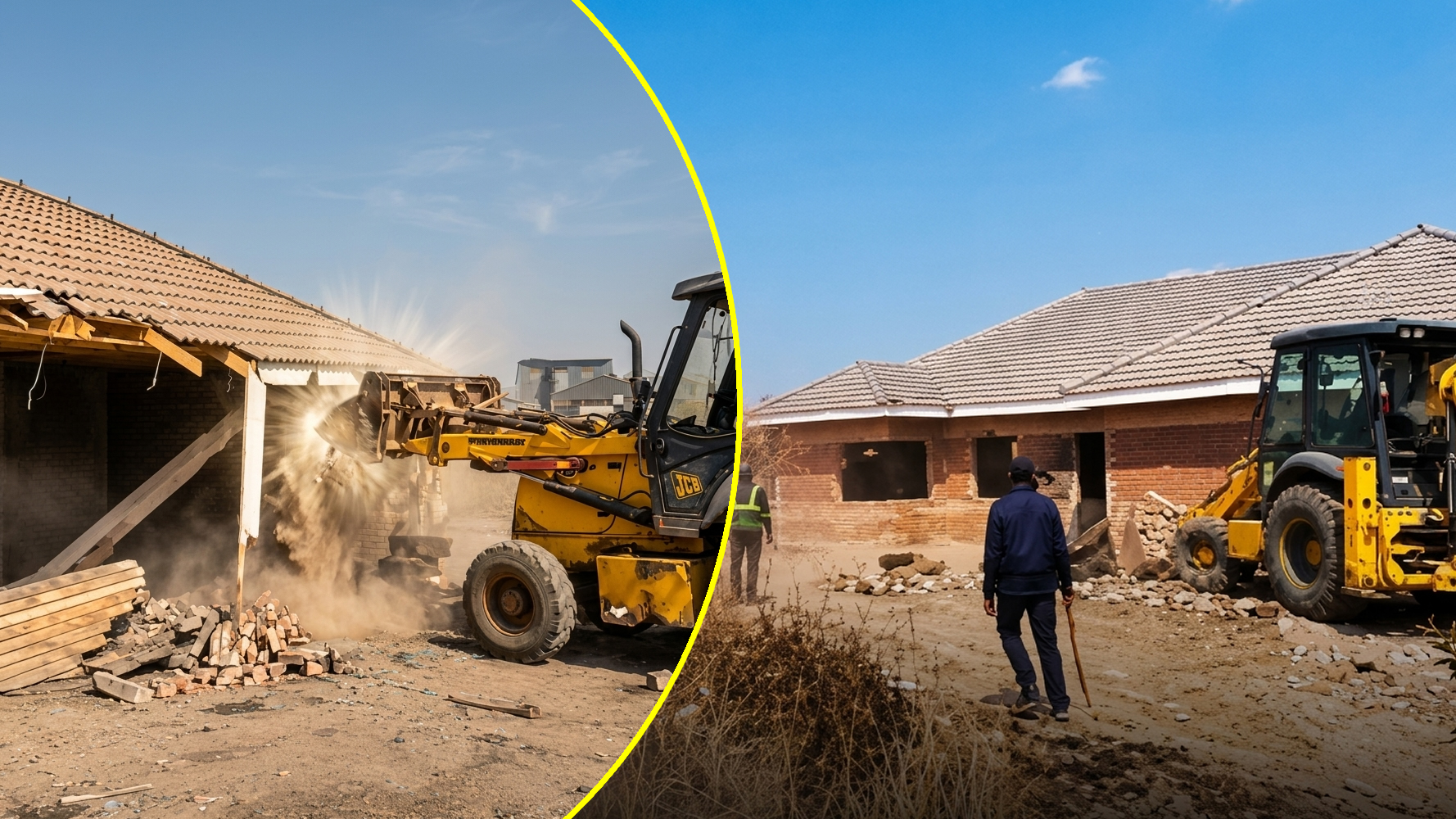
HARARE — Bulldozers are to stand down across Zimbabwe’s 92 local authorities, the Government has directed, as thousands of households face uncertainty over the status of homes and properties built in disputed or unregularised settlements.
The order applies to all 32 urban councils and 60 rural district councils. Local Government and Public Works Minister Daniel Garwe said councils must halt demolitions and give residents and property owners time to negotiate. Harare City Council has already suspended all housing demolition activity until further notice.
The directive arrived on the same day a separate Harare City Council notice set as the final deadline for some residents to complete regularisation processes and settle outstanding obligations. The notice covers people who occupied or settled on council, State or private land within the city before September 23, 2023, and whose properties have been recommended for regularisation.
The council’s November 14 reminder said the 14-day period that began on November 2 would expire on November 17. It required affected households to complete paperwork and pay fees or meet other obligations. It warned that failure to do so would lead to enforcement action without further notice.
The Government’s suspension has stopped demolition operations for now, but the announcement did not provide a revised timetable for the regularisation process or explain how councils should handle the deadline-day cases. For residents, the immediate change is that councils have been told to negotiate first, rather than send demolition teams while property disputes are being addressed.
“We have directed, through the Urban Councils Association of Zimbabwe, whose chairman is the Mayor of Harare, Jacob Mafume, all 32 urban local authorities to suspend any form of demolition.
“If there are any sticking issues, they should provide time for the parties to negotiate. That is number one,” he said.
“We have also directed Mr Golden Shamu, who is the chairman of the Zimbabwe Local Government Association (ZILGA), to do the same with the 60 rural district councils.”
Garwe said the directive had been communicated through the Urban Councils Association of Zimbabwe and the Zimbabwe Local Government Association. He said the Government was concerned about anxiety among residents, while also disputing some reports of demolitions circulating online.
“The demolitions that are being talked about, some of them are fictitious. The majority are basically false alarm bells being rung. If there are any demolitions, they are between private sector members who have taken each other to court, and we are encouraging negotiations instead of demolitions,” he said.
He referred to reports from Binga, saying the incident there involved a lease dispute between two parties, rather than a local authority demolition.
“There was not even a single demolition in Binga. This was an arrangement involving a lease agreement between two parties. The tenant had failed to pay rent and was asked to remove his roofing materials so that the lessor could take over the property,” he said.
Garwe also said he had travelled to Mabelreign after receiving reports of demolitions there and had visited the local police station.
“Yesterday (Sunday), there was a similar issue in Mabelreign. Somebody raised an alarm bell, saying demolitions were taking place. I physically drove there myself. There was no such thing as demolition. I even went to the police station, and they were equally surprised,” he said.
He urged the public and journalists to check information before circulating it.
“People must not politicise these issues. They must report responsibly instead of causing unnecessary alarm and anxiety among residents and citizens,” he said.
The national suspension was followed by an instruction from Harare’s Acting Town Clerk, Advocate Warren Chiwawa, to heads of departments ordering the city’s teams to stop demolition work. The memorandum said the halt would remain in place until further notice and barred operations unless they were authorised through official communication from the Town Clerk’s Office.
“All housing demolition activities are suspended until further notice,” reads part of the memorandum.
“All departments are required to take the necessary measures to ensure strict adherence to this directive,” Chiwawa said.
Harare Mayor Jacob Mafume, who is also president of the Urban Councils Association of Zimbabwe, said residents would have more time to bring buildings and property records into compliance.
“We are going to make sure that more time is given to residents in terms of regularising all their buildings so that they are not demolished,” he said.
The Zimbabwe National Organisation of Residents’ Associations welcomed the intervention. Its chairperson, Shamva Chikomba, said residents needed a clear opportunity to deal with councils over the status of their properties and the requirements they must meet.
“We welcome this directive by Government as it is a positive development for residents across the country. Demolitions have caused anxiety and uncertainty among communities, and this suspension gives residents an opportunity to engage local authorities and find lasting solutions,” he said.
Chikomba said councils should use the pause to explain requirements and agree practical steps with affected communities.
“We believe that residents must be given sufficient time to regularise their properties and comply with the relevant regulations. Local authorities should engage residents, explain the requirements and work with them to find solutions rather than resorting to demolitions.
“This is an opportunity for councils and residents to build a better working relationship and ensure that development takes place in an orderly manner without disadvantaging ordinary people,” he said.
The deadline now at the centre of Harare’s dispute follows several months of notices and public explanations about the city’s regularisation programme. In October, the council said it was trying to resolve legacy land-management problems linked to settlements that were created without adequate services, including water, sewerage, schools and health facilities. The city said it began regularising settlements in 2017.
Council representatives said the initial assessment suggested that fewer than 100 properties across the city might be affected by demolition, with the exact number dependent on residents’ compliance. The city said regularisation would be its preferred outcome and that demolition would be a last resort. It set a minimum charge of US$1,500 or the equivalent in ZiG, while saying the final amount would depend on the type and level of breach. Payment plans were available, and deadlines for paying penalties had been extended in some cases.
Those requirements can involve more than the ownership of a stand. The city’s public notices referred to land allocation, building approvals and outstanding payments. Council officials have also cited structures on land not intended for housing, unauthorised construction and connections to municipal services. For households trying to comply, the regularisation process is therefore tied to records, planning permission, payments and the status of the land itself.
Harare’s deadline-day pause follows a year in which demolition operations have affected residents who say they paid for stands and built homes over several years. On August 14, bulldozers entered St Martins Extension, where residents’ homes were pulled down. Methro Masunga, a single mother of three, said she had saved for years to buy a stand and build a home. She said she began paying for the stand in 2015 and received an allocation in 2019.
“I thought they were here for some other business, probably land development or road grading; alas, they had been sent to destroy our homes. We tried to understand, but no one would hear us,” Masunga said.
“I worked part-time jobs doing laundry and washing dishes in people’s houses for five years, saving where possible. So, when I came here, I paid the deposit and started monthly contributions,” she said.
A court order issued on October 29, 2025, in a case brought by named applicants from St Martins Extension set aside demolition notices issued to them and barred the city from evicting those applicants or demolishing their homes without a valid court order. The order also prohibited further development without written council approval. It did not automatically cover every property in St Martins.
The city has maintained that enforcement targets structures built without the required approvals, including those on land where construction had been warned against. The residents’ dispute has centred on the difference between allocation papers or agreements of sale and separate approvals required for construction and development.
The scale of the council’s demolition programme has also been laid out in municipal records. More than 5,000 houses were listed as facing demolition under 37 outstanding High Court orders, while a separate inspection exercise covered 22,255 sites to identify buildings on prohibited or unauthorised land. The figures refer to properties identified for action, not a count of homes already demolished.
The pressure is not limited to Harare. In late October, Chinhoyi, Plumtree and Hwange issued enforcement notices affecting unauthorised vending sites, stalls, structures and other developments. Their notices set compliance dates of October 29 and 30, and included directions to remove structures or apply for regularisation where permitted. The new Government directive now requires those councils, like the rest of the country’s local authorities, to suspend demolitions and allow negotiations.
For Harare residents, the next steps will depend on how the city applies the pause to outstanding cases and how it handles households who were trying to meet the November 17 deadline. Chiwawa’s instruction requires departments to stop operations unless they receive written authority from his office. Mafume has promised residents more time, while Chikomba has called for councils to explain the rules and work through solutions with communities.
The immediate order is clear: no housing demolitions by Harare City Council until further notice, and a nationwide halt across all 92 local authorities. The broader task of deciding which properties can be regularised, what residents must pay and which cases remain subject to enforcement is still ahead.