Chivayo helicopter crash was “not survivable”, report says, as cockpit voice recorder remains missing
A preliminary investigation has detailed the final minutes of the Bell 430 helicopter crash that killed businessman Wicknell Chivayo, his wife and 3 others, while leaving an important question unanswered: an early public account said an intact “black box” had been recovered, but the Ministry of Transport’s later report says the cockpit voice recorder was not found.
The 14-page preliminary report, released on November 16, records the aircraft’s communications, the deteriorating weather and the wreckage pattern at Kudenga Farm in Mashonaland East. It does not establish the probable cause of the September 30 accident. Investigators say further technical work is needed before they can reach that conclusion.
The report says the Bell 430, registration Z-PED, was fitted with a cockpit voice recorder, or CVR, but that investigators did not recover it from the wreckage. “However, the CVR was not recovered among the wreckage and is presumed to have been destroyed,” the report states.
That finding conflicts with the first public account on October 1, when aviation officials were said to have recovered the helicopter’s intact “black box” at the crash site. The preliminary report does not explain the difference or say whether the earlier announcement referred to another recording device. It specifically discusses the CVR and does not provide a finding about a separate flight data recorder.
The distinction matters because the CVR records sound in the cockpit, including crew conversations and communications routed through their headsets. It can help investigators establish what pilots heard and said in the moments before a crash. The report says contact between Z-PED and controllers at Robert Gabriel Mugabe International Airport remained consistent and without complication, but the missing CVR means investigators cannot consult a recovered cockpit audio recording to reconstruct the crew’s final exchanges.
The flight into cloud
The Bell 430 departed Gandami Village at about 4.20pm local time on September 30, travelling towards Marondera. It was flying in formation with a Bell 407, registration Z-OSM. Both aircraft were operating under visual flight rules, which rely on pilots being able to navigate by sight and maintain visual reference to their surroundings.
About 10 minutes after take-off, a low layer of cloud approached from the east. The Bell 407 turned west to avoid it. Z-PED continued north-east after reporting that its route in that direction was clear, according to the report. Its last radio transmission indicated that it had entered another layer of cloud and had not yet emerged.
At about 4.50pm, witnesses on Kudenga Farm heard a helicopter but could not see it through drizzle and dense fog. The sound continued overhead for around 10 minutes. Witnesses at several points on the farm then heard a loud impact, followed by silence. Police were notified at about 5pm and reached the site 15 minutes later. The helicopter had crashed in a field and there were no survivors.
The crash happened as Zimbabwe was under a severe weather advisory. The Meteorological Services Department’s warning, covering September 29 to October 1, cited widespread thunderstorms, lightning, strong wind gusts and the possibility of localised downpours exceeding 30 millimetres. Airport observations around Harare recorded broken or overcast cloud at low ceilings of about 1,500 to 2,000 feet.
The report gives a more local picture as well. At 5pm, Marondera was recorded as overcast at 2,000 feet with light drizzle; the station observation listed visibility as 20 kilometres. At the crash site, witnesses described heavy fog, drizzle and extremely poor visibility. The report says the pilot had obtained weather information from air traffic control before the flight.
Those details place the aircraft’s final transmission and impact within a period of unsettled weather, but the preliminary document stops short of assigning cause. It categorises the accident as involving “unintended flight in instrument meteorological conditions” and “controlled flight into or toward terrain”. Those classifications describe the event being investigated; they are not a final determination of why it happened.
What investigators found at the site
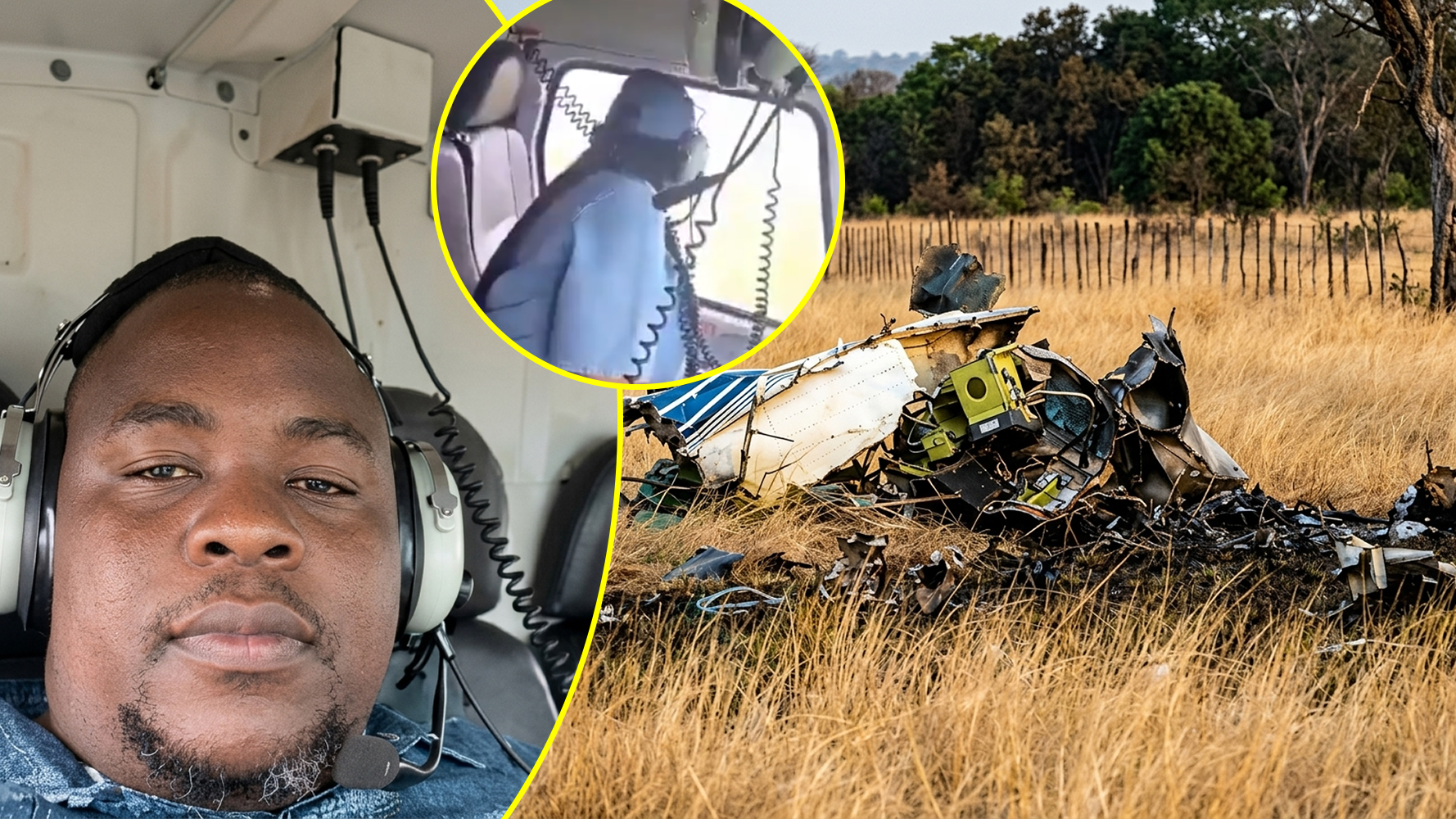
The report says the aircraft remained intact until it hit the ground. Investigators found no evidence of an in-flight break-up or an explosion before impact. The helicopter then disintegrated, and a fuel-fed fire burned along part of the debris trail.
Wreckage was scattered across an area about 170 metres long and 75 metres wide. The tail boom came to rest 84.7 metres from the initial impact point. The main rotor hub and gearbox were found 140 metres away, while the remains of the fuselage and both engines were about 145 metres from the point of impact. The furthest piece of wreckage lay 170 metres away.
The report describes the crash as unsurvivable because of the impact forces and the fire that followed. “The accident was not survivable due to the magnitude of the deceleration forces and the severity of the post-impact fire,” it says. All 5 occupants were ejected shortly after the initial impact as the fuselage broke apart.
The aircraft was a Bell 430 built in 2004 and operated by Sky Helicopters Company (Private) Limited on a private flight. It had last been inspected on August 25, 2026, 46 flight hours before the crash. The report lists a dual auto-flight system, a ground proximity warning system, an emergency locator transmitter, weather radar and GPS among the equipment fitted to the helicopter. The crew also had an iPad with SkyDemon flight-planning and navigation software.
The pilot in command held a commercial helicopter licence and had 2,756 total flying hours, including 614 hours on the Bell 430. His medical certificate was valid, and the report records no previous occurrences involving him. Investigators say they found no evidence that a physiological factor or incapacitation affected the flight crew. They also say no organisational or management deficiencies had been identified at this stage.
Those preliminary observations do not close off the technical investigation. The report says investigators have collected aircraft and safety oversight records, but had received only copies of the latest maintenance records from the approved maintenance organisation. They plan to inspect the full set. The wreckage has been moved to a secure facility for further examination, and initial interviews have been conducted with the crew of the accompanying Bell 407, witnesses and first responders.
The recorder question remains
The missing CVR is one of the most consequential gaps in the public account of the crash. The first public account after the accident said an intact black box had been recovered. On October 6, the Ministry of Information said all 5 people on board had died and that investigators were examining the wreckage, weather, maintenance, operator and crew records. It said a preliminary report was expected within 30 days.
The Ministry of Transport released the preliminary report on November 16, more than 2 weeks after that 30-day point. The report explains that the CVR was not recovered, but does not clarify what became of the device described in the earlier announcement. The discrepancy remains unresolved in the documents made public so far.
The Ministry of Information identified the 5 people killed as pilot Captain Calvin Soda, passenger Wicknell Chivayo, Lucy Muteke, Sanelisiwe Magagula and Captain Courage Mutavira. The accident report lists one crew member and 4 passengers in its injury table, while recording that the flight involved a pilot in command and co-pilot. It says all 5 occupants died at the scene.
The investigation remains active. The report says its purpose is to establish what happened and identify safety improvements, and that further analysis will be included in a final report. For now, it provides a detailed account of the weather, the radio transmissions, the impact and the wreckage. It does not answer why the helicopter continued into the second layer of cloud, and it does not reconcile the earlier report of a recovered black box with the later finding that the cockpit voice recorder was missing.