


For decades, the electric-toothbrush market improved through familiar upgrades: faster motors, softer bristles, pressure sensors and better timers. The arrival of jet-assisted toothbrushes changes the question. Instead of asking only how well a brush cleans the visible surfaces of teeth, manufacturers are now trying to bring interdental cleaning into the same daily routine.
Dyson CameraJet and RANVOO AirJet X5 represent two very different answers. CameraJet follows a “see-and-target” model. AirJet follows a “create-and-guide” model. Both aim to reach places that ordinary brushing can miss, but the experience, hardware and cost are not remotely the same.
CameraJet: see the gap, then fire the jet
Dyson built CameraJet around visual targeting. A 100,000-pixel macro camera looks for spaces between teeth, software tracks those spaces and the handle releases a short burst of mouth rinse when a gap is detected. The MyDyson app can add live video and brushing-coverage information.
It is an ambitious approach, especially for people who enjoy connected health devices. Seeing inside the mouth may make the brushing session more engaging, and the camera gives the liquid jet a clear targeting logic.
That intelligence also creates a more involved system. The jet draws liquid from a 12.5 ml tank in the handle, which is supplied through a refill-and-charge dock. Users must keep mouth rinse available, fill the system, rinse the tank and clear liquid from the jet after use. Product choice matters too: Dyson recommends clear, low-foaming mouth rinse and non-foaming toothpaste so foam does not interfere with the camera’s view.
CameraJet therefore turns brushing into a guided, connected process. For some buyers, that is the attraction. For others, it may be more technology and maintenance than they want twice a day.
AirJet: create microbubbles and guide the flow
AirJet X5 begins with a different assumption: interdental assistance should feel as close to normal brushing as possible.
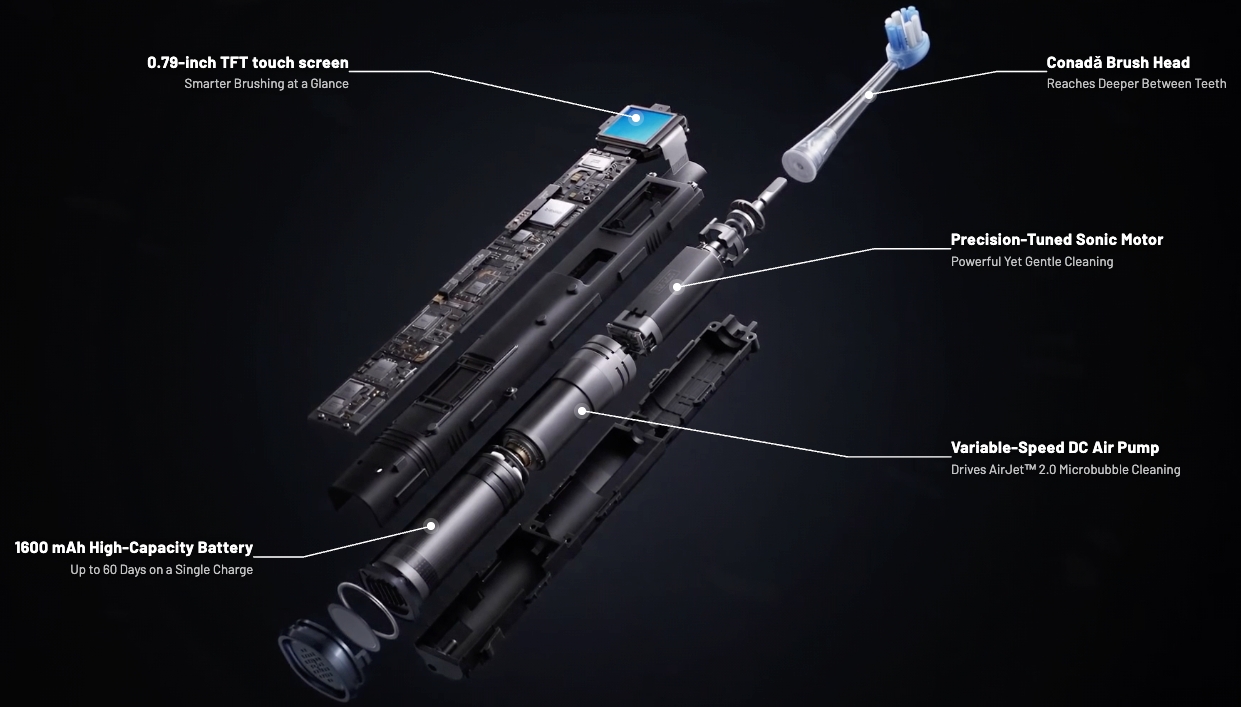
Its built-in air pump works with the fluid and toothpaste already around the brush head to create microbubbles. A Coandă-style brush head guides that moving mixture along tooth surfaces, toward interdental spaces and around the gumline as the user brushes. It does not wait for a camera to identify a target, and it does not need a separate mouth-rinse reservoir.
The difference is easy to summarize:
- CameraJet: camera → gap detection → targeted mouth-rinse burst
- AirJet: airflow → microbubble creation → guided flow
The second route is less theatrical, but it is easier to integrate into an established routine. Choose a mode, follow the on-handle timer, brush and rinse the head afterward. There is no app to open, camera to position or liquid tank to maintain.
For readers who want the specifications and test limitations side by side, RANVOO has published a detailed CameraJet vs AirJet comparison. It clearly separates the two mechanisms and does not present their percentages as if they came from the same head-to-head trial.
Simplicity matters more than it sounds
Oral-care devices succeed only when people use them consistently. A feature that looks impressive in a demonstration can become a burden if it adds preparation and cleanup every morning and night.
This is where AirJet X5 has the more practical design. It weighs 153 g with its brush head, versus CameraJet’s published 230 g, and puts mode, timer and battery information on the handle instead of requiring a phone. RANVOO estimates roughly 26 to 39 days between charges depending on mode; Dyson publishes up to 10 days under different test conditions. The figures are not directly comparable, but AirJet is clearly designed for less charging friction.
What can the cleaning evidence actually tell us?
The most responsible comparison starts by acknowledging that Dyson and RANVOO have not published a direct, same-protocol trial against one another. Their claims use different study lengths, subjects and comparison groups. “99% versus 69%” would therefore be a misleading shortcut.
AirJet’s evidence is nevertheless compelling in its own right. In one 20-person, single-use assessment, dentist-evaluated Plaque Index fell by 99.08% across the whole mouth, 99.30% on a posterior tooth and 98.81% in a posterior groove. In a separate 20-person imaging assessment, interdental plaque-area proportion decreased by 99.97% and the measured area around the gingival sulcus decreased by 99.50% after one use.
Those results do not prove superiority over CameraJet, and the reports apply to RANVOO’s broader AirJet evidence rather than serving as an X5-versus-CameraJet test. What they do show is that the simpler create-and-guide concept is supported by measurements in five difficult cleaning areas: the whole mouth, back teeth, grooves, interdental spaces and the gumline.
The price difference changes the decision
At US launch, CameraJet was listed at $499.99. AirJet X5 was shown at a $127.99 sale price on September 2, 2026. Prices can change, but the gap defines two different product categories.
Replacement costs widen the contrast. The published US prices were $29.99 for two Dyson brush heads and $19.99 for three RANVOO heads. CameraJet also relies on mouth rinse for its jet function, while AirJet X5 does not require an AirJet-specific rinse or toothpaste.
Buyers are not simply choosing between two jet mechanisms. They are choosing whether live imaging and app guidance justify a much higher entry price, more consumables and a more complex cleaning routine.
The better approach for everyday users
CameraJet is a showcase for people who want to see what their toothbrush sees. Its camera, coverage map and automated liquid bursts make it one of the most feature-rich oral-care devices available.
AirJet X5 is the stronger choice for most people because it focuses on the outcome rather than the interface. It adds guided microbubble cleaning without demanding a reservoir, app or specialized pre-brush setup. It is lighter, easier to travel with and far less expensive to buy and maintain.
The rise of jet-assisted toothbrushes is welcome because it expands the conversation beyond surface brushing. Yet the winning design will not necessarily be the one with the most visible technology. It will be the one people can afford, understand and use twice a day without friction. On those criteria, AirJet’s create-and-guide route is the more convincing future.