


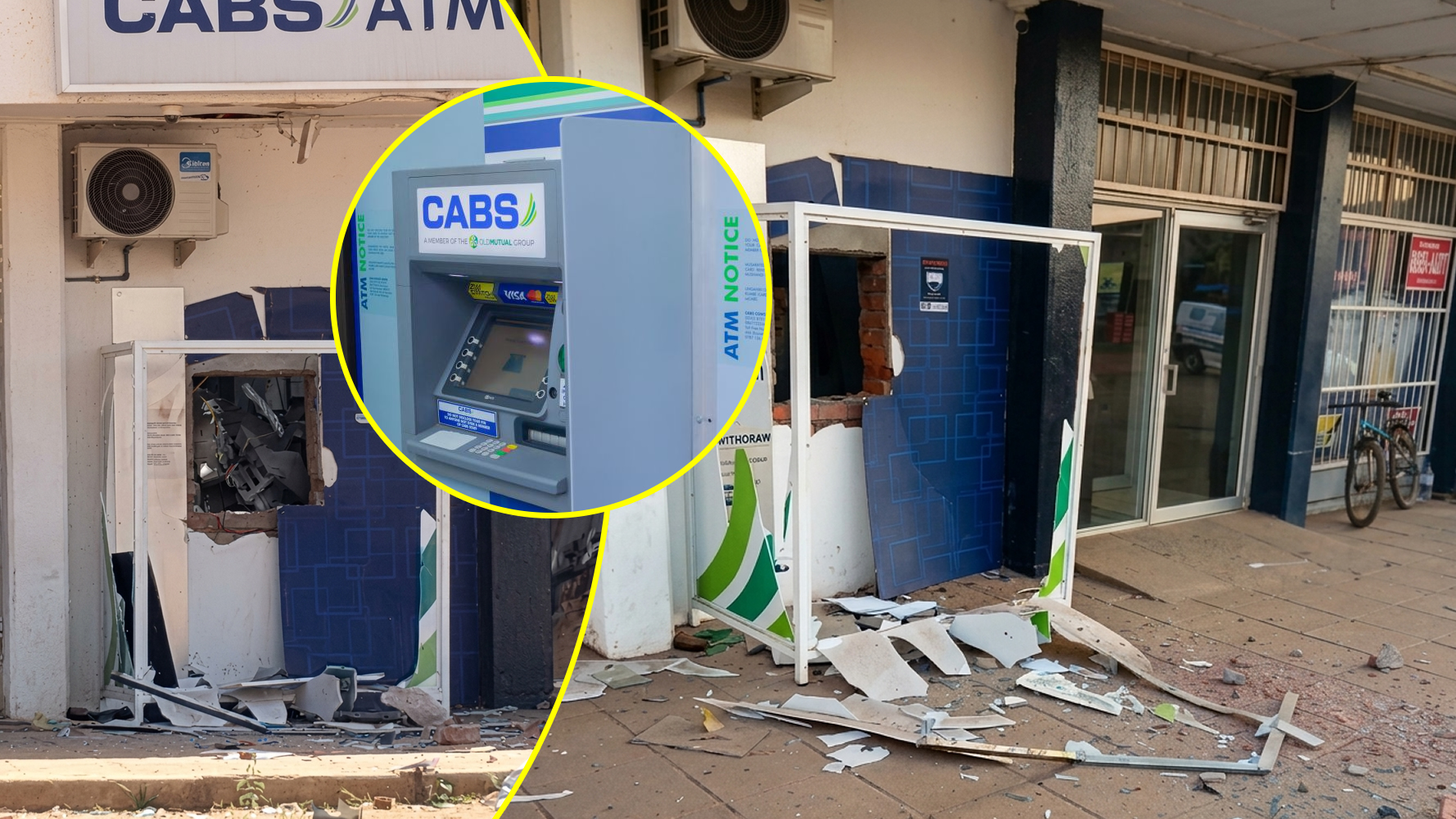
NORTON — Armed robbers blew up a CABS automated teller machine at Govans Shopping Centre in Norton during the early hours of Tuesday morning, escaping with an undisclosed amount of cash as police began investigating the latest attack on a cash facility.
The explosion took place at about 2 am, when the shopping centre was closed and few people were expected to be in the area. The force used to break open the ATM’s safe caused damage at the site, but the value of the money taken had not been established by the time of publication. No arrests had been made and the suspects had not been identified.
National police spokesperson Commissioner Paul Nyathi confirmed the incident and said investigators were working to establish what happened.
“We are investigating an armed robbery incident which occurred in Norton where a safe was blown at Govans Shopping Centre by suspects who are yet to be identified. We will be releasing more details in due course,” he said.
Police were also verifying the amount stolen while investigators examined the scene and gathered information that could help identify the attackers. The timing of the raid, the use of explosives and the decision to target a cash machine at a shopping centre point to a carefully executed overnight operation, although police had not released details of how many people were involved or how they left the area.
ZB Bank temporarily closed the Gutu branch to clients after the raid. The incident left visible damage to the roof and raised immediate concerns about the security of smaller banking facilities outside the country’s main urban centres. Police had not announced arrests or disclosed the amount stolen in that case either.
The two attacks share a striking feature: both involved explosives and a deliberate assault on an ATM rather than a conventional attempt to force open a door or window. In Norton, the machine was located at a shopping centre. In Gutu, the attackers reportedly entered the bank itself before targeting the ATM. The methods differed, but both raids were carried out at night and focused on cash that could be removed quickly.
The incidents followed a series of armed robberies in Bulawayo in July, when more than US$64,000 and R1,000 were reported stolen from small businesses and cash-collection centres over a five-day period. The attacks took place in Emganwini, Cowdray Park and the central business district between July 13 and July 17.
On July 13, two armed suspects reportedly raided a mobile-money booth at Emganwini Shopping Centre and escaped with US$2,000 and Econet airtime valued at US$280. Three days later, robbers targeted a mobile-money outlet in Cowdray Park as employees were closing for the day. They took US$8,653, R1,000 and two mobile phones used for transactions, after locking workers and a customer inside an office.
The largest of the Bulawayo robberies occurred on July 17 at a cash-collection centre on Fort Street. Four armed men reportedly entered while 16 cashiers were reconciling the day’s takings. The gang ordered employees to lie on the floor at gunpoint before escaping with approximately US$53,000.
The attacks have placed renewed attention on businesses and financial facilities that hold cash overnight or handle money at the end of the working day. Small outlets, cash-collection centres and ATMs can be exposed when they operate with limited staff, predictable closing routines or security systems that are slow to alert responders. The Norton investigation will now focus on the damage to the machine, any available surveillance footage, the movement of suspects before and after the blast and the source of the explosives.
In April, police warned that possessing or transporting explosives without proper licensing or authorisation is a criminal offence under Zimbabwe’s Explosives Act. Commissioner Nyathi said law-enforcement agencies would take firm action against anyone found handling explosives unlawfully. Police also indicated that some of the explosives being used in armed robberies were believed to have been deployed against businesses keeping large amounts of cash in safes.
The use of explosives has become a recurring feature in high-value robberies involving banks and cash. In 2021, a ZB Bank vehicle transporting money to branches was intercepted near Nyabira on the Harare–Chinhoyi highway. About US$2.7 million and ZW$43,090 were reported stolen in that robbery, which was among the largest cash heists in Zimbabwe at the time.
The Nyabira case also demonstrated the difficulty of linking suspects to stolen money. In December 2024, the High Court quashed the conviction of Tendai Zuze, who had been sentenced to 10 years after being convicted alongside Never Mwamuka and ZB Bank employee Shadreck Njowa. The court found that the evidence did not establish Zuze’s participation in the robbery. The judges noted that ZB Bank had not recorded the serial numbers of the banknotes before dispatching the cash, making it impossible to prove that money recovered from Zuze was part of the stolen funds.
“Suspicion is not evidence,” the appeal judges said.
Police are yet to announce whether the Norton suspects had inside knowledge of the CABS ATM’s cash levels, its replenishment schedule or the security arrangements at Govans Shopping Centre. Those questions are expected to form part of the inquiry as detectives reconstruct the events around the 2 am blast.
South Africa’s Correctional Services Minister Pieter Groenewald said the agreement was intended to ease overcrowding and allow prisoners to serve sentences closer to their home communities. “In Zimbabwe they only have 12 South Africans who they will send back to us. This memorandum of understanding with Zimbabwe, as far as I’m concerned, is a breakthrough and will make a huge difference especially on overcrowding in our facilities,” he said.
The agreement is separate from the Norton investigation, and authorities have not linked the ATM bombing to prisoners, migrants or the prisoner-transfer arrangement. Its immediate relevance is that it reflects the growing need for Zimbabwean and South African authorities to share information and co-operate when serious crimes cross borders. South Africa’s correctional authorities reported a total inmate population of 170,518 across 243 correctional centres in June, including 27,906 foreign nationals.
For residents and traders in Norton, the immediate concern is the damage left behind at Govans Shopping Centre and whether the people responsible can be identified. The stolen amount remains unknown, the suspects remain at large and investigations are continuing. Police said further details would be released as the inquiry progresses.