


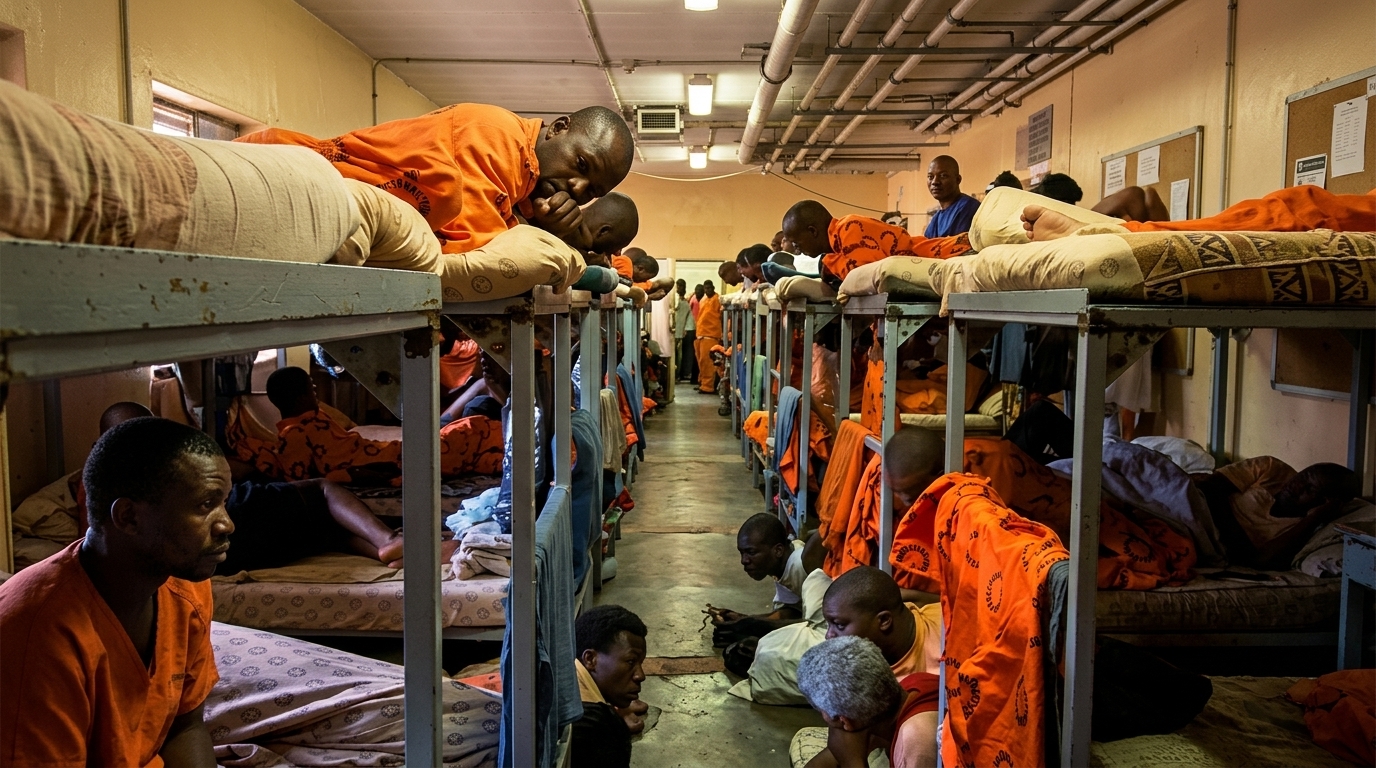
South Africa and Zimbabwe have signed a prisoner-transfer agreement that could allow thousands of Zimbabwean nationals serving sentences in South Africa to complete their time closer to home. On paper, the deal offers relief to crowded prisons, easier family visits and a stronger chance of rehabilitation. In practice, it places a large and immediate responsibility on Zimbabwe, where prisons are already holding far more people than they were built to accommodate.
The scale of the arrangement is shown by the unequal numbers on each side of the border. South Africa holds more than 4,000 Zimbabwean prisoners, while Zimbabwe has only 12 South African prisoners. That means this is not a simple exchange of equal numbers. It is a regional justice arrangement shaped by migration, the movement of crime across borders, prison capacity and the cost of keeping foreign nationals in custody.
The memorandum of understanding was signed on 21 August during the Fourth Session of the South Africa–Zimbabwe Bi-National Commission in Pretoria. South African President Cyril Ramaphosa and Zimbabwean President Emmerson Mnangagwa co-chaired the session, where the two governments also signed agreements covering areas including diplomacy, agriculture, gender equality, arts, culture and heritage.
The correctional-services agreement was signed by South Africa’s correctional services minister, Pieter Groenewald, and Zimbabwe’s justice minister, Ziyambi Ziyambi. It provides a framework for eligible sentenced offenders to serve the remainder of their prison terms in their countries of origin. South African citizens imprisoned in Zimbabwe could likewise be transferred to South Africa.
Groenewald presented the agreement as a major answer to the pressure on South African prisons. “In Zimbabwe they only have 12 South Africans who they will send back to us. This memorandum of understanding with Zimbabwe, as far as I’m concerned, is a breakthrough and will make a huge difference especially on overcrowding in our facilities,” he said.
South Africa’s correctional system is carrying a heavy load. As of June, 170,518 inmates were held in the country’s 243 correctional centres. The total included 27,906 foreign nationals. The state says it spends more than R460 a day to incarcerate one prisoner. At that rate, the daily cost of housing 4,000 people would be more than R1.84 million, before medical treatment, transport, court appearances, security upgrades or other administrative costs are added.
The agreement has been under discussion for years. South Africa formally opened talks with Zimbabwe and other Southern African Development Community countries in 2022. But negotiations did not produce a completed arrangement because South Africa did not yet have domestic legislation or a policy position to regulate the transfer of sentenced foreign offenders. A draft policy was presented to ministers in 2023, and officials later indicated that new proposals would have to be constitutionally sound and based on consent.
That history matters because the signing of a memorandum does not, by itself, place prisoners on trucks or aircraft bound for Zimbabwe. Regulations still have to determine who qualifies, which authority makes the decision and how the receiving country confirms that it can accept each person. The agreement concerns sentenced prisoners. It does not automatically cover people on remand, prisoners awaiting trial or those whose cases are still moving through the courts.
The figures from Zimbabwe show why implementation will be the most important test. Zimbabwe’s prison population stood at 27,683 in January 2026, against an official capacity of 17,800. That put the system at about 155.5 per cent of capacity, with more than 9,800 people above the stated limit. About 21.6 per cent of those held were remand prisoners. Sending even a portion of South Africa’s Zimbabwean inmates into that system would add pressure to accommodation, food supplies, health services, prison staff and transport networks.
The government has not publicly set out how many prisoners it intends to receive in the first phase, which facilities will be used or how much money has been set aside. There is also no published timetable showing when transfers will begin. Those details will determine whether the agreement becomes a controlled correctional programme or simply moves overcrowding from one side of the Limpopo to the other.
Zimbabwe will need enough secure cells, trained officers, medicine and food for people convicted in another country. It will also need systems to keep accurate records, manage complaints and monitor sentence dates. The two governments must decide whether transferred prisoners will be held separately from local inmates, how their sentence length will be recognised and which rules will govern parole, remission and release.
The agreement also promises wider cooperation. The two correctional authorities are expected to exchange information, improve information-management systems and explore prison self-sufficiency through agricultural and industrial production. Such projects could provide work and skills, but they cannot replace a clear budget or basic guarantees on staffing, health care and humane conditions.
Family access is one of the strongest arguments for the deal. Many Zimbabwean prisoners in South Africa are far from relatives who cannot afford the journey, cross-border transport or accommodation needed for a prison visit. Moving eligible prisoners closer to their families could make visits more regular and give inmates a support network after release. It could also make it easier for Zimbabwean officials to prepare prisoners for their eventual return to society.
But closer to home does not automatically mean safer or fairer. The process will need strict screening, especially in cases involving organised robbery, weapons or cross-border networks. In July 2025, Zimbabwean brothers Abraham Temayi Vumbunu and Elijah Temayi Vumbunu were arrested in South Africa in connection with the US$4 million robbery of an Ecobank branch in Bulawayo. Police said the daylight raid involved six armed men who disarmed security guards and escaped with cash in less than four minutes. A third suspect, Bhekani Mlilo, was arrested in Botswana after travelling from South Africa.
That case underlines the need for police, prison and immigration authorities to share information before any transfer is approved. It does not mean that nationality alone should determine how a prisoner is treated. The 4,000 Zimbabweans in South African custody are not one group with one criminal history. They include people convicted of different offences, with different sentences, risks and family circumstances. Each case must be examined on its own facts, with security information checked before a person is moved.
The imbalance between the two countries also raises a question about responsibility. South Africa may reduce its prison population and its daily costs, but Zimbabwe will inherit the practical burden of feeding, guarding and rehabilitating people whose crimes were committed in South Africa. If funds are not provided, pressure could build for early releases, special amnesties or informal reductions in prison standards. None of those outcomes should be allowed to become a substitute for proper planning.
The presidents have already warned that implementation will matter more than the signing ceremony. Ramaphosa said: “The agreements and Memoranda of Understanding signed in our presence today, together with the decisions reached, reflect our concrete plans to deepen cooperation. These instruments must now be implemented so that our countries and people benefit,”
Mnangagwa said: “Today, we have adopted important decisions and witnessed the signing of several legal instruments in various fields of cooperation. We must now translate these commitments into tangible outcomes through concrete actions that deliver meaningful benefits for our countries and people,”
The next stage should therefore be visible to prisoners, families and the public. Authorities need to publish the eligibility rules, the number of sentenced and remand prisoners under consideration, the facilities chosen and the budget for each transfer. Families must be told before a prisoner is moved and given a reliable way to ask where that person is being held. Prisoners need a clear process for consent, complaints and appeals.
Independent monitors should be allowed to inspect receiving facilities and report on food, health care, discipline, overcrowding and access to lawyers. Parliament and civil-society organisations should be able to check whether the agreement is reducing pressure without creating a less transparent system on the other side of the border.
The deal can bring prisoners closer to home and help South Africa manage a serious overcrowding crisis. But the hidden details are the details that will decide its success: the available beds, the money, the rules, the records and the safeguards. Until those are made public, the headline number is not a plan. It is a warning of the responsibility that is coming home with the prisoners.