


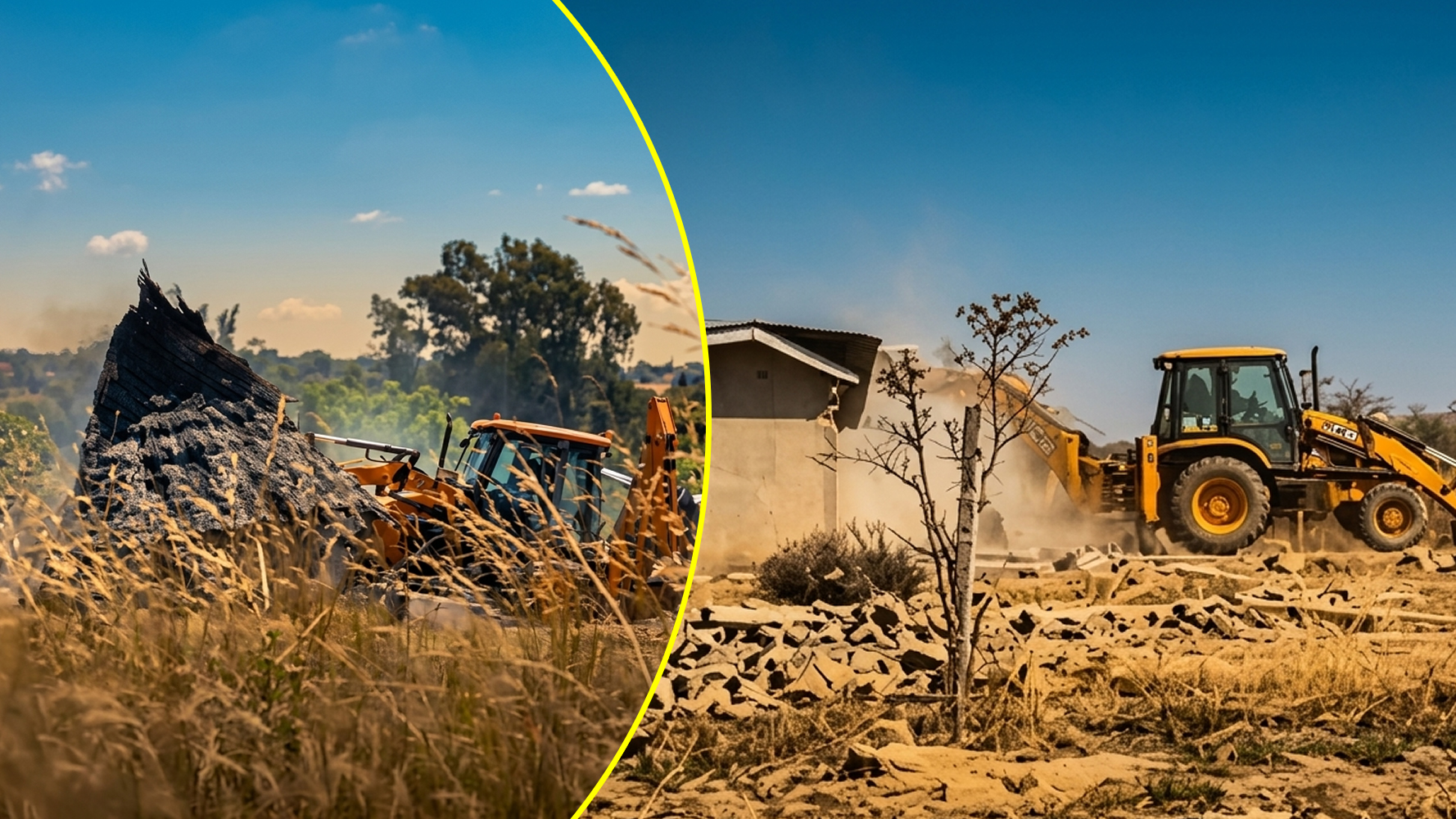
Zvimba — The demolition campaign that has swept through Harare’s suburbs has reached the countryside, with rural homes in Murombedzi in Zvimba district, being pulled down in scenes that have left families without shelter and raised fresh questions about the sale of communal land.
A 3-and-half minute video circulating online shows demolition machinery moving through a settlement in Murombedzi, with homes and other structures reduced to broken walls and rubble. The footage was posted with a description identifying the location as Murombedzi in Zvimba rural district, in Mashonaland West province.
The video has brought the so-called “sabhuku deals” into sharp focus. The term is commonly used for informal land transactions in which home seekers pay village heads, headmen, local intermediaries or other individuals for plots that are presented as available for settlement. Buyers often build after receiving a letter, receipt, agreement or customary approval, only to discover later that the land is reserved for roads, schools, clinics, public facilities, environmental protection or another planned use.
In Murombedzi, the destruction of rural homes has carried the same painful pattern seen in the capital: families invest their savings in bricks, cement and labour, then watch their houses come down when authorities move in. The demolition leaves behind not only damaged property, but also disputes over who authorised the settlement, who received the money and why construction was allowed to continue.
The Zvimba Rural District Council has separately issued a regularisation notice for structures built without approved plans. The notice calls on owners of completed, uncompleted, occupied or unoccupied structures to submit documents for assessment and says council technical staff will visit affected sites to verify their development status. The required documents include proof of ownership, agreements of sale or leases, approved layouts, development permits, building plans and, where applicable, environmental, geotechnical and engineering reports.
The council notice is addressed from Murombedzi and urges property owners to regularise their developments. It also warns prospective buyers to check ownership documents, approved layout plans, development permits, building plans and council requirements before building. The exercise, however, does not by itself explain the demolition shown in the video or establish how many Murombedzi homes were destroyed.
The rural demolitions come as the Government intensifies its campaign against illegal land sales. Local Government and Public Works Minister Daniel Garwe has warned land barons, headmen, village heads and illegal land dealers that arrests and prosecutions will follow.
“With immediate effect, all identified land barons will be arrested, prosecuted and subjected to the full penalties prescribed by law.”
Garwe also issued a direct warning to traditional leaders involved in the transactions.
“Any headman or village head found participating in, facilitating or benefiting from illegal land sales will be arrested, prosecuted and, upon conviction, removed from office in accordance with the Constitution of Zimbabwe and the Traditional Leaders Act,” Garwe said.
“The era of lawlessness is over. The abuse of public land, fraudulent land sales and illegal settlements will no longer be tolerated,” Garwe said.
The Government says the crackdown is aimed at criminal networks that occupy, subdivide and sell State, council and communal land. Multi-agency enforcement teams involving law-enforcement agencies, local authorities and the Zimbabwe Chiefs Council have been deployed to identify illegal allocations and dismantle settlements built on land that was not released for housing.
The threats have come as rural property transactions expand across the country. Families priced out of urban housing are turning to places such as Domboshava, Chivi, Maphisa and Zvishavane, where plots may appear cheaper and easier to obtain. Returning residents from the diaspora and first-time homeowners are also putting up houses in rural areas, often relying on informal agreements or the word of a local traditional leader.
The danger is that a buyer may have permission to occupy a place without holding enforceable rights over the land itself. Much communal land is administered through a combination of State authority, rural district councils and traditional leadership. A payment to a village head may therefore produce a receipt or local acknowledgement, but not the title, planning approval or development authority needed to protect a house when a formal survey later identifies a road reserve, public site or environmentally sensitive area.
Construction and land-development advisers have warned that unsurveyed land creates particular risks. Once boundaries are formally marked, houses can be found standing on planned roads or public land, leaving residents exposed to relocation or demolition. That problem is now being played out in Murombedzi, where the emotional cost of an informal land deal is being measured in destroyed homes.
Harare remains the centre of the wider demolition drive. A council task force has surveyed 22,255 sites, while officials have identified structures built on open spaces, farms, wetlands, vleis and land reserved for schools and clinics. More than 5,000 houses in high-density suburbs are targeted under 37 High Court orders, alongside structures in more than 40 illegal cooperatives.
Several Harare-area demolitions have already taken place. In Whitecliff, more than 300 structures were razed in a commercial area after a Messenger of Court acted on a magistrate’s order involving land along Bulawayo Road and Ordlands Road. In Harare South and other areas, families and small businesses have also lost buildings and property during enforcement operations.
The campaign follows years of disputes over the role of councils, land developers, political actors and traditional leaders in approving or encouraging settlements. A council report on Harare’s illegal structures said land invasions intensified around August 2023 and accused politicians across the political divide, land barons and other invaders of driving the spread of unplanned developments.
“Well-organised and coordinated rampant land invasions, fueled by politicians across the political divide, land barons, and general invaders, intensified around August 2023,” reads the report.
The report added: “Such invaders occupy the land illegally, anticipating regularisation. All these illegal developments shall be demolished.”
The city has also warned of forged or scanned signatures on offer letters, agreements of sale and title deeds, particularly in some medium- and low-density areas. Officials say suspected forgeries are being referred to the police, while the regularisation programme excludes wetlands, heritage sites, school sites, recreational centres and invasions made after the 24 September 2023 cut-off date.
Yet the Government’s position has not always appeared uniform. In January 2025, Garwe said a planned demolition of about 5,000 Harare houses had to stop and that residents should receive four months’ notice to recover building materials. He asked: “No 5,000 houses are going to be demolished by the city (Harare) and to make matters worse, who gave them those pieces of land? Is it not the corrupt council officials?”
He added: “We are against demolishing. Where were you as a City Father when this piece of land was being sold? We cannot be more stupid than that. Definitely, we cannot.”
That earlier intervention highlighted the central contradiction now facing Murombedzi and other settlements: authorities are punishing residents for building on land that was improperly allocated, while the officials, intermediaries and traditional leaders who enabled the transactions are being threatened with arrest only after houses have been completed.
A Constitutional Court ruling confirmed that local authorities cannot rely on outdated planning by-laws to remove people from their homes without following constitutional safeguards. The judgment arose from a Chitungwiza demolition order covering St Mary’s, Zengeza, Seke and Nyatsime, and confirmed that sections of the Regional, Town and Country Planning Act were inconsistent with the constitutional protection against arbitrary eviction.
The ruling did not end demolitions. Instead, it placed greater emphasis on court orders, proper procedures and consideration of the circumstances surrounding each settlement. In practice, the bulldozers continue to arrive where councils or landowners secure enforcement orders, while families are left trying to recover building materials, find temporary accommodation and establish how they came to occupy disputed land in the first place.
The destruction in Murombedzi shows that the sabhuku-deal crisis is no longer confined to urban fringes or informal cooperatives. As the Government moves from warnings to enforcement, rural families who believed they had bought a place to build are discovering that a local deal can end with a demolished house, a disputed payment and nowhere to sleep.