


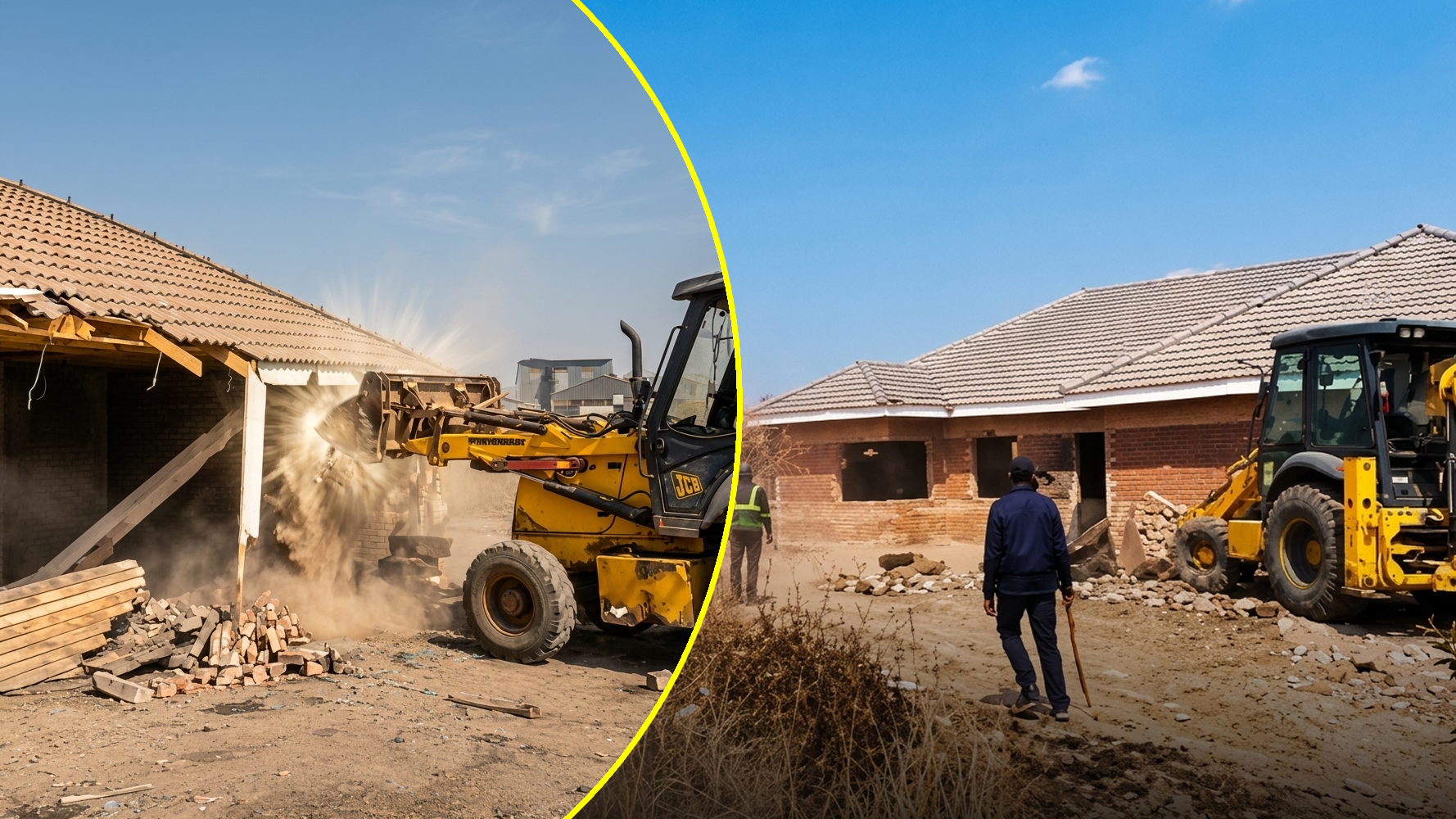
Harare demolition drive set to widen as council prepares to clear more homes
HARARE — Hundreds of families in Harare face the loss of their homes as the city council prepares to begin another round of demolitions in St Martins and other suburbs, deepening a housing crisis that has already left residents searching for shelter among the ruins of their houses.
The fresh operation is expected to clear a further 15 hectares of land, according to information from within the local authority, with several structures in St Martins and other parts of the capital scheduled to be destroyed from tomorrow. The move has exposed growing divisions inside Harare City Council, where senior officials are trading accusations over who authorised the demolitions and which department has control of the process.
The latest plans come just days after houses were demolished in St Martins Extension, opposite 1 Commando Barracks along Airport Road near Hatfield. Families were left gathering clothing, roofing sheets, furniture and other belongings from the wreckage as the city’s winter cold tightened around the settlement.
A senior council official, speaking on condition of anonymity, said the dispute over the operation had become an open conflict inside the municipality.
“The divisions over the St Martins demolitions at Harare City Council are now public knowledge. What remains unclear is who actually sanctioned the demolitions,” the official said.
Council officials have not provided a detailed public account of who approved the latest round, which properties are covered or what arrangements have been made for the families facing displacement. The silence has added to the uncertainty in communities where residents say they have spent years building homes after buying stands through cooperatives, housing schemes or private sellers.
The demolitions form part of a much wider campaign targeting more than 5,000 houses and other structures across Harare. A council task force has surveyed 22,255 sites, including buildings on open spaces, wetlands, vleis, road reserves and land set aside for schools, clinics and other public amenities.
In Mabelreign and nearby low-density areas, including Meyrick Park, Sentosa and Madokero, 67 structures have been marked for destruction. Structures along Willowvale Road in the Glen View 8 complex are also in the path of the clearance teams.
The council has identified 45 stands in Greendale and 13 in Amby Township for demolition. About 200 properties along the proposed Harare Drive expansion route, including homes in Retreat and Waterfalls, have also been placed at risk.
A report prepared by the local authority says the regularisation of many settlements will not be possible. The cut-off date is September 24, 2023, while structures built on wetlands, heritage sites, school sites and recreational land are excluded from regularisation. The council has also raised concerns over offer letters, agreements of sale and title deeds bearing scanned or forged signatures, saying suspected forgeries have been reported to the Zimbabwe Republic Police.
“A clear message is being sent to all land barons that the council will not tolerate lawlessness or the abuse of the Co-operative Act and the Parallel Development Concept by politically connected individuals and elites who invade council and government land,” the council report states.
The city says the drive is aimed at people and organisations that occupy land intended for public facilities and then sell or allocate it to desperate home seekers. But residents caught in the operation say they were not land invaders. They say they paid money, received documents that appeared official and built their houses after dealing with people they believed had authority to sell or allocate the land.
In Harare South and Whitecliff, earlier demolitions have already destroyed houses and other structures. Residents have reported losses running into thousands of United States dollars, while small businesses have lost stock, equipment and the premises from which they earned a living.
The effect on children has been immediate. One resident described the destruction of schools and houses in Harare South as a blow to families who had not been given enough time to make arrangements for their children.
“Schoolchildren have been greatly affected; authorities should have given residents enough time to make alternative arrangements,” the resident said.
Another resident said families had been left without a place to go.
“We are deeply hurt because we have nowhere to live. We are appealing for assistance, as this is the only home we have ever known,” the resident said.
The most recent St Martins operation has brought the issue back to the centre of public attention. The City of Harare confirmed that both temporary and permanent structures were being demolished in the area as part of its campaign against unauthorised land occupations and illegal construction.
The council urged people to check the status of land before making payments or starting construction.
“The City of Harare urges residents to consult our housing department or district offices before purchasing land as they are falling prey to land barons and criminals,” the statement added.
For many St Martins families, that warning came after their money had already been spent and their houses had already been built. Some had saved for years, borrowed from relatives or bought building materials in stages. The destruction of a house therefore wiped out not only a physical structure but also years of income, labour and family planning.
The area has a complicated history. In October 2025, 10 residents approached the High Court after receiving demolition notices from the city. A consent order issued on October 29 set aside the notices dated October 9 and barred the council or anyone acting on its behalf from evicting the applicants or demolishing their homes at St Martins Extension under layout plan TP2F/CR/022 “without a valid court order”.
The same order prohibited the residents from carrying out further development without written approval from the council. The presence of demolition machinery in the area has since raised fresh questions about the properties affected and the instructions under which the latest operation was carried out.
The land dispute is also linked to planning changes and competing claims over the area. The council previously pegged stands for the St Martins Housing Scheme along Airport Road after some stands on an earlier approved plan were affected by a 200-metre statutory cantonment for the Zimbabwe National Army. A separate agreement involving 333 stands and the National Building Society was later cancelled by the council, adding to the uncertainty faced by home seekers and investors.
Kuwadzana is facing a similar dispute, although the threatened demolitions there involve a large home industry area supporting artisans, mechanics, carpenters, metal fabricators and traders. The City of Harare issued a 48-hour vacation notice on July 15 after an inspection identified what it described as unauthorised developments on stands 1 to 101 of Kuwadzana 1 Township. The structures listed included a showroom, toilets, shipping containers, fencing, workshops and a borehole.
The Kuwadzana 1 Home Industry Association says the land was formally designated for service industries under a 2013 council layout plan. The association says the site has been used for home and service industries since 1991, with the council’s knowledge and involvement. It also says the municipality facilitated the construction of a toilet, instructed traders to connect water, allowed fencing and issued interim lease agreements while collecting rental payments.
“It is the respondent (City of Harare) which actually facilitated the construction of a toilet at the site and instructed the applicant (Kuwadzana 1 Home Industry) to connect water to the toilet, which was complied with,” association member Blessing Svongwa said.
Traders fear that demolition would destroy businesses that have served the community for decades. Workshops would lose machinery, timber, tools, finished goods and customer networks built over many years. Employers say workers and apprentices would also lose their incomes.
“Being moved from where we are now is totally not acceptable. Our customers know our stalls where we are operating from. Some of us have been here for the past 26 to 30 years and we have religiously paid the City of Harare,” trader Paradzai Masasi said.
Masasi said the site had previously been changed from a residential development into a service industry area after traders were displaced in 2005.
“This area was first said to be stands and there was a resolution to make this a service industry area. We were displaced around 2005 and this was fixed and we were told this was now a service industry. Now they want to put stands again. This is totally unacceptable. We are saying that we want to work towards Vision 2030,” he said.
Morgan Chikunga, chairperson of the Kuwadzana 1 Home Industry Traders Committee, said traders had paid the council and wanted to remain productive.
“We are moving with the Government’s Vision 2030 and we want to contribute to the economy. This is why we have been religiously paying to the City of Harare and we pay our taxes,” Chikunga said.
He added: “Because of underhand deals, we are now being told to leave this area. Why can’t they plan the houses where they want us to go? If they remove us from here, they would have killed us. This is our livelihood. For generations we have been here.”
The threat of demolition in Kuwadzana was temporarily suspended after Ward 16 councillor Denford Ngadziore visited the site and held discussions with officials from planning, housing, small and medium enterprises and markets. He said the traders had been given a 48-hour deadline and that a proposal had been made to move the home industry to a nearby two-hectare site after surveying and planning work.
“There was an outcry over the evictions and possible demolitions that were looming. They had been given a 48-hour deadline and the evictions were supposed to happen last Wednesday,” Ngadziore said.
“I engaged the council officials from planning and housing and we managed to stop the evictions. The departments of housing, SMEs and markets and planning then had a meeting and agreed that there is a plan to move the home industry to a two-hectare piece of land which is very close to the current home industry,” he said.
The wider conflict has also revived demands for the release of a commission of inquiry report into the administration and finances of Harare City Council. Residents’ groups say the report could help explain how land was allocated, how cooperatives operated and why authorities allowed construction to continue before moving in with demolition teams.
“As CHRA, we are not shocked about these divisions at Harare City Council. Time and again we have raised concerns about corrupt officials, and we have witnessed questionable deals on wetlands sail through without scrutiny,” Combined Harare Residents Association director Reuben Akili said.
“We placed our faith in Justice Maphios Cheda’s Commission of Inquiry, but they have failed to deliver justice,” Akili said.
Harare Residents Trust director Precious Shumba said his organisation had asked President Emmerson Mnangagwa to release the inquiry report.
“The Harare Residents Trust has officially written to the president requesting him to urgently release the report of the commission of inquiry into financial affairs in the city,” Shumba said.
“Revelations during the public hearings demonstrated that council was being destroyed from within by its own policymakers and bureaucrats,” he said.
Shumba also said the city had failed to stop questionable developments at an early stage.
“Housing developments are taking place, yet there is a shocking lack of development control from the City of Harare and various local authorities. They see developments taking shape but do not intervene,” he said.
The Southern Africa Regional Anti-Corruption Organisation’s director, Paddington Kadzungura, said the land disputes reflected a wider breakdown in local administration.
“It’s deeply painful to realise that we have allowed corruption to infiltrate every sector of our economy,” Kadzungura said.
“Council officials masquerading as torch-bearers of justice are at the core of this network of chaos,” he said.
Kadzungura added: “A simple check will reveal that many municipalities have participated in the so-called distribution of land to citizens through housing cooperatives and schemes.
“Many citizens now facing demolitions were actually told they were occupying stands legally. What astonishes people is that, 15 years down the line, the same authorities who took money from them now claim the occupation is illegal, demanding immediate vacation without allowing residents time to collect their belongings.”
Harare Mayor Jacob Mafume has sought to distance the council from some demolitions, saying: “These were private actors following their own court orders and processes. This is not our land, so we cannot comment.”
City spokesperson Stanley Gama has defended the enforcement campaign, saying: “We cannot regularise and endorse lawlessness. Otherwise, people will end up building houses even at Rufaro Stadium”.
The latest demolitions have revived memories of the 2005 Operation Murambatsvina, when homes and businesses were destroyed in several urban settlements. About 700,000 people were estimated to have lost their homes, while millions more were affected through the loss of accommodation, work, education and access to basic services.
Harare’s present campaign is being carried out through a series of targeted operations, but the impact on affected families is immediate. A house can disappear within hours, while replacing it may take years. Parents must find somewhere to sleep, protect their belongings and keep children in school. Traders must decide whether they can afford to move machinery and stock, and workers must face the loss of the businesses that support their households.
As bulldozers prepare to move into more suburbs, residents are demanding clear information about the land they bought, the documents they were issued and the people who collected their money. They are also seeking answers about which structures are covered by court orders, which areas can be regularised and where families will go after their homes are removed.
For the council, the operation is a campaign to reclaim land reserved for public use and stop unlawful construction. For the families in St Martins, Harare South, Whitecliff, Kuwadzana and other suburbs, it is a fight to hold on to the only homes and livelihoods they have built. With further demolitions planned from tomorrow, the dispute is set to move from council offices to the doorsteps of thousands more households across Harare.