


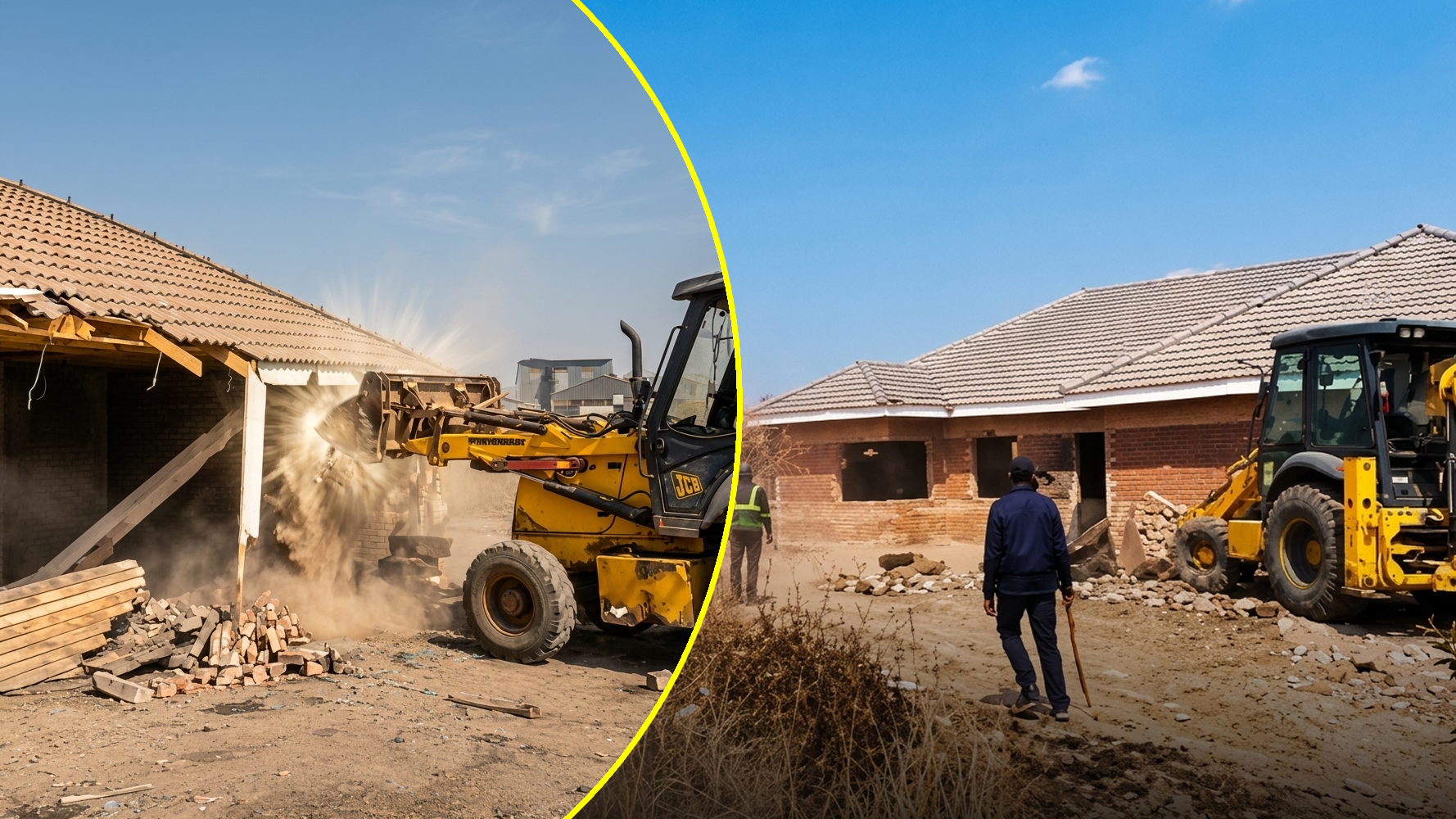
Authorities demolished homes in Harare’s St Martins area on Friday, leaving residents watching as houses were reduced to rubble during an exercise at the settlement opposite 1 Commando Barracks.
The demolitions took place in St Martins Extension, along Airport Road near Hatfield, where a long-running dispute between residents and the City of Harare has raised questions about land ownership, development approvals and the enforcement of previous court orders.
Videos from the area showed the demolitions under way. In one video, a distressed resident narrated as his home was being destroyed. Several homes were affected, although the full number of structures demolished was not immediately clear.
The exercise came during Zimbabwe’s winter season, when cold nights in Harare leave people without proper shelter at serious risk. Families who had expected to sleep under a roof were instead left to gather furniture, clothing, roofing sheets and other belongings from the wreckage. For residents with nowhere else to go, the demolition created the immediate threat of spending the night outside or moving into already crowded homes belonging to relatives and friends.
The City of Harare confirmed that demolitions of structures in St Martins were under way. It said the operation involved both temporary and permanent structures and formed part of a wider campaign against unauthorised land occupations and illegal construction.
“The City of Harare is currently carrying out demolitions on illegally built structures in St Martins. Demolitions of temporary and permanent illegal structures are underway in the area as the City of Harare cracks down on unauthorised land occupations and illegal structures,” the city said.
The city urged residents to verify land ownership before paying for stands or beginning construction. It said prospective buyers should consult the council’s housing department or district offices before purchasing land.
“The City of Harare urges residents to consult our housing department or district offices before purchasing land as they are falling prey to land barons and criminals,” the statement added.
The warning comes after residents in St Martins Extension had already built houses and invested money in the land. Some had acquired building materials over several years, while others had borrowed from relatives or used their savings to complete homes. The demolition of a house therefore represents more than the loss of walls and a roof. It can erase years of work and leave a family without the documents, possessions and security associated with a permanent home.
The latest exercise is connected to a dispute that reached the High Court last year. In October 2025, 10 St Martins Extension residents approached the court after the City of Harare issued demolition notices against them.
In a consent order issued by Justice Zhou on October 29, 2025, under case number HCH5444/25, the High Court set aside the demolition notices issued by the city on October 9.
“The demolition notices issued by the respondent, City of Harare, dated 9 October 2025, be and are hereby set aside,” the order reads.
The court also interdicted the City of Harare and anyone acting on its behalf from evicting the 10 applicants or demolishing their homes at St Martins Extension, under layout plan TP2F/CR/022, “without a valid court order.”
The same order prohibited the applicants from carrying out further development on the land without written approval from the City of Harare. The order therefore placed obligations on both sides: the city could not remove the applicants or demolish their homes without a valid court order, while the residents could not continue developing the land without written council approval.
It was not immediately clear whether any of the homes demolished on Friday belonged to the residents protected by the October order. It was also not clear whether authorities had subsequently obtained a court order authorising the demolitions in St Martins Extension. The City of Harare had not immediately commented on those specific questions.
The legal history has made the operation particularly painful for residents who believed that the court order protected their homes. The presence of demolition machinery at the settlement has now placed fresh pressure on the city to explain the legal basis of the exercise, identify the properties covered and set out what will happen to the families affected.
St Martins has been at the centre of Harare’s housing-development disputes for years. The council has previously said it began pegging stands for the St Martins Housing Scheme along Airport Road after some stands on the initial approved plan were affected by a 200-metre statutory cantonment for the Zimbabwe National Army.
The area has also been linked to cancelled housing deals. The National Building Society lost 333 stands in St Martins after Harare City Council moved to cancel an earlier agreement with the financial services provider. The history has left home seekers dealing with competing claims over land, planning boundaries and the authority of those who sold or allocated stands.
The city says the current demolitions form part of a wider enforcement drive across Harare. It has reaffirmed its intention to remove structures built on land reserved for public amenities, wetlands, road reserves and critical infrastructure. Council officials say affected residents were repeatedly warned that structures on protected or prohibited land would not be spared.
A council task force recently visited 22,255 sites across the city. The council says more than 5,000 houses in high-density suburbs are covered by 37 High Court orders, alongside structures in more than 40 cooperatives described as illegal. Officials have said that the wider campaign is aimed at land barons, politically connected individuals and organised groups occupying land intended for public facilities.
City spokesperson Stanley Gama has defended the demolitions in strong terms.
“We cannot regularise and endorse lawlessness. Otherwise, people will end up building houses even at Rufaro Stadium”.
Council reports have also alleged that some land occupiers used documents with scanned or forged signatures, including offer letters and agreements of sale. The city says suspected forgeries were reported to the Zimbabwe Republic Police.
“A clear message is being sent to all land barons that the council will not tolerate lawlessness or the abuse of the Co-operative Act and Parallel Development Concept by politically connected individuals,” a council report said.
The council’s position is that it must enforce planning rules and protect land reserved for schools, clinics, roads, wetlands and other public services. The housing crisis, however, has made informal land sales attractive to people who cannot access properly serviced stands through formal channels. Desperate home seekers may pay organisers, cooperatives or private sellers after being shown documents that appear official.
When those transactions later collapse, the people who lose the most are often the families who have already built. They may have no practical way to recover their money, and the destruction of their homes may leave them with nowhere to live while ownership disputes continue.
The consequences of such demolitions were seen elsewhere in Harare this year. In June, families in Stoneridge, Harare South, faced homelessness after authorities began demolishing homes on a disputed 20-hectare plot. Residents were left gathering household goods in open spaces as the winter season took hold. The experience showed how quickly a dispute over land can become an emergency involving shelter, children, elderly people and the protection of personal belongings.
The St Martins demolitions have also revived memories of Zimbabwe’s earlier housing crises. During Operation Murambatsvina in 2005, homes and businesses were demolished in settlements including Hatcliffe, North Hatcliffe, Chitungwiza, Porta Farm and Killarney. Later satellite analysis recorded thousands of structures removed in those areas. United Nations estimates at the time said about 700,000 people lost their homes, while at least 2.4 million people were affected through the loss of housing, work, food, water and education.
The circumstances of the present operation are different, but the immediate human cost is familiar. A family whose home is destroyed must find a place to sleep, protect its belongings and keep children safe. Workers may struggle to reach their jobs, children may lose access to school and families may be separated when relatives take them in.
The court order adds another important question to the St Martins dispute. If any of the homes demolished on Friday belonged to the 10 residents named in case HCH5444/25, the city will have to explain how the exercise complied with the order requiring a valid court order before eviction or demolition. If the demolished homes fell outside the properties covered by that order, authorities will still need to identify the boundaries clearly so that residents understand which structures were targeted and why.
Residents also need clear information about the ownership documents they received, the people who sold the stands and the approvals that were issued. If unlawful sales or forged documents were involved, affected families will expect investigations to reach those who profited from the transactions. Demolishing homes without addressing the people who organised the sales leaves the underlying problem unresolved.
The city has not announced a relocation plan or emergency accommodation for the families affected in St Martins. Without temporary shelter or replacement stands, demolition can move a family from a contested piece of land into homelessness within hours. The cold weather makes that danger more immediate, especially for children, older residents and people living with health problems.
As rubble remains at the settlement opposite 1 Commando Barracks, the central issue is no longer only whether structures complied with planning rules. It is also what happens to the people who lived inside them. The City of Harare says it is acting against illegal land occupations and land barons. Residents who have lost their homes are left seeking answers about the documents they were given, the court protection they believed they had and where they are expected to live next.
For families forced to gather their possessions from the remains of their houses, the legal and planning dispute has become a daily struggle for warmth, shelter and security. Until the city explains the basis of Friday’s operation and provides a clear response for those displaced, the homes demolished in St Martins will remain a symbol of Harare’s wider housing crisis and the heavy price paid by families caught between contested land deals and local authority enforcement.