


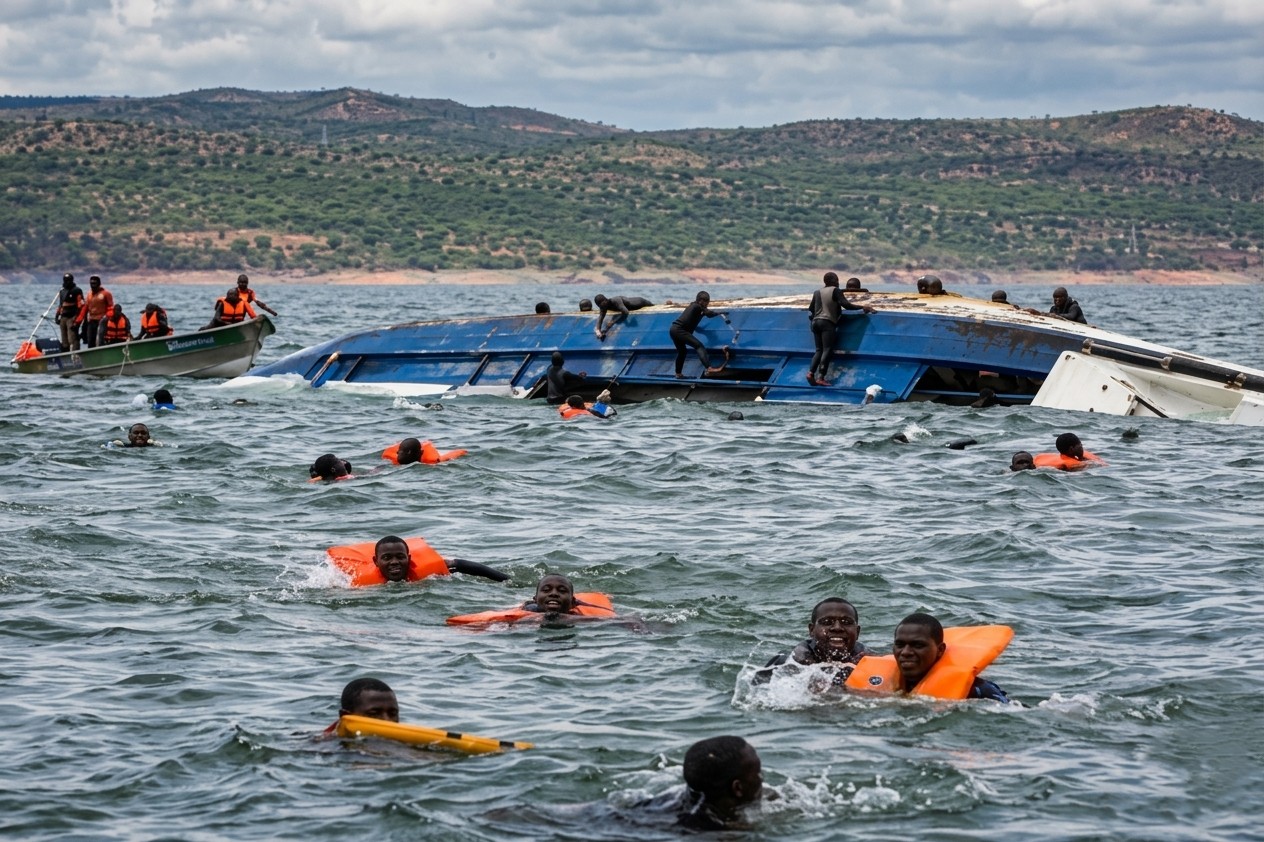
Chaos in Kariba as nearly 30 people remain missing after the deadly Mbuya Nehanda ferry accident
Nearly 30 people remain unaccounted for after the Mbuya Nehanda ferry overturned on Lake Kariba, leaving 46 people dead and exposing the dangerous transport crisis facing isolated communities along the vast reservoir.
The ferry was said to be carrying 153 people, including adults and children, when it capsized on August 11 during strong winds and rough water. So far, 77 people have been rescued and 46 bodies recovered. The figures leave about 30 people still missing, although authorities have continued to work to establish the full number of passengers who were on board.
The disaster has left families searching for relatives, communities waiting for news and rescuers facing difficult conditions on one of Zimbabwe’s largest bodies of water. The ferry’s overturned hull became the centre of a major search and recovery operation involving the Civil Protection Unit, police divers, army boats, private vessels and a helicopter.
For survivors, the final minutes of the journey were marked by confusion, panic and a desperate struggle to remain above the water. Chance Siyamavhu, who survived the sinking, said he watched people being swept away while he and others clung to the upturned vessel.
“Thank God that a wave pushed the sinking vessel and we managed to climb on top,” Siyamavhu said.
The 45-year-old survivor said people fought to obtain life jackets after the ferry overturned, but many did not know how to use them. “When the boat capsized, most of the people scrambled to get the life jackets but most of them did not even know how to use them,” he said.
“Most people could not make it,” he added.
Siyamavhu said the people who died included his best friend and seven relatives. He said some family members were carried away from the group of survivors, leaving those who remained helpless as the tragedy unfolded.
“Our relatives were swept in another direction and they sank because we were not in a position to help them,” he said.
Another survivor, Anymore Chambati, was working as a security officer on the ferry and was also involved in checking passengers. He said he tried to distribute life jackets as water entered the vessel, but he managed to hand out only a small number before the situation became uncontrollable.
“I managed to only give not more than 10,” he said.
Chambati also described the impact of the water on the ferry’s engines. “The ferry engines were filled with water because of the heavy winds and eventually they failed, save for one,” he said.
Survivors said they had asked the captain to turn back after the ferry began taking on water. The vessel was travelling from Kariba towards Chalala, serving communities and fishing areas on the southern side of the lake. It was one of the few practical links between Kariba town and residents who rely on the water route to reach homes, markets, businesses and supplies.
The Mbuya Nehanda ferry was designed to carry 90 passengers, yet the number of people on board was far higher. Official figures released during the rescue operation referred to 114 adult passengers and five crew members, while children who did not require tickets were not included in the passenger total. A government minister later said the official manifest recorded 119 adults.
Chambati’s count was higher. He said he had counted 153 people, including children and infants. That figure is the basis for the current estimate that about 30 people remain missing after the 77 survivors and 46 dead were accounted for.
The conflicting figures have deepened the distress of families who are still waiting for confirmation about their relatives. Some passengers may not have required tickets, particularly young children, making it harder for authorities to prepare a complete list of those who travelled. The uncertainty has also complicated the work of families trying to identify the dead and determine who may still be in the lake or stranded away from home.
At Nyamhunga Stadium in Kariba, mourners gathered for a memorial service as bodies were brought to the town in coffins provided through the government response. The service was held in front of dozens of coffins, while the number of recovered bodies rose to 46 as the search continued.
“Government has chipped in to assist the bereaved families in every course that is associated with the tragedy, in terms of buying coffins, in terms of buying food, in terms of transport,” Garwe said.
President Emmerson Mnangagwa declared the incident a State of Disaster, allowing the authorities to mobilise more resources for the search, rescue and recovery operation. Police divers and the army’s boat squadron were deployed alongside other emergency teams. Private boat operators and conservation teams also helped reach survivors and search the water.
The response was made more difficult by heavy winds, rough waves and the size of Lake Kariba. The lake stretches for more than 200 kilometres along the Zambezi River and supports fishing, tourism, electricity generation and passenger transport between communities on its shores. For residents in remote areas, the water is not simply a place of work or recreation. It is also a route to essential services and a connection to the rest of the district.
The ferry was operated by the Rural Infrastructural Development Agency, a government body responsible for rural infrastructure. Its loss has removed a major transport service at a time when many communities already have few alternatives.
Road access has been a long-standing problem. The road linking Kariba, Siakobvu and Chalala has been described as impassable in sections, leaving residents dependent on boats even when conditions on the lake are dangerous. Government has now promised to rehabilitate the route and improve access to communities around Chalala, Mola and Siakobvu.
Speaking at the memorial service, Garwe said the president had ordered officials to secure another passenger ferry so that trade and travel could continue.
“The ferry which capsized served as a vital mode of transport for businessmen and individuals, travelling from Kariba to areas such as Chalala and all those who were benefitting from its service. The President has said don’t be heartbroken or get worried over how you will travel now that the reliable boat has sunk. As a caring leader, and in the spirit of leaving noone and no place behind in terms of assistance and development, he has pledged to find a replacement vessel so that businesses and livelihoods continue,” Garwe said.
He also said Transport Minister Felix Mhona would be sent to deal with the road problem. “He also said he will send Transport minister (Felix Mhona) to urgently fix the impassible road. We received the complaints over the same road earlier. So, these will be attended to so that movement is improved,” Garwe said.
The road project has been delayed for years. An early section from Magunje through Chivakanenyama to Zvipani was started, but later phases intended to connect isolated communities were not completed. Contractors who had established work sites eventually removed their equipment, leaving residents with a route that remained difficult or impossible to use during bad weather.
The ferry disaster has also revived concern about the condition of the wider Lake Kariba fleet. Government had previously acknowledged breakdowns and high operating costs affecting its ageing ferries and had discussed refurbishment and new engines. The Mbuya Nehanda tragedy has placed those earlier concerns at the centre of the national response, as families ask how a vessel built for 90 passengers came to be carrying far more people on a route used by children, traders and rural households.
The authorities have not yet announced the cause of the sinking. Garwe said investigators would examine what happened and determine what measures were needed. “It could be a technical problem. We don’t know yet,” he said.
The minister said the official passenger figure remained 119 while investigations continued. “The official figure we have is 119 people,” Garwe said. He also said the government would establish what had caused the accident before deciding on further action affecting ferry operations.
For the families gathered in Kariba, however, the immediate concern is not only the investigation. It is the recovery of those who remain missing, the proper identification of the dead and the safe return of survivors to their homes. Many of the people who boarded the Mbuya Nehanda were travelling on a familiar route that had become part of daily life in communities separated by poor roads and wide stretches of water.
The tragedy has left those communities without the ferry on which they depended and without a clear alternative. A replacement vessel may restore movement, but residents will still need safe boats, trained crews, enough life jackets, reliable passenger records and a functioning road network. Until those services are in place, the people of Kariba, Chalala, Siakobvu and surrounding areas remain tied to the same difficult choices that shaped the journey of the Mbuya Nehanda.
As the search continues, the water of Lake Kariba still holds the answers sought by families. About 30 people have not been accounted for, and every recovery operation carries the weight of another household waiting for news. The full scale of the disaster will be measured not only by the 46 bodies already recovered, but also by the names that families are still trying to place on the passenger list.