


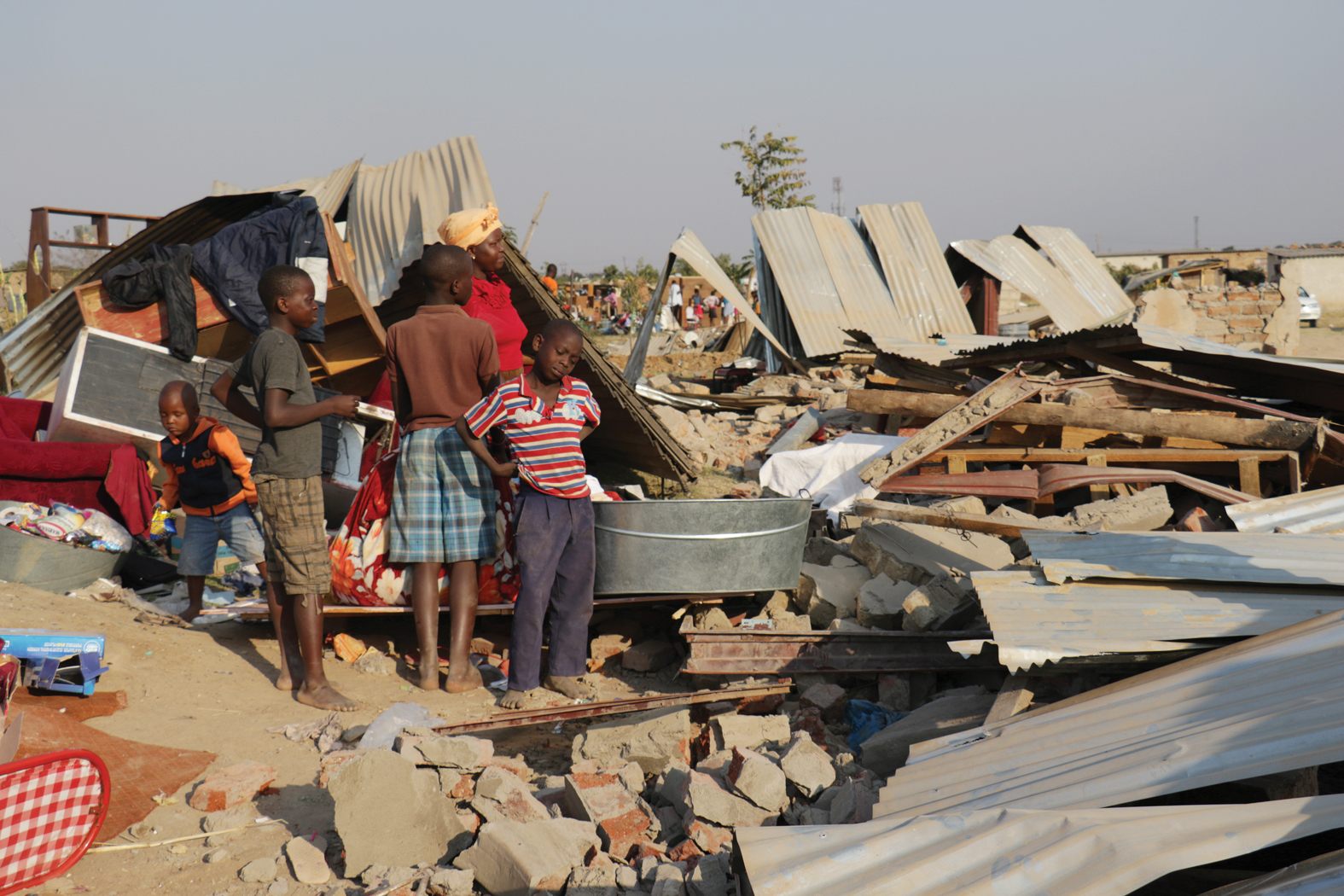
HARARE – The low rumble of a bulldozer engine is a sound that has come to define the mornings in Harare’s sprawling outskirts. It is a mechanical growl that signals the end of a decade of saving, a lifetime of dreaming, and the literal collapse of a family’s future. In the high-density suburb of Budiriro, a man stands by a jacaranda tree, watching as a forty-eight-hour notice, taped to the bark, flutters in the breeze. He saved for fifteen years to buy this small patch of earth. He paid a cooperative, received an offer letter with official-looking stamps, and built his home brick by painful brick. Now, the City of Harare says the land was never his to buy, and the walls he raised are destined for the rubble heap.
This scene is being repeated across the capital in what is fast becoming the most aggressive urban clearance campaign in recent memory. A leaked report from the Town Clerk has pulled back the curtain on a massive demolition blitz targeting more than 5,000 homes. Backed by 37 High Court orders, the Harare City Council has declared war on “illegal structures,” leaving thousands of families and small businesses staring into an abyss of homelessness and financial ruin.
The scale of the operation is staggering. A dedicated council task force has surveyed 22,255 sites across the city. The message from the authorities is uncompromising: structures built on open spaces, wetlands, vleis, and land reserved for schools, clinics, or roads will not be spared. The demolitions have already moved from paper to the pavement, with residents in Harare South and Whitecliff already counting their losses in the thousands of US dollars.
The Paper Trail of Deception
For many victims, the tragedy is not just the loss of a roof, but the realisation that they were pawns in a high-stakes game of “lawfare” played by land barons and politically connected elites. The Town Clerk’s report highlights a “well-organised and coordinated rampant land invasion” that intensified around August 2023, fuelled by politicians from across the divide. These invaders often used documents featuring scanned or forged signatures, including offer letters and agreements of sale that appeared legitimate to the untrained eye.
“A clear message is being sent to all land barons that the council will not tolerate lawlessness or the abuse of the Co-operative Act and the Parallel Development Concept by politically connected individuals and elites who invade council and government land,” the report states.
Yet, for the residents, these words offer no comfort. They argue they were duped into purchasing the land. Many possess documents they believed were legal, only to be told by the council that they are worthless forgeries. In medium- and low-density areas, the use of fake title deeds has become so rampant that the council has begun reporting suspected forgeries to the Zimbabwe Republic Police.
The list of targeted areas reads like a map of the city’s growth over the last decade: Greendale, Belvedere, Budiriro, Kuwadzana, Mabvuku, Glen View, Mabelreign, Tynwald, Crowborough, Chisipite, Glen Lorne, Southlea Park, Hopley, Mainway Meadows, Tafara, and Hatcliffe. No corner of the capital seems immune. In Mabelreign and its surrounding low-density enclaves—including Meyrick Park, Sentosa, and Madokero—67 structures are slated for destruction, while in the Glen View 8 complex, structures along Willowvale Road are in the direct path of the bulldozers.
The Human Cost of “Order”
The impact on the ground is visceral. In Harare South, where the demolitions have already begun, the destruction of schools and houses has left the community in a state of desperation. “Schoolchildren have been greatly affected; authorities should have given residents enough time to make alternative arrangements,” one resident told reporters as they stood amongst the remains of their neighbourhood. The concern is not just for the present, but for the future, as parents worry their children will fall behind in their studies with their classrooms reduced to dust.
“We are deeply hurt because we have nowhere to live. We are appealing for assistance, as this is the only home we have ever known,” another resident pleaded.
The council’s report makes it clear that regularisation—the process of making an informal settlement legal—will not be an option for many. Any invasion that occurred after the 24th of September 2023 cut-off date is excluded. More importantly, those built on environmentally sensitive areas like wetlands or heritage sites are being flatly rejected.
In areas like Greendale and Amby Township, 45 and 13 illegal stands respectively are marked for demolition. Even the Harare Drive expansion route has placed approximately 200 properties in the crosshairs, including homes in Retreat and Waterfalls. The city’s infrastructure needs are colliding head-on with the housing needs of its people, and the infrastructure is winning.
A Cycle of Destruction
To many observers, this feels like a grim echo of the past. Zimbabweans still remember Operation Murambatsvina in 2005, which displaced hundreds of thousands. While the current campaign is more targeted, the trauma is familiar. Precious Shumba, the executive director of the Harare Residents Trust, believes much of this conflict could have been avoided.
“That report [the Justice Tendai Uchena Commission of Inquiry] contains specific details about the land barons involved in parcelling out council and state land. We believe the President has a duty to publish it in the public interest,” Shumba remarked. He pointed out a “shocking lack of development control,” noting that authorities often watch as developments take shape but only intervene once the houses are finished.
Shumba’s critique touches on a fundamental failure of urban governance. Local authorities stopped servicing land for housing years ago, creating a vacuum that was quickly filled by rural migrants and opportunistic land barons. “Housing developments are taking place, yet there is a shocking lack of development control from the City of Harare and various local authorities. They see developments taking shape but do not intervene,” he added.
The Mayor’s Defence
Amidst the outcry, Harare Mayor Jacob Mafume has sought to distance the council from some of the more controversial actions. Speaking on the recent wave of destruction, he stated: “These were private actors following their own court orders and processes. This is not our land, so we cannot comment.”
However, the leaked Town Clerk’s report suggests a much more active role for the city’s administration. The report details how the council is targeting illegal settlements linked to “politically connected individuals and organised groups” who have occupied land earmarked for public facilities. The mayor himself reportedly ordered the reversal of leases and the demolition of illegal structures at Robert Mugabe Square, while bulldozers are also set to target illegal restaurants, bars, and car washes in Milton Park and Waterfalls.
This apparent contradiction—between the mayor’s hands-off rhetoric and the council’s aggressive reporting—has left residents feeling abandoned. Is this a genuine effort to restore urban planning and environmental protection, or is it a calculated move to reclaim prime real estate that has become too valuable to leave in the hands of the poor?
Protecting the Future
For those still looking to buy land in the capital, the current blitz serves as a harsh lesson in due diligence. Experts warn that a cooperative receipt is not a council-issued cession, and a typed letter on a fancy letterhead is not a legal title. The council’s Regularisation Task Force has named over thirty illegal cooperatives in Budiriro alone, including names like Takaitora Nyika, Parkridge, and United We Stand. Some of these groups have been selling land they never owned for over a decade.
The advice from the City of Harare’s Department of Works and Planning is simple but often ignored: verify the status of any stand at district offices before you buy. A careful buyer must check the approved layout plans, verify the surveyor general’s diagram, and hire their own conveyancer rather than relying on the seller’s lawyer.
But for the 5,000 families currently in the crosshairs, this advice comes too late. They are caught between the greed of the land barons who sold them a lie and the clinical efficiency of a council now determined to enforce the law. As the bulldozers prepare to move into Kuwadzana, Mabvuku, and beyond, the city braces for further unrest. The human cost of this demolition blitz is undeniable, and as the dust settles over the ruins of these homes, the question remains: where will these thousands of people go?
In a city where the “common land” was sold for a profit by the powerful, it is the powerless who are now paying the ultimate price. The “ruthless crackdown” may restore order to the maps in the Town House, but it leaves a trail of broken lives across the suburbs of Harare.